The terms of the California directed trust provide that the trustee director can never be liable to a beneficiary – now what – what would the California Directed Trust Act hold?

The question posed in the heading to this post is a scenario that is referenced in the National Directed Trust Act. The following is the short answer for California: under the California Uniform Directed Trust Act a fiduciary trustee director’s conduct and liability can be limited for conduct and culpability that are below the level of willful misconduct (i.e., that do not constitute willful misconduct) if the provisions of the trust so specify, and if the conduct in question is by law within the scope and authority of a trustee director, and if the conduct in question is within the scope and authority of the specific trustee director in question as specified by the terms of the specific directed trust.

Laws, regulations, instruments, and other materials that you may want to consider when evaluating the above issues at least include the following:

– The provisions of the specific directed trust in question.

– In appropriate circumstances and when necessary, the trustor’s intent and wishes.

– The legal definition of willful misconduct.

– The California Uniform Directed Trust Act, including for example new Cal. Probate Code §§16608, 16612, 16614 and 16630 (and perhaps also Probate Code §16618 as related).

– The National Uniform Directed Trust Act including for example Section 8 (Duty and Liability of Trust Director) and Comments thereafter (Extended discretion, and Exculpation or exoneration, and possibility including the Restatement (Third) of Trusts and the Uniform Trust Code).

– California Assembly Committee on Judiciary, June 6, 2023, hearing Synopsis which in part states “This bill would enact the California Uniform Directed Trust Act, which, according to the author and co-sponsors, is modeled on the National Commission’s UDTA, but with minor modifications to reflect California law and drafting practices.”

– See also and consider already existing California Probate Code §16461 as relevant to the specific circumstances in question ((b) A provision in the trust instrument is not effective to relieve the trustee of liability (1) for breach of trust committed intentionally, with gross negligence, in bad faith, or with reckless indifference to the interest of the beneficiary, or (2) for any profit that the trustee derives from a breach of trust).

On this blog you will find additional prior posts about the new California directed trusts – additional posts will also be following as I have a list of directed trust scenarios that I will be covering.

* * * *

Thank you for viewing this discussion. Please do pass this blog and blog post and information to other people who would be interested as it is only through collaboration and sharing that great things and success are more quickly achieved. If you are interested in discussing anything that I have said in the discussion above or in either of my two blogs (see blog addresses below), or if you simply want to reach out or are seeking assistance, it is best to reach me by email at dave@tateattorney.com.

David Tate, Esq. (and inactive CPA)

  • Business litigation and disputes – business, breach of contract/commercial, co-owners, shareholders, investors, founders, workplace and employment, environmental, D&O, governance, boards and committees.
  • Trust, estate and probate court litigation and disputes – trust, estate, probate, elder and dependent abuse, conservatorship, POA, real property, mental health and care, mental capacity, undue influence, conflicts of interest, and contentious administrations.
  • Governance, boards, audit and governance committees, investigations, auditing, ESG, etc.
  • Mediator and facilitating dispute resolution (evaluative and facilitative):
    • Trust, estate, probate, conservatorship, elder and dependent abuse, etc.
    • Business, breach of contract/commercial, owner, shareholder, investor, etc.
    • D&O, board, audit and governance committee, accountant and CPA related.
    • Other: workplace and employment, environmental, trade secret.

Remember, every case and situation is different. It is important to obtain and evaluate all of the evidence that is available, and to apply that evidence to the applicable standards and laws. You do need to consult with an attorney and other professionals about your particular situation. This post is not a solicitation for legal or other services inside of or outside of California, and, of course, this post only is a summary of information that changes from time to time, and does not apply to any particular situation or to your specific situation. So . . . you cannot rely on this post for your situation or as legal or other professional advice or representation, or as or for my opinions and views on the subject matter.

Also note – sometimes I include links to or comments about materials from other organizations or people – if I do so, it is because I believe that the materials are worthwhile reading or viewing; however, that does not mean that I do not or that I might not have a different view about some or even all of the subject matter or materials, or that I necessarily agree with, or agree with everything about or relating to, that organization or person, or those materials or the subject matter.

Please also subscribe to this blog and my other blog (see below), and connect with me on LinkedIn and Twitter.

My two blogs are:

http://tateattorney.com – business, D&O, audit committee, governance, compliance, etc. – previously at http://auditcommitteeupdate.com

Trust, estate, conservatorship, elder and elder abuse, etc. litigation and contentious administrations http://californiaestatetrust.com

David Tate, Esq. (and inactive California CPA) – practicing only as an attorney in California.

Select California Directed Trustee And Trustee Director Liability Probate Code Sections For The New California Directed Trust Statutes

I have provided below a pdf of select California directed trustee and trustee director liability Probate Code sections for the new California directed trust statutes. The Probate Code sections that I have provided below are select color-coded sections from a longer document. Thus, for example, I have not included any of the green color-coded sections.

The first part of the below pdf pertains to the California directed trustee liability sections. The second part of the below pdf pertains to the California trustee director liability sections.

The legislation became effective January 1, 2024; however, the legislation specifies that it also applies to directed trusts that were created or formed prior to January 1, 2024.

Although the sections make reference to directed trustee and trustee director liability in circumstances of willful misconduct, liability variously depends on or can depend on the wording of the specific trust in question, the reasonableness of the directed trustee’s or trustee director’s actions, the knowledge that the directed trustee or the trustee director has or should have about the situation, applicable law(s), and/or “willful” misconduct as that conduct is defined and determined by the trier of fact. Probate Code §16630 further provides that in applying and construing this chapter, consideration shall be given to the need to promote uniformity of the law with respect to its subject matter among states that enact it – i.e., reference to the Uniform Directed Trust Act.

The following are select color-coded California directed trustee and trustee director liability Probate Code sections for the new California directed trust statutes. Please see also my other posts discussing the new California Uniform Directed Trust Act and statutes.

* * * *

Thank you for viewing this discussion. Please do pass this blog and blog post and information to other people who would be interested as it is only through collaboration and sharing that great things and success are more quickly achieved. If you are interested in discussing anything that I have said in the discussion above or in either of my two blogs (see blog addresses below), or if you simply want to reach out or are seeking assistance, it is best to reach me by email at dave@tateattorney.com.

David Tate, Esq. (and inactive CPA)

  • Business litigation and disputes – business, breach of contract/commercial, co-owners, shareholders, investors, founders, workplace and employment, environmental, D&O, governance, boards and committees.
  • Trust, estate and probate court litigation and disputes – trust, estate, probate, elder and dependent abuse, conservatorship, POA, real property, mental health and care, mental capacity, undue influence, conflicts of interest, and contentious administrations.
  • Governance, boards, audit and governance committees, investigations, auditing, ESG, etc.
  • Mediator and facilitating dispute resolution (evaluative and facilitative):
    • Trust, estate, probate, conservatorship, elder and dependent abuse, etc.
    • Business, breach of contract/commercial, owner, shareholder, investor, etc.
    • D&O, board, audit and governance committee, accountant and CPA related.
    • Other: workplace and employment, environmental, trade secret.

Remember, every case and situation is different. It is important to obtain and evaluate all of the evidence that is available, and to apply that evidence to the applicable standards and laws. You do need to consult with an attorney and other professionals about your particular situation. This post is not a solicitation for legal or other services inside of or outside of California, and, of course, this post only is a summary of information that changes from time to time, and does not apply to any particular situation or to your specific situation. So . . . you cannot rely on this post for your situation or as legal or other professional advice or representation, or as or for my opinions and views on the subject matter.

Also note – sometimes I include links to or comments about materials from other organizations or people – if I do so, it is because I believe that the materials are worthwhile reading or viewing; however, that does not mean that I do not or that I might not have a different view about some or even all of the subject matter or materials, or that I necessarily agree with, or agree with everything about or relating to, that organization or person, or those materials or the subject matter.

Please also subscribe to this blog and my other blog (see below), and connect with me on LinkedIn and Twitter.

My two blogs are:

http://tateattorney.com – business, D&O, audit committee, governance, compliance, etc. – previously at http://auditcommitteeupdate.com

Trust, estate, conservatorship, elder and elder abuse, etc. litigation and contentious administrations http://californiaestatetrust.com

David Tate, Esq. (and inactive California CPA) – practicing only as an attorney in California.

THE CALIFORNIA UNIFORM DIRECTED TRUST – TRUST DIRECTOR POWERS, AND UNDER THE NATIONAL UNIFORM DIRECTED TRUST ACT

The question arises, under the new California Uniform Directed Trust Act, what powers can a trust director have? The California statutes do not directly answer that question (see Cal. Probate Code Sections 16600 and 16602 below). Certainly the trust as drafted will in some manner specify the trust director’s powers. Depending on how those powers are worded, they might be broad or they might be more specific, or both. Hopefully the powers will not be vague; however, as with any wording, and with sometimes uncertain or changing situations, wording that initially seemed clear might not end up being so. And, in some circumstances it is certain that Court approval, review, application, or interpretation will be desired and sought. Undoubtedly that will also be options and opportunities for mediation and uncertainty, disagreement or dispute resolution. Please also be mindful that there will be many posts on these topics both now and into the future – this post is only one of my posts – this is a complicated topic – you should read all of my posts, and also see the disclaimer below.

With respect to trust director powers, the California Uniform Directed Trust Act provides the following at Cal. Probate Code Sections 16600 and 16602:

California Probate Code Section 16600

(a) This chapter shall be known, and may be cited, as the California Uniform Directed Trust Act.

(b) The Legislature finds and declares all of the following:

(1) This chapter governs an arrangement commonly known as a directed trust

(2) In a directed trust, the terms of the trust grant a person other than a trustee a power over some aspect of the trust’s administration.

(3) Under this chapter, this power is called a power of direction, the person that holds the power is called a trust director, a trustee that is subject to the power is called a directed trustee, and the trust is a directed trust.

California Probate Code Section 16602

For purposes of this chapter, the following definitions shall apply:

(a) “Breach of trust” includes a violation by a trust director or trustee of a duty imposed on that director or trustee by the terms of the trust, this chapter, or law of this state other than this chapter pertaining to trusts.

(b) “Directed trust” means a trust for which the terms of the trust grant a power of direction.

(c) “Directed trustee” means a trustee that is subject to a trust director’s power of direction.

(d) “Power of direction” means a power over a trust granted to a person by the terms of the trust to the extent the power is exercisable while the person is not serving as a trustee. Power of direction includes a power over the investment, management, or distribution of trust property or other matters of trust administration. The term excludes the powers described in subdivision (a) of Section 16606.

(e) “Settlor” means a person, including a testator, who creates, or contributes property to, a trust. If more than one person creates or contributes property to a trust, each person is a settlor of the portion of the trust property attributable to that person’s contribution except to the extent another person has the power to revoke or withdraw that portion.

(f) “Terms of a trust” means either of the following:

(1) The manifestation of the settlor’s intent regarding a trust’s provisions as expressed in the trust instrument or established by other evidence that has been admitted in a judicial proceeding.

(2) The trust’s provisions as established, determined, or amended by a trustee or trust director in accordance with applicable law, the exercise of a power of appointment in accordance with applicable law, a court order, or other binding modification, including, but not limited to, under Section 15404.

(g) “Trust director” means a person that is granted a power of direction by the terms of a trust, to the extent the power is exercisable while the person is not serving as a trustee. The person is a trust director whether or not the terms of the trust refer to the person as a trust director and whether or not the person is a beneficiary or settlor of the trust.

Thus, under the new California Uniform Directed Trust Act, the trust director’s powers are those powers that are provided and determined by the terms of the trust and generally (but vaguely) include a power over the investment, management, or distribution of trust property or other matters of trust administration, but exclude the powers described in subdivision (a) of Section 16606. However, see also the definition of the “Terms of a trust” above in Section 16602, which in in some circumstances may be more broad that the written terms of the trust instrument as “established by other evidence that has been admitted in a judicial proceeding.”

As I have previously blogged, materials under the National Conference of Commissioners on Uniform State Laws Uniform Directed Trust Act might also be relevant. Thus, the following are the provisions and some of the materials pertaining to trust director powers under Section 6 of the National Uniform Directed Trust Act – note, however, that the specific trust at issue is not required to contain each power that is listed below in the Comment, and, as also indicated in the Comment, the specific powers that are listed are not limiting or comprehensive.

The following is wording from Section 6 (Powers of Trust Director) and some of the other related materials from the National Uniform Directed Trust Act:

SECTION 6. POWERS OF TRUST DIRECTOR.

(a) Subject to Section 7, the terms of a trust may grant a power of direction to a trust director.

(b)Unless the terms of a trust provide otherwise: (1) a trust director may exercise any further power appropriate to the exercise or nonexercise of a power of direction granted to the director under subsection (a); and

(2) trust directors with joint powers must act by majority decision.

Comment

Validating a trust director. Subsection (a) validates a provision for a trust director in the terms of a trust. This subsection does not provide any powers to a trust director by default. Nor does it specify the scope of a power of direction. The existence and scope of a power of direction must instead be specified by the terms of a trust. A trust director may be named by the terms of the trust, by a procedure prescribed by the terms of the trust, or in accordance with Section 16(6).

Breadth of subsection (a). Without limiting the definition of a “power of direction” in Section 2(5), the drafting committee specifically contemplated that subsection (a) would validate terms of a trust that grant a power to a trust director to:

  • acquire, dispose of, exchange, or retain an investment;
  • make or take loans;
  • vote proxies for securities held in trust;
  • adopt a particular valuation of trust property or determine the frequency or methodology of valuation;
  • adjust between principal and income or convert to a unitrust;
  • manage a business held in the trust;
  • select a custodian for trust assets;
  • modify, reform, terminate, or decant a trust;
  • direct a trustee’s or another director’s delegation of the trustee’s or other director’s powers;
  • change the principal place of administration, situs, or governing law of the trust;
  • ascertain the happening of an event that affects the administration of the trust;
  • determine the capacity of a trustee, settlor, director, or beneficiary of the trust;
  • determine the compensation to be paid to a trustee or trust director;
  • prosecute, defend, or join an action, claim, or judicial proceeding relating to the trust;
  • grant permission before a trustee or another director may exercise a power of the trustee or other director; or
  • release a trustee or another trust director from liability for an action proposed or previously taken by the trustee or other director.

This subsection does not, however, override the background law that regulates the formation of a trust, such as the requirements that a trust be lawful, not contrary to public policy, and possible to achieve. See, e.g., Uniform Trust Code § 404 (2000); Restatement (Third) of Trusts §§ 29–30 (2003).

* * * *

Thank you for viewing this discussion. Please do pass this blog and blog post and information to other people who would be interested as it is only through collaboration and sharing that great things and success are more quickly achieved. If you are interested in discussing anything that I have said in the discussion above or in either of my two blogs (see blog addresses below), or if you simply want to reach out or are seeking assistance, it is best to reach me by email at dave@tateattorney.com.

David Tate, Esq. (and inactive CPA)

  • Business litigation and disputes – business, breach of contract/commercial, co-owners, shareholders, investors, founders, workplace and employment, environmental, D&O, governance, boards and committees.
  • Trust, estate and probate court litigation and disputes – trust, estate, probate, elder and dependent abuse, conservatorship, POA, real property, mental health and care, mental capacity, undue influence, conflicts of interest, and contentious administrations.
  • Governance, boards, audit and governance committees, investigations, auditing, ESG, etc.
  • Mediator and facilitating dispute resolution (evaluative and facilitative):
    • Trust, estate, probate, conservatorship, elder and dependent abuse, etc.
    • Business, breach of contract/commercial, owner, shareholder, investor, etc.
    • D&O, board, audit and governance committee, accountant and CPA related.
    • Other: workplace and employment, environmental, trade secret.

Remember, every case and situation is different. It is important to obtain and evaluate all of the evidence that is available, and to apply that evidence to the applicable standards and laws. You do need to consult with an attorney and other professionals about your particular situation. This post is not a solicitation for legal or other services inside of or outside of California, and, of course, this post only is a summary of information that changes from time to time, and does not apply to any particular situation or to your specific situation. So . . . you cannot rely on this post for your situation or as legal or other professional advice or representation, or as or for my opinions and views on the subject matter.

Also note – sometimes I include links to or comments about materials from other organizations or people – if I do so, it is because I believe that the materials are worthwhile reading or viewing; however, that does not mean that I do not or that I might not have a different view about some or even all of the subject matter or materials, or that I necessarily agree with, or agree with everything about or relating to, that organization or person, or those materials or the subject matter.

Please also subscribe to this blog and my other blog (see below), and connect with me on LinkedIn and Twitter.

My two blogs are:

http://tateattorney.com – business, D&O, audit committee, governance, compliance, etc. – previously at http://auditcommitteeupdate.com

Trust, estate, conservatorship, elder and elder abuse, etc. litigation and contentious administrations http://californiaestatetrust.com

David Tate, Esq. (and inactive California CPA) – practicing only as an attorney in California.

Connection between the California Uniform Directed Trust Act and the National Conference of Commissioners on Uniform State Laws Uniform Directed Trust Act

The new California Uniform Directed Trust Act, effective January 2024, is somewhat sparse on details. And with legislation and already existing statutes it is not uncommon for questions about interpretation to arise. Interpretation can be answered through cases that pertain to the relevant statute and also sometimes through legislative history. As the California Uniform Directed Trust Act is new, and there are no California cases that discuss the Act, the question arises whether there are other materials that apply or that might apply for the purpose of interpreting the California Act or at least certain provisions therein. This is also pertinent for my purposes as I will continue to discuss and blog about various provisions in the California Uniform Directed Trust Act.

The California Assembly Committee on Judiciary, June 6, 2023, hearing Synopsis in part states “This bill would enact the California Uniform Directed Trust Act, which, according to the author and co-sponsors, is modeled on the National Commission’s UDTA, but with minor modifications to reflect California law and drafting practices.”

The California Uniform Directed Trust Act at new Cal. Probate Code section 16630 also states as follows: “In applying and construing this chapter, consideration shall be given to the need to promote uniformity of the law with respect to its subject matter among states that enact it.”

Thus, on the issue of interpreting the new California Uniform Directed Trust Act, in addition to eventual cases, and the already existing California legislative history (if any of it is relevant), it can be said that the National Uniform Directed Trust Act and provisions and materials thereunder or relating thereto also are or may be relevant and citable, depending on the view of the Court that is hearing the matter.

In future posts I will be covering the California Uniform Directed Trust Act in greater and greater detail, including scenarios and situations where having a directed trust and a trust director might be helpful.

* * * *

Thank you for viewing this discussion. Please do pass this blog and blog post and information to other people who would be interested as it is only through collaboration and sharing that great things and success are more quickly achieved. If you are interested in discussing anything that I have said in the discussion above or in either of my two blogs (see blog addresses below), or if you simply want to reach out or are seeking assistance, it is best to reach me by email at dave@tateattorney.com.

David Tate, Esq. (and inactive CPA)

  • Business litigation and disputes – business, breach of contract/commercial, co-owners, shareholders, investors, founders, workplace and employment, environmental, D&O, governance, boards and committees.
  • Trust, estate and probate court litigation and disputes – trust, estate, probate, elder and dependent abuse, conservatorship, POA, real property, mental health and care, mental capacity, undue influence, conflicts of interest, and contentious administrations.
  • Governance, boards, audit and governance committees, investigations, auditing, ESG, etc.
  • Mediator and facilitating dispute resolution (evaluative and facilitative):
    • Trust, estate, probate, conservatorship, elder and dependent abuse, etc.
    • Business, breach of contract/commercial, owner, shareholder, investor, etc.
    • D&O, board, audit and governance committee, accountant and CPA related.
    • Other: workplace and employment, environmental, trade secret.

Remember, every case and situation is different. It is important to obtain and evaluate all of the evidence that is available, and to apply that evidence to the applicable standards and laws. You do need to consult with an attorney and other professionals about your particular situation. This post is not a solicitation for legal or other services inside of or outside of California, and, of course, this post only is a summary of information that changes from time to time, and does not apply to any particular situation or to your specific situation. So . . . you cannot rely on this post for your situation or as legal or other professional advice or representation, or as or for my opinions and views on the subject matter.

Also note – sometimes I include links to or comments about materials from other organizations or people – if I do so, it is because I believe that the materials are worthwhile reading or viewing; however, that does not mean that I do not or that I might not have a different view about some or even all of the subject matter or materials, or that I necessarily agree with, or agree with everything about or relating to, that organization or person, or those materials or the subject matter.

Please also subscribe to this blog and my other blog (see below), and connect with me on LinkedIn and Twitter.

My two blogs are:

http://tateattorney.com – business, D&O, audit committee, governance, compliance, etc. – previously at http://auditcommitteeupdate.com

Trust, estate, conservatorship, elder and elder abuse, etc. litigation and contentious administrations http://californiaestatetrust.com

David Tate, Esq. (and inactive California CPA) – practicing only as an attorney in California.

Questions to Consider to Help Facilitate Legal Dispute Resolution and Settlement (please use, and forward to other people who would benefit)

I have provided below a snapshot of the first page and a complete pdf copy to my paper Questions to Consider to Help Facilitate Legal Dispute Resolution and Settlement. Please use the paper, and please also pass the paper and this blog post to other people who would benefit or who would at least find the paper and the discussions interesting. I have also posted this to my business, D&O, governance, audit committee, audit, investigation, etc. blog (http://tateattorney.com).

The following is a snapshot of the first page of the paper:

The following is a pdf of the complete paper, including a pdf link:

* * * *

Thank you for viewing this discussion. Please do pass this blog and blog post and information to other people who would be interested as it is only through collaboration and sharing that great things and success are more quickly achieved. If you are interested in discussing anything that I have said in the discussion above or in either of my two blogs (see blog addresses below), or if you simply want to reach out or are seeking assistance, it is best to reach me by email at dave@tateattorney.com.

David Tate, Esq. (and inactive CPA)

  • Business litigation and disputes – business, breach of contract/commercial, co-owners, shareholders, investors, founders, workplace and employment, environmental, D&O, governance, boards and committees.
  • Trust, estate and probate court litigation and disputes – trust, estate, probate, elder and dependent abuse, conservatorship, POA, real property, mental health and care, mental capacity, undue influence, conflicts of interest, and contentious administrations.
  • Governance, boards, audit and governance committees, investigations, auditing, ESG, etc.
  • Mediator and facilitating dispute resolution (evaluative and facilitative):
    • Trust, estate, probate, conservatorship, elder and dependent abuse, etc.
    • Business, breach of contract/commercial, owner, shareholder, investor, etc.
    • D&O, board, audit and governance committee, accountant and CPA related.
    • Other: workplace and employment, environmental, trade secret.

Remember, every case and situation is different. It is important to obtain and evaluate all of the evidence that is available, and to apply that evidence to the applicable standards and laws. You do need to consult with an attorney and other professionals about your particular situation. This post is not a solicitation for legal or other services inside of or outside of California, and, of course, this post only is a summary of information that changes from time to time, and does not apply to any particular situation or to your specific situation. So . . . you cannot rely on this post for your situation or as legal or other professional advice or representation, or as or for my opinions and views on the subject matter.

Also note – sometimes I include links to or comments about materials from other organizations or people – if I do so, it is because I believe that the materials are worthwhile reading or viewing; however, that does not mean that I do not or that I might not have a different view about some or even all of the subject matter or materials, or that I necessarily agree with, or agree with everything about or relating to, that organization or person, or those materials or the subject matter.

Please also subscribe to this blog and my other blog (see below), and connect with me on LinkedIn and Twitter.

My two blogs are:

http://tateattorney.com – business, D&O, audit committee, governance, compliance, etc. – previously at http://auditcommitteeupdate.com

Trust, estate, conservatorship, elder and elder abuse, etc. litigation and contentious administrations http://californiaestatetrust.com

David Tate, Esq. (and inactive California CPA) – practicing only as an attorney in California.

I had new professional pictures (head pictures) taken – I selected these four out of many

I have also posted the following to my business, D&O, governance, audit committee, audit, investigation, etc. blog (http://tateattorney.com).

This just a fun post. It has been six years since I last had professional head pictures taken. It was time (actually past time) to get new pictures. Out of many pictures, I narrowed the pictures and I selected these four because I just could not decide which one of the two with a tie and which one of the two without a tie. If you are interested, the pictures taken at Dawdy Photography (in Burlingame, California). Dawdy Photography was great. I will be substituting out my existing pictures for the new pictures – which may take a week or more as I have a trial this coming week.

* * * *

Thank you for viewing this discussion. Please do pass this blog and blog post and information to other people who would be interested as it is only through collaboration and sharing that great things and success are more quickly achieved. If you are interested in discussing anything that I have said in the discussion above or in either of my two blogs (see blog addresses below), or if you simply want to reach out or are seeking assistance, it is best to reach me by email at dave@tateattorney.com.

David Tate, Esq. (and inactive CPA)

  • Business litigation and disputes – business, breach of contract/commercial, co-owners, shareholders, investors, founders, workplace and employment, environmental, D&O, governance, boards and committees.
  • Trust, estate and probate court litigation and disputes – trust, estate, probate, elder and dependent abuse, conservatorship, POA, real property, mental health and care, mental capacity, undue influence, conflicts of interest, and contentious administrations.
  • Governance, boards, audit and governance committees, investigations, auditing, ESG, etc.
  • Mediator and facilitating dispute resolution (evaluative and facilitative):
    • Trust, estate, probate, conservatorship, elder and dependent abuse, etc.
    • Business, breach of contract/commercial, owner, shareholder, investor, etc.
    • D&O, board, audit and governance committee, accountant and CPA related.
    • Other: workplace and employment, environmental, trade secret.

Remember, every case and situation is different. It is important to obtain and evaluate all of the evidence that is available, and to apply that evidence to the applicable standards and laws. You do need to consult with an attorney and other professionals about your particular situation. This post is not a solicitation for legal or other services inside of or outside of California, and, of course, this post only is a summary of information that changes from time to time, and does not apply to any particular situation or to your specific situation. So . . . you cannot rely on this post for your situation or as legal or other professional advice or representation, or as or for my opinions and views on the subject matter.

Also note – sometimes I include links to or comments about materials from other organizations or people – if I do so, it is because I believe that the materials are worthwhile reading or viewing; however, that does not mean that I do not or that I might not have a different view about some or even all of the subject matter or materials, or that I necessarily agree with, or agree with everything about or relating to, that organization or person, or those materials or the subject matter.

Please also subscribe to this blog and my other blog (see below), and connect with me on LinkedIn and Twitter.

My two blogs are:

http://tateattorney.com – business, D&O, audit committee, governance, compliance, etc. – previously at http://auditcommitteeupdate.com

Trust, estate, conservatorship, elder and elder abuse, etc. litigation and contentious administrations http://californiaestatetrust.com

David Tate, Esq. (and inactive California CPA) – practicing only as an attorney in California.
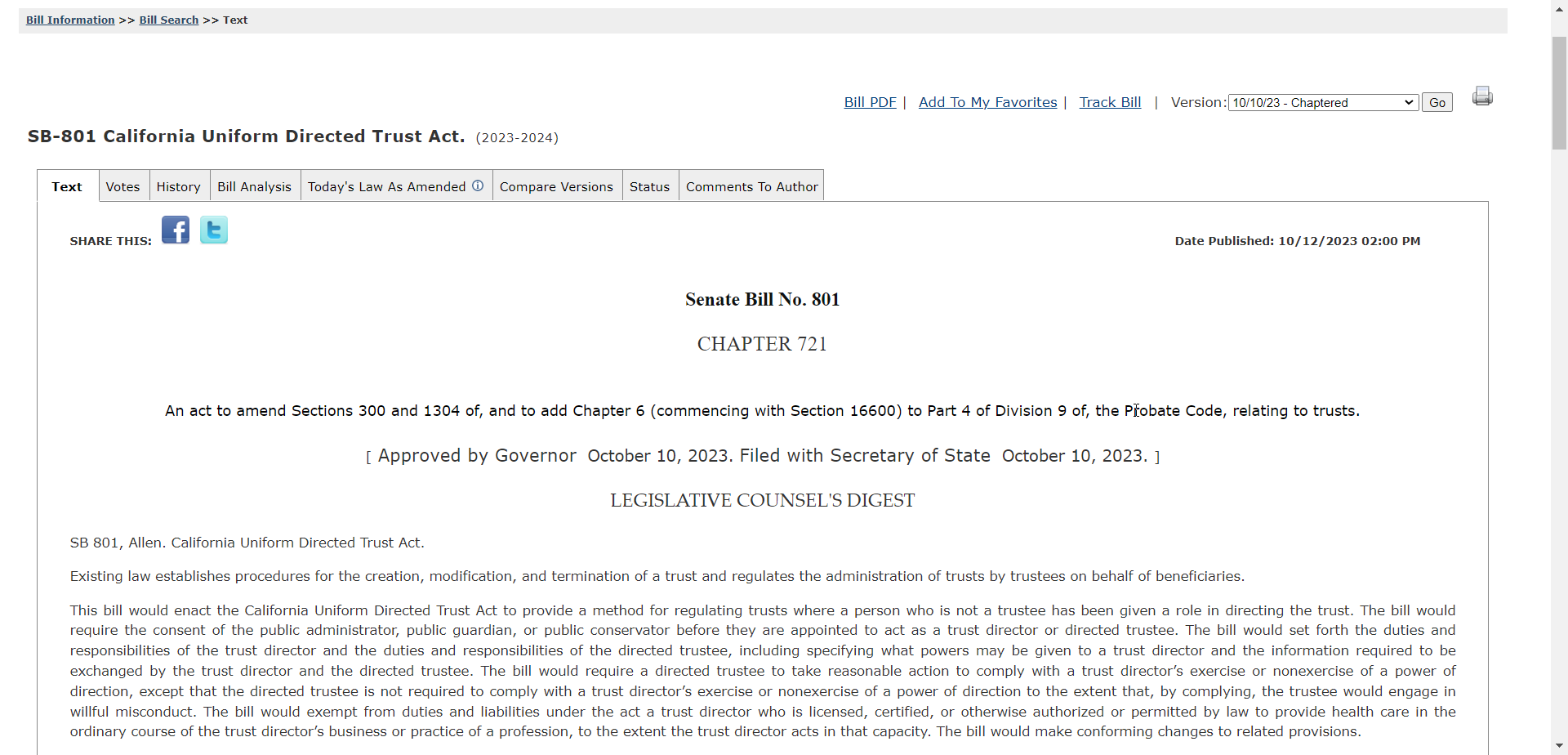
California allows directed trusts beginning January 1, 2024 – not just for the really wealthy

I have provided below a snapshot of the first part of California Senate Bill No. 801, which has been signed into law. The bill is just over 5 pages long, so it will take some reading, study and evaluation. However, the bill enacts “the California Uniform Directed Trust Act to provide a method for regulating trusts where a person who is not a trustee [i.e., the “trust director”] has been given a role in directing the trust.” Thus, for California the bill creates a possible new means for directing how a trust is administered and adds the new roles and terms “directed trustee” and “trust director.”

The California Uniform Directed Trust Act is contained at new Probate Code Sections 16600-16632. Probate Code Section 16608(a) states: “Subject to Section 16610, the terms of a trust may grant a power of direction to a trust director.” The California Uniform Directed Trust Act primarily addresses the authority, limitation on authority, liability, and limitation on liability of the directed trustee and of the trust director, and the interactions and relationships between the directed trustee and the trust director. In no small part the terms and provisions that are stated in the trust will be determinative or instructive, assuming that those terms and provisions in fact pertain to the issues and situation at hand.

This is sure to create a lot of legal and estate planning discussion, and opportunities. Indeed, I will be covering the new legislation in greater detail. Directed trusts often are thought of as being just for the very wealthy; however, there may in fact be many different family relationships and dynamics, businesses and family businesses, and wealth, financial and estate planning situations in which the option of a directed trust might be considered with a directed trustee who can in some situations be subject to the power of direction by the trust director.

Below is the snapshot from the first part of California Senate Bill No. 801:

* * * *

Thank you for viewing this discussion. Please do pass this blog and blog post and information to other people who would be interested as it is only through collaboration and sharing that great things and success are more quickly achieved. If you are interested in discussing anything that I have said in the discussion above or in either of my two blogs (see blog addresses below), or if you simply want to reach out or are seeking assistance, it is best to reach me by email at dave@tateattorney.com.

David Tate, Esq. (and inactive CPA)

  • Business litigation and disputes – business, breach of contract/commercial, co-owners, shareholders, investors, founders, workplace and employment, environmental, D&O, governance, boards and committees.
  • Trust, estate and probate court litigation and disputes – trust, estate, probate, elder and dependent abuse, conservatorship, POA, real property, mental health and care, mental capacity, undue influence, conflicts of interest, and contentious administrations.
  • Governance, boards, audit and governance committees, investigations, auditing, ESG, etc.
  • Mediator and facilitating dispute resolution (evaluative and facilitative):
    • Trust, estate, probate, conservatorship, elder and dependent abuse, etc.
    • Business, breach of contract/commercial, owner, shareholder, investor, etc.
    • D&O, board, audit and governance committee, accountant and CPA related.
    • Other: workplace and employment, environmental, trade secret.

Remember, every case and situation is different. It is important to obtain and evaluate all of the evidence that is available, and to apply that evidence to the applicable standards and laws. You do need to consult with an attorney and other professionals about your particular situation. This post is not a solicitation for legal or other services inside of or outside of California, and, of course, this post only is a summary of information that changes from time to time, and does not apply to any particular situation or to your specific situation. So . . . you cannot rely on this post for your situation or as legal or other professional advice or representation, or as or for my opinions and views on the subject matter.

Also note – sometimes I include links to or comments about materials from other organizations or people – if I do so, it is because I believe that the materials are worthwhile reading or viewing; however, that does not mean that I do not or that I might not have a different view about some or even all of the subject matter or materials, or that I necessarily agree with, or agree with everything about or relating to, that organization or person, or those materials or the subject matter.

Please also subscribe to this blog and my other blog (see below), and connect with me on LinkedIn and Twitter.

My two blogs are:

http://tateattorney.com – business, D&O, audit committee, governance, compliance, etc. – previously at http://auditcommitteeupdate.com

Trust, estate, conservatorship, elder and elder abuse, etc. litigation and contentious administrations http://californiaestatetrust.com

David Tate, Esq. (and inactive California CPA) – practicing only as an attorney in California.

Updated Questions to Consider to Help Facilitate Legal Dispute Resolution and Settlement – See Attached – David Tate, Esq., californiaestatetrust.com

Greetings. I have attached my slightly updated Questions to Consider to Help Facilitate Legal Dispute Resolution and Settlement, which you can see below, and which you can download and use, and please tell other people. I am also posting this to my other blog (business, D&O, governance, boards, audit and governance committees, compliance with laws and regulations, investigations, internal and external audit, risk management, etc. – http://tateattorney.com).

David Tate, Esq.

* * * *

Thank you for viewing this discussion. Please do pass this blog and blog post and information to other people who would be interested as it is only through collaboration and sharing that great things and success are more quickly achieved. If you are interested in discussing anything that I have said in the discussion above or in either of my two blogs (see blog addresses below), or if you simply want to reach out or are seeking assistance, it is best to reach me by email at dave@tateattorney.com.

David Tate, Esq. (and inactive CPA)

  • Business litigation and disputes – business, breach of contract/commercial, co-owners, shareholders, investors, founders, workplace and employment, environmental, D&O, governance, boards and committees.
  • Trust, estate and probate court litigation and disputes – trust, estate, probate, elder and dependent abuse, conservatorship, POA, real property, mental health and care, mental capacity, undue influence, conflicts of interest, and contentious administrations.
  • Governance, boards, audit and governance committees, investigations, auditing, ESG, etc.
  • Mediator and facilitating dispute resolution (evaluative and facilitative):
    • Trust, estate, probate, conservatorship, elder and dependent abuse, etc.
    • Business, breach of contract/commercial, owner, shareholder, investor, etc.
    • D&O, board, audit and governance committee, accountant and CPA related.
    • Other: workplace and employment, environmental, trade secret.

Remember, every case and situation is different. It is important to obtain and evaluate all of the evidence that is available, and to apply that evidence to the applicable standards and laws. You do need to consult with an attorney and other professionals about your particular situation. This post is not a solicitation for legal or other services inside of or outside of California, and, of course, this post only is a summary of information that changes from time to time, and does not apply to any particular situation or to your specific situation. So . . . you cannot rely on this post for your situation or as legal or other professional advice or representation, or as or for my opinions and views on the subject matter.

Also note – sometimes I include links to or comments about materials from other organizations or people – if I do so, it is because I believe that the materials are worthwhile reading or viewing; however, that does not mean that I do not or that I might not have a different view about some or even all of the subject matter or materials, or that I necessarily agree with, or agree with everything about or relating to, that organization or person, or those materials or the subject matter.

Please also subscribe to this blog and my other blog (see below), and connect with me on LinkedIn and Twitter.

My two blogs are:

http://tateattorney.com – business, D&O, audit committee, governance, compliance, etc. – previously at http://auditcommitteeupdate.com

Trust, estate, conservatorship, elder and elder abuse, etc. litigation and contentious administrations http://californiaestatetrust.com

David Tate, Esq. (and inactive California CPA) – practicing only as an attorney in California.

The California CARE Court begins . . .

The California CARE Court begins. A group of counties are scheduled to implement the CARE Court first: San Francisco, Riverside, Glenn, Orange, San Diego, Stanislaus and Tuolumne. Other counties have until December 1, 2024. I have provided below links to the San Francisco Superior Court CARE Court page, and also the CARE Court page for the Riverside Superior Court. They are open for filings beginning October 2, 2023).

I have previously blogged about the CARE Court. As the San Francisco CARE Court page notes:

I have read different authoritative papers, discussions, and forms about the CARE Court, who can file a petition to start the proceeding, who qualifies to be a respondent/defendant in a CARE Court proceeding (i.e., against whom a petition can be filed), and the Court processes after a petition is filed. Frankly, different papers, discussions, and forms are not always in agreement. There are uncertainties to be resolved – I presume that the Courts of Appeal will also become involved as appeals are filed on various issues and proceedings.

Ideally the CARE Court process is supposed to be voluntary on the part of the respondent/defendant; however, it is my understanding that if the respondent/defendant objects or is unable to voluntarily agree (or perhaps simply does not agree?), the Court proceeding will continue and move forward anyway, the respondent/defendant will be appointed an attorney, a hearing will be scheduled “on the merits of the petition,” and the Court will issue orders about the petition and defenses, including orders pertaining to care and treatment, and possibly about housing.

Information for Respondents – About the CARE Act (California Judicial Council Form CARE-060-INFO) states: “The court will set a hearing on the merits of the petition. The hearing on the merits of the petition may happen at the same time of the initial appearance on the petition but only if you (the respondent), the petitioner, and the court agree.” I presume that a hearing on the merits will include evidence and will be conducted in accord with the rules of evidence – however, that might be a matter to be determined.

A CARE Court proceeding is not a general conservatorship, or an LPS health conservatorship (Lanterman-Petris-Short), or a California Welfare & Institutions Code Section 5150 mental health proceeding, all of which still exist, and to which a person in need of help or assistance still can voluntarily agree, just like the right to agree with or object to and oppose the CARE Court petition and proceeding.

However, as I have previously written, a CARE Court proceeding is an action by the State that limits or restricts the respondent/defendant’s freedoms, activities, and rights – thus, it is arguable that the protections that exist in general conservatorships (and perhaps also in LPS conservatorships) also will or may apply to a respondent/defendant in a CARE Court proceeding. The California appellate courts and the Legislate have confirmed that a prospective conservatee in a general conservatorship (and also in an LPS conservatorship) has certain important rights, including, for example, the right to a jury trial.

The CARE Court starts October 2, 2023. I view it as a work in progress, with some significant uncertainties of law and process.

For your additional reading, just as examples, the following are links to the the San Francisco Superior Court and Riverside Superior Court CARE Court pages:

https://sf.courts.ca.gov/divisions/civil-division/care-act-court

https://riverside.courts.ca.gov/Divisions/CAREAct/care-act.php

* * * *

Thank you for viewing this discussion. Please do pass this blog and blog post and information to other people who would be interested as it is only through collaboration and sharing that great things and success are more quickly achieved. If you are interested in discussing anything that I have said in the discussion above or in either of my two blogs (see blog addresses below), or if you simply want to reach out or are seeking assistance, it is best to reach me by email at dave@tateattorney.com.

David Tate, Esq. (and inactive CPA)

  • Business litigation and disputes – business, breach of contract/commercial, co-owners, shareholders, investors, founders, workplace and employment, environmental, D&O, governance, boards and committees.
  • Trust, estate and probate court litigation and disputes – trust, estate, probate, elder and dependent abuse, conservatorship, POA, real property, mental health and care, mental capacity, undue influence, conflicts of interest, and contentious administrations.
  • Governance, boards, audit and governance committees, investigations, auditing, ESG, etc.
  • Mediator and facilitating dispute resolution (evaluative and facilitative):
    • Trust, estate, probate, conservatorship, elder and dependent abuse, etc.
    • Business, breach of contract/commercial, owner, shareholder, investor, etc.
    • D&O, board, audit and governance committee, accountant and CPA related.
    • Other: workplace and employment, environmental, trade secret.

Remember, every case and situation is different. It is important to obtain and evaluate all of the evidence that is available, and to apply that evidence to the applicable standards and laws. You do need to consult with an attorney and other professionals about your particular situation. This post is not a solicitation for legal or other services inside of or outside of California, and, of course, this post only is a summary of information that changes from time to time, and does not apply to any particular situation or to your specific situation. So . . . you cannot rely on this post for your situation or as legal or other professional advice or representation, or as or for my opinions and views on the subject matter.

Also note – sometimes I include links to or comments about materials from other organizations or people – if I do so, it is because I believe that the materials are worthwhile reading or viewing; however, that does not mean that I do not or that I might not have a different view about some or even all of the subject matter or materials, or that I necessarily agree with, or agree with everything about or relating to, that organization or person, or those materials or the subject matter.

Please also subscribe to this blog and my other blog (see below), and connect with me on LinkedIn and Twitter.

My two blogs are:

http://tateattorney.com – business, D&O, audit committee, governance, compliance, etc. – previously at http://auditcommitteeupdate.com

Trust, estate, conservatorship, elder and elder abuse, etc. litigation and contentious administrations http://californiaestatetrust.com

David Tate, Esq. (and inactive California CPA) – practicing only as an attorney in California.

Richard Blum Trust case (Feinstein) ordered to mediation under authority of the Breslin case

On September 13, the San Francisco Superior Court in Probate ordered the Richard Blum Trust case (Feinstein) to mediation. There are actually two related cases, both of which were ordered to mediation.

It is very early in both cases, but the Court nevertheless ordered both cases to mediation. The cases were filed in late June and in early August, 2023. It appears that there has been no discovery. I do believe that more parties should engage in mediation earlier in cases, and then also a second or third time if that case still has not settled and if settlement appears reasonably possible.

In Blum Trust (Feinstein) the allegations are serious but not unusual for trust litigation pleading, including a petition to compel accounting, to instruct the trustees to fund the marital trust, for breach of trust, to set aside the acts of the trustees, to disgorge and reduce the trustees’ compensation, to suspend and remove the trustees, for financial elder abuse, and to prohibit the trustees from using the trust funds.

Settlement might reasonably be possible if the parties really do not want to have to litigate the claims in public; however, there might be significant issues of law and fact (evidence), and the history of the relationships and interactions might also be relevant. It is also possible that discovery could be needed on some issues and claims before the case is ready for resolution; however, if a case does not settle, often mediation still can be worthwhile to get the parties communicating and discussing and perhaps agreeing on next steps, possible issues relating to the pleadings, and discovery to occur. The law firms that are involved in the cases are well-known and experienced. It appears that there are sufficient assets available. I would say that although it is early in both cases, attending a mediation is worthwhile.  

In Blum Trust (Feinstein) the Court ordered the cases to mediation based on the authority provided in Breslin v. Breslin (2021) 62 Cal. App. 5th 801, 806, in which the court held that the probate court has the power to order the parties into mediation (citing California Probate Code §17206). In Breslin a detailed notice was served on the parties informing them that the court had ordered the parties to mediation – subsequently when a party did not attend and participate in the court-ordered mediation the terms of the mediated settlement agreement that was reached between the parties who did attend the mediation were held to also be binding against the party who failed to attend and participate in the court-ordered mediation. Thus, if you are ordered to mediation, you need to attend and participate in good faith.

In the Blum Trust (Feinstein) cases the Court has ordered the mediation to be completed by December 11, 2023, and the parties are ordered to notify the Probate Examiner of the outcome of the mediation by December 18, 2023, with a follow up new Court hearing date on January 22, 2024.

Good luck to all in the mediation.

I have attached below my paper discussing questions to consider to help facilitate legal dispute resolution and settlement.


* * * *

Thank you for viewing this discussion. Please do pass this blog and blog post and information to other people who would be interested as it is only through collaboration and sharing that great things and success are more quickly achieved. If you are interested in discussing anything that I have said in the discussion above or in either of my two blogs (see blog addresses below), or if you simply want to reach out or are seeking assistance, it is best to reach me by email at dave@tateattorney.com.

David Tate, Esq. (and inactive CPA)

  • Business litigation and disputes – business, breach of contract/commercial, co-owners, shareholders, investors, founders, workplace and employment, environmental, D&O, governance, boards and committees.
  • Trust, estate and probate court litigation and disputes – trust, estate, probate, elder and dependent abuse, conservatorship, POA, real property, mental health and care, mental capacity, undue influence, conflicts of interest, and contentious administrations.
  • Governance, boards, audit and governance committees, investigations, auditing, ESG, etc.
  • Mediator and facilitating dispute resolution (evaluative and facilitative):
    • Trust, estate, probate, conservatorship, elder and dependent abuse, etc.
    • Business, breach of contract/commercial, owner, shareholder, investor, etc.
    • D&O, board, audit and governance committee, accountant and CPA related.
    • Other: workplace and employment, environmental, trade secret.

Remember, every case and situation is different. It is important to obtain and evaluate all of the evidence that is available, and to apply that evidence to the applicable standards and laws. You do need to consult with an attorney and other professionals about your particular situation. This post is not a solicitation for legal or other services inside of or outside of California, and, of course, this post only is a summary of information that changes from time to time, and does not apply to any particular situation or to your specific situation. So . . . you cannot rely on this post for your situation or as legal or other professional advice or representation, or as or for my opinions and views on the subject matter.

Also note – sometimes I include links to or comments about materials from other organizations or people – if I do so, it is because I believe that the materials are worthwhile reading or viewing; however, that does not mean that I do not or that I might not have a different view about some or even all of the subject matter or materials, or that I necessarily agree with, or agree with everything about or relating to, that organization or person, or those materials or the subject matter.

Please also subscribe to this blog and my other blog (see below), and connect with me on LinkedIn and Twitter.

My two blogs are:

http://tateattorney.com – business, D&O, audit committee, governance, compliance, etc. – previously at http://auditcommitteeupdate.com

Trust, estate, conservatorship, elder and elder abuse, etc. litigation and contentious administrations http://californiaestatetrust.com

David Tate, Esq. (and inactive California CPA) – practicing only as an attorney in California.