Can You Stop An Aging Parent From Self-Neglect At Home – by Carolyn Rosenblatt

The following is a good discussion by Carolyn Rosenblatt, on a topic that is ongoing for many, many families – can you stop an aging parent from self-neglect at home? The link to Carolyn’s article is provided below.

When is it self-neglect or self-abuse, and what can or do you do about it?

Unless you have the cooperation of the parent (and other family members), and the needed financial, insurance coverage, and time resources, and know who to contact, the issues are even more difficult to resolve. I see many family members who are dealing with these issues in trust, power of attorney, and conservatorship situations. What are the responsibilities/duties and rights, and what options are available and can be achieved? I am also aware of one California case involving a finding of elder abuse in a situation where family members did not take action to try to remedy the situation.

These issues are or can be difficult even with cooperation and resources. To see Carolyn’s article, CLICK HERE.

Dave Tate, Esq. San Francisco and California

Trustee and Beneficiary Responsibilities and Rights – Discussion Paper

If you are a trustee you need to know your responsibilities, and if you are a beneficiary you should know your rights. The following is a summary paper discussing both the responsibilities and the rights. Of course the California Probate Code is considerably longer and more detailed than the points discussed in this paper, there are also case law interpretations, and every case and situation is unique, but the paper will give you good insight. Click on the following link for the paper and discussion, A Summary of California Trustee and Beneficiary Responsibilities and Rights Dave Tate Esq 01052016.

Dave Tate, Esq., San Francisco

What Is A California Conservatorship – An Overview

I was initially going to make this discussion as a video, and I still might; however, the video obviously takes more time. Below is the discussion about California conservatorships – specifically, what is a California conservatorship, an overview.

First – a reminder and an obligatory disclaimer – this discussion is only a summary of a complicated topic. You need to consult with an attorney about your situation. You cannot rely on this discussion for your situation. And this is not a solicitation for services inside or outside of California, I only represent clients in California, I don’t know anything about your situation or case, and you have not hired me for your situation or case.

Now, that having been said, the following is an overview discussion about California conservatorships.

A conservatorship is a court proceeding where the court legally appoints someone to make and manage personal, medical, daily living, residential placement, or financial matters and decisions for another person.

The person whose rights are being taken away or limited is called the conservatee. The person who is being appointed to manage matters and make decisions for the conservatee is called the conservator.

A conservatorship is a serious legal proceeding because the court, which is a state governmental entity, is being petitioned to take away or limit some of the prospective conservatee’s freedoms and personal and constitutional rights.

The conservatee has the right to fight or oppose the conservatorship, who might be appointed, and the powers of the conservator. And a prospective conservatee has the right to a jury trial.

You might ask, when is a conservatorship needed? Typically a conservatorship might be needed when a person can no longer make and manage the personal, medical or financial matters and decisions for herself or himself, and she or he hasn’t legally appointed someone else to handle those matters and decisions.

So, for example, a conservatorship might be needed if there are no, or insufficient, power of attorney and trust documents, and the person no longer has the mental capacity to execute those documents or refuses to do so.

On the other hand, a conservatorship should not be granted if there is a less restrictive way to provide the help or assistance that is needed, and if the court grants the petition for conservatorship, the court can order only the least restrictive terms, conditions and limitations that are necessary under the circumstances.

The person who is petitioning for conservatorship has the burden of producing sufficient admissible evidence to establish that the court should grant the conservatorship. Conservatorship proceedings can be very contentious.

If a conservatorship is granted, the case remains with the court for future review of the actions taken or not taken by the conservator, accountings if the conservatorship is of the estate, and whether the conservatorship is still needed.

Often a conservator is required to make very important and serious decisions. The conservatee and other people can oppose or object to what the conservator is going to do or has done. Sometimes the case will go back to court for the court to make decisions or orders.

The conservator needs to be represented by an attorney. The conservatee will be represented by an attorney if the conservatee requests one. And in conservatorship disputes it is common for other family members or friends to also be represented by legal counsel.

Recent California conservatorship court decisions have dealt with conservatee’s rights including the right to a jury trial, and in a very recent case the appellate court overruled the trial court, holding that the conservatorship should not have been granted because a friend had instead offered to provide the help and assistance that the prospective conservatee needed.

I have already explained that a prospective conservatee has the right to oppose the conservatorship, and to a jury trial.

You should also be aware that if the conservatorship is granted, the conservatee might also continue to disagree with decisions and actions that are being made or taken.

And I have also seen situations where the preexisting relationship between the conservatee and the conservator was forever damaged, and situations where the prospective conservatee, or the actual conservatee if the conservatorship was granted, then sought to disinherit the person who petitioned for conservatorship or who was appointed by the court to serving as the conservator.

There are many provisions in the California Probate Code that discuss conservatorship proceedings and duties and rights. There are too many provisions to cover in these materials. However, generally you can look at Probate Code sections 1400 through 3212. Other Probate Code sections are also applicable.

In addition to the conservatee’s rights, I also find particularly interesting and important the provisions that relate to conservator duties and decision making, including how the conservator should go about making decisions and what to consider, possibly including the wishes of the conservatee.

You can find additional information on my blogs at http://californiaestatetrust.com and http://auditcommitteeupdate.com, and you can call me at (415) 917-4030. That’s all for now. Thanks for reading.

Dave Tate, Esq., San Francisco and California

New California Case – Gregge v. Hugill – Probate Code Section 17200 Petition Improperly Dismissed, And Policy Favors Trials And Determinations On The Issues And The Claims Alleged

On July 14, 2016, the California Court of Appeal for the Sixth District issued its decision in Gregge v. Hugill, Case No. HO40663. Viewed most simply, the Court determined that Appellant had standing to bring his petition under California Probate Code section 17200 in which he alleged lack of testamentary capacity, undue influence and elder abuse, and that Probate Code section 17202 and another beneficiary’s disclaimer did not operate to defeat or eliminate Appellant’s pecuniary interest and standing to bring his petition and for trial thereon.

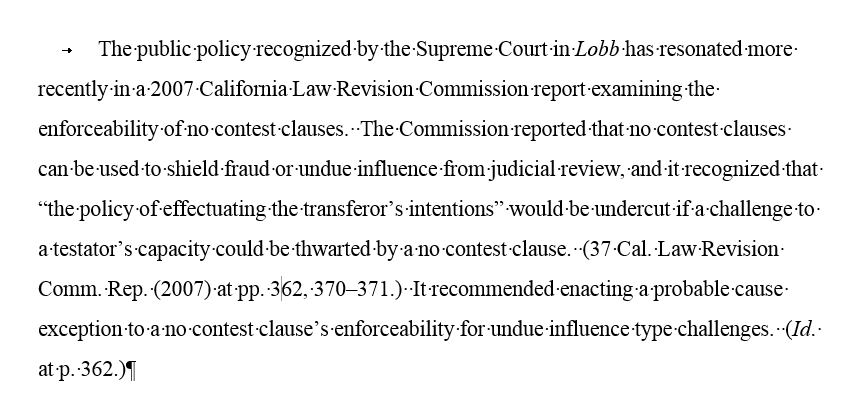
But viewed in its entirety, the decision in Gregge v. Hugill affirms policies that favor a party’s entitlement to a determination on the issues and the claims alleged, arguably disfavors claim forfeiture arguments, and affirms that estate planning document, i.e., will and trust, and inheritance contest determinations and findings should be based on the decedent’s intent.

The following are six snapshots from the opinion in Gregge v. Hugill which will provide you with some of the Court’s insight (the first snapshot is only of the case caption).

Gregge v. Hugill image 1 of 6


Gregge v. Hugill image 2 of 6

Gregge v. Hugill image 3 of 6

Gregge v. Hugill image 4 of 6

Gregge v. Hugill image 5 of 6

Gregge v. Hugill image 6 of 6


Conservatorship Should Not Have Been Granted Where “Friend” Offered To Provide Help – Conservatorship of Jesse G.

I have attached below a pdf of this new California Appellate Court decision in which the Appellate Court overruled a trial court order granting a LPS conservatorship. I have attached the pdf of the entire decision because the decision is lengthy in its discussion of the facts, and only by reading the decision will you get a feel for how difficult it might be to establish that a conservatorship should be granted. And you should read other prior blog posts by me discussing conservatorship issues, including the rights of the prospective conservatee. Also note in my prior posts the crossover that there can be between the legal authorities that relate to LPS conservatorships and general probate court conservatorships. Thus, although Conservatorship of Jesse G. is a LPS conservatorship, the reasoning of the Court, and some or perhaps even most of the legal authorities cited, might also equally apply in a general probate court conservatorship proceeding.

As you read the decision in Conservatorship of Jesse G., note the facts that could arguably suggest that the prospective conservatee might need help, and arguably that the conservatorship could be granted. The Appellate Court (similar to the trial court) also notes that the case is a close call. Also note that it isn’t certain that the help or assistance that the friend offered to provide to the prospective conservatee will be sufficient, or that it will be lasting over time. And yet, the Appellate Court concludes that under the circumstances of the case, the granting of the conservatorship was not legally justified. And some of the reasons why the Court reached that decision have to do with the burden of proof that is required, and that preference to less restrictive measures must be given.

Here is a link to a pdf of the decision Conservatorship of Jesse G. – discussing evidence that a LPS conservatorship should not have been granted

Dave Tate, Esq., San Francisco Bay Area and throughout California.

Is This Undue Influence – It Could Be – You Decide

I was reading an article recently. It in part described a situation where one of Dad’s adult children said that Dad could not see his granddaughter anymore because the son was upset with Dad’s estate plan, but that Dad could see his granddaughter if he made some changes to the plan.

Undue influence is described in several different ways, including by statute and by case law. When are statements or discussions merely opinions, or influence, or persuasion, or even argument or disagreement, but not “undue” influence in nature? It’s not always easy to tell; but on other occasions it is obvious. You judge the above scenario using the below definition of undue influence. It sounds like undue influence, and quite possibly also elder abuse, if it meets the below criteria.

The following information is copied from my elder abuse presentation slides.

California Welfare & Institutions Code §15610.70 provides the following statutory definition of undue influence:

(a) “Undue influence” means excessive persuasion that causes another person to act or refrain from acting by overcoming that person’s free will and results in inequity. In determining whether a result was produced by undue influence, all of the following shall be considered:

(1) The vulnerability of the victim. Evidence of vulnerability may include, but is not limited to, incapacity, illness, disability, injury, age, education, impaired cognitive function, emotional distress, isolation, or dependency, and whether the influencer knew or should have known of the alleged victim’s vulnerability.

(2) The influencer’s apparent authority. Evidence of apparent authority may include, but is not limited to, status as a fiduciary, family member, care provider, health care professional, legal professional, spiritual adviser, expert, or other qualification.

(3) The actions or tactics used by the influencer. Evidence of actions or tactics used may include, but is not limited to, all of the following: (A) Controlling necessaries of life, medication, the victim’s interactions with others, access to information, or sleep. (B) Use of affection, intimidation, or coercion. (C) Initiation of changes in personal or property rights, use of haste or secrecy in effecting those changes, effecting changes at inappropriate times and places, and claims of expertise in effecting changes.

(4) The equity of the result. Evidence of the equity of the result may include, but is not limited to, the economic consequences to the victim, any divergence from the victim’s prior intent or course of conduct or dealing, the relationship of the value conveyed to the value of any services or consideration received, or the appropriateness of the change in light of the length and nature of the relationship.

(b) Evidence of an inequitable result, without more, is not sufficient to prove undue influence.


New Story – elder in board and care assisted living (RCFE) runs out of money, and doesn’t qualify for a nursing home under Medi-Cal

I heard about this recently – a new situation is arising. I’m just telling you about it. The elder is living in a residential care facility for the elderly, sometimes referred to as a RCFE, or assisted living or board and care. The elder is paying with private money. The assets and money run out. The elder doesn’t have family, or the family doesn’t have money, or the family won’t pay for the elder. Medi-Cal will not pay for a RCFE. In the past, in some situations, going to a nursing home was a last resort as Medi-Cal will pay for the cost of the nursing home. In the past the referral to a nursing home might merely have needed a doctor’s signature. Increasingly, Medi-Cal or its agents or representatives are starting to evaluate whether the elder’s physical, medical or mental conditions actually qualify the elder to be in the nursing home. In other words, if it is decided that the elder’s conditions are not sufficiently bad to qualify the elder to be in the nursing home, Medi-Cal will not pay for the costs of the nursing home, and the elder either will not be allowed initially into the home, or the nursing home and Medi-Cal will want to discharge and force the elder from the nursing home. But in those situations the elder has nowhere that she or he can afford with private pay.

New Story – Charity requests an accounting after all assets are distributed – nothing left to pay for it

Here’s a new story that I heard about recently – it’s not one of my cases.

The decedent died and the successor trustee began administering the trust. The trustee then made prior partial distributions to all of the beneficiaries including the charity, none of whom objected or requested additional information or an accounting. Over time the trustee finished the administration of the trust and then distributed the remaining assets to the same beneficiaries. No assets remain in trust.

The charity beneficiary has now requested an accounting – not that they believe anything is wrong – they just want an accounting to be sure.

The trustee had a couple of options for how to make the final distribution: (1) do it as the trustee did; (2) get a waiver of accounting and information (and consent) from each beneficiary (see Cal. Probate Code sections 16060 through 16069), (3) prepare and provide an accounting to each beneficiary and obtain a waiver and consent; or (4) prepare an accounting and submit a petition to the court for an order approving the accounting.

Unless in some situations the trust provides otherwise, the statute of limitations on an action against a fiduciary trustee for breach of duty is three years, but also could be longer in cases where wrongful actions were hidden and it could not be expected that the beneficiary knew or should have known about the wrongful actions.

Each case is different, there isn’t one correct or absolutely wrong way to handle the above situation, but only (4) will (in most cases) clear the trustee from future actions and liability.

In the above situation the trustee now has to provide the requested accounting and information, but without the funds being available in the trust to pay for it. There might also be a possible need or requirement for beneficiary return of assets that have already been distributed – but that possibility also raises the issue whether return of assets can be compelled.

These situations require risk management, due diligence and evaluation of the various options available.


Fraudsters’ Latest Target: The Already Defrauded – NY Times

2016-02-16_11-43-30

The below is a link to a good article in the NY Times, fraudsters target the already defrauded by promising to recover their originally lost money for a fee and then doing little or nothing to recover the originally lost money – clearly preying on the already victims. Strong people who are good need to take action – stay regularly in touch with the elder, in person if possible, really talk about and share things that are happening in the elder’s life, and consider helping or taking control over finances [you might legally be required to], but while leaving the elder with freedoms and self-respect. These are difficult situations. Call me if you have a situation where legal help is needed – (415) 917-4030 – San Francisco Bay Area and throughout California. For the article CLICK HERE.
Best,
Dave Tate, Esq., Trust/Estate Blog: http://californiaestatetrust.com, Website: http://tateattorney.com.

Our Elder and Dependent Adult Abuse Prevention and Remedies Are Ridiculously Inadequate and Archaic – Insufficient Resources and Boots on the Ground, and No Collaboration

Let’s talk more about elder and dependent adult abuse and protection, and why we are failing in California. Prevention and remedies are ridiculously inadequate and archaic, particularly taking into account the numbers of cases of abuse.

I first started bringing elder and dependent adult abuse cases in 1993. My cases were primarily for physical, care, mental, undue influence, duress, fraud, financial, theft, real property, trust, and will abuse. I have to say that the more that things change they also stay the same. The same types of abuse still occur, and they always will. The cases were difficult then, and they still are. These cases take time and expertise. There is often difficulty obtaining evidence. And defendants really fight these cases, always arguing that nothing wrongful occurred, that the victim rightfully knew what they were doing and of their own free will, and in physical abuse cases that the injury naturally occurred due to the victim’s naturally poor condition. In other words, everything was known and on the up-and-up. Defendants in these cases count on the prospect that you will have difficulty proving the case, and that you will go away eventually for lack of resources and time. Nothing has really changed.

We should ask, what resources are available to fight elder and dependent adult abuse?  The first line of prevention and defense includes good people who are family, friends, professionals such as doctors, bankers, caregivers, accountants and financial advisors, and sometimes other third parties. Will these people recognize the possible or actual abuse, and then also take action? Do they even know what action might be possible and who to contact?  If so, most likely only to a certain limited extent.

The next line of defense probably includes law enforcement, adult protective services and the district attorney. Most likely these people only get involved because someone in the first line of defense has contacted them. I have previously discussed the inadequacy of the second line of defense – they simply do not have the time and people power and resources to handle the numbers of possible or actual abuse cases, or to stick with the cases long-term. They can pick some cases to attempt to handle.

I would say that the third line of defense includes the private attorneys. There are resources in this category that are under utilized, at least in part because people in the first category don’t know who to contact, people in the second category don’t know who to contact and aren’t authorized to contact or won’t contact people in the third line of defense, and it is also true that private attorneys also have resources and abilities that are not unlimited and each case must also be evaluated.

Improvements can be made to the situations described above. In particular, problems and issues relating to people in the first category, the first line of prevention and defense, can be improved by getting the information out so that they can better spot abuse or possible abuse and take action. Problems and issues relating to people in the second category, the second line of defense, can be improved with additional funding or monetary resources, and by having people in the second line of defense refer people or cases to the private attorneys in the third category or third line of defense.  And efforts can be made to further educate attorneys in the third line of defense about the procedures, causes of action, and remedies that are available to them. Similarly, additional effort needs to be made to educate the courts, judges, and other legal system professionals about types of abuse, evidence that abuse has occurred, and the procedures, causes of action and remedies available.

And let me discuss one additional program, the ombudsman program, which every county in California is supposed to have, and the members/volunteers of which go into the nursing homes (SNF) and residential care facilities (RCFE) and similar entities to check on the care provided and advocate on behalf of the residents. I’m a board member of Ombudsman Services of San Mateo County, California. This is a tremendous nonprofit organization. They do great work. Ombudsman Services organizations do vary from county to county – they are run different, they have different funding, they have different numbers of volunteers, they have different training, they have different decision-making processes, and some are county-run whereas other’s are separate nonprofit entities, etc. Here is a link to Ombudsman Services of San Mateo County, http://ossmc.org/. I ask that you also donate to them if you wish.

That’s all for now. These cases really haven’t changed for over 20 years, in my experience. You might hear a commercial about reporting elder abuse, and those commercials are important, but it is really about having numbers of boots on the ground that make a difference. If the boots and referrals aren’t there, nothing will be done or remedied, and it goes on and on.

Dave Tate, Esq., San Francisco and throughout California, http://californiaestatetrust.com