New Case – Hospital That Was Systematically Understaffed Supported Cause Of Action For Elder Abuse – Fenimore V. Regents Of The University Of California

This is an important new case, but you do need to read the facts and opinion carefully to determine whether your situation fits. Here is a pdf of the opinion Fenimore v. The Regents of the University of California.

It is arguable that this opinion expands the situations where an elder abuse claim can be stated.

For more than 20 years there has been a tug-of-war between ordinary negligence including medical or care malpractice on the one hand and elder abuse on the other hand. And that tension will continue; however, very slowly the courts are more often holding that elder abuse can be alleged in a medical or care situation where there are systemic deficiencies such as, for example, lack of staffing and inadequate training, particularly where those deficiencies violate a statutory duty, requirement or standard of care.

As the underlying opinion in Fenimore applies in the circumstance of systemic violation of a statutory duty, arguably this case, as it applies to elder abuse, could be cited in a whole host of care and other situations including but not limited to nursing homes, RCFE/assisted living, fiduciary care duties, fiduciary financial duties, and more.

Dave Tate, Esq. San Francisco and California – civil real property and business, trust, estate, conservatorship, power of attorney and elder abuse litigation, and helping fiduciaries and beneficiaries in administrations. http://californiaestatetrust.com, and audit committees and D&O http://auditcommitteeupdate.com.

New Story – elder in board and care assisted living (RCFE) runs out of money, and doesn’t qualify for a nursing home under Medi-Cal

I heard about this recently – a new situation is arising. I’m just telling you about it. The elder is living in a residential care facility for the elderly, sometimes referred to as a RCFE, or assisted living or board and care. The elder is paying with private money. The assets and money run out. The elder doesn’t have family, or the family doesn’t have money, or the family won’t pay for the elder. Medi-Cal will not pay for a RCFE. In the past, in some situations, going to a nursing home was a last resort as Medi-Cal will pay for the cost of the nursing home. In the past the referral to a nursing home might merely have needed a doctor’s signature. Increasingly, Medi-Cal or its agents or representatives are starting to evaluate whether the elder’s physical, medical or mental conditions actually qualify the elder to be in the nursing home. In other words, if it is decided that the elder’s conditions are not sufficiently bad to qualify the elder to be in the nursing home, Medi-Cal will not pay for the costs of the nursing home, and the elder either will not be allowed initially into the home, or the nursing home and Medi-Cal will want to discharge and force the elder from the nursing home. But in those situations the elder has nowhere that she or he can afford with private pay.

Broad Process Conservatee and Fiduciary/Conservator Decision Making

The California Fiduciaries Code of Ethics and the National Guardianship Association Standards of Practice provide requirements for professional fiduciaries, which are also helpful to guide non-professional fiduciaries. The following is a summary of the broad process for conservatee and fiduciary/conservator decision making in the Code of Ethics and the Standards of Practice – of course the Code of Ethics and the Standards of Practice contain much greater coverage of these topics and each situation much stand and be evaluated separately and by itself – the below discussion about informed consent, substituted judgment and best interest covers the broad process approach. I also find it interesting that I have never heard a discussion by a Court about this or a different process for conservatee and fiduciary or conservator decision making. Comparing this to board of director deliberations, perhaps this might, at least in small part, be analogized to the business judgment rule?

1. Informed Consent – The decision should first be made by informed consent if possible.

A person’s (the conservatee’s) agreement or decision to allow or to have something happen that is based on a full disclosure of facts needed to make the decision intelligently, i.e., knowledge of the risks involved, alternatives, etc.

In other words, the individual choice or decision by the conservatee, that the conservatee is capable of making, unless doing or allowing so would violate the fiduciary’s duties to the conservatee or impose unreasonable expense to the estate.

2. Substituted Judgment – Second, if informed consent cannot be obtained, the decision is made by substituted judgment if possible.

The principle of decision making that requires implementation of the course of action that comports with the individual person’s (the conservatee’s) known wishes expressed before incapacity, provided the conservatee was once capable of developing views relevant to the matter at issue and reliable evidence of those views remains.

In other words, the decision is made or action taken or not taken, by the fiduciary, based on the ascertained desires and wishes, if any, of the conservatee, as expressed or demonstrated by the conservatee while the conservatee had capacity to so express or demonstrate, relevant to the current subject matter at issue, unless doing or allowing so would violate the fiduciary’s duties to the conservatee or impose unreasonable expense to the estate.

3. Best Interest – If informed consent, first, and substituted judgment, second, are not available or possible, the decision is made based on best interest.

The course of action that maximizes what is best for a person (the conservatee) and that includes consideration of the least intrusive, most normalizing, and least restrictive course of action possible given the needs of the conservatee.

Nursing home won’t implement a music program – it should be part of the care plan – by law

You might be aware that it has been found that music and musical activities can be helpful and therapeutic, including for the purpose of reducing or eliminating antipsychotic and other medications, for elders and seniors in geriatric care, palliative care, with Alzheimer’s and other dementia, and with depression.

And I have heard that grants and funding for these types of activities are available, but that for the most part nursing homes are not implementing these programs, possibly because to do so would require some additional nursing home time and staff resources.

The excuse for not implementing these programs entirely misses the point, breaches a nursing home’s care duties, and quite possibly also breaches duties and responsibilities pertaining to medications and dosages that might be reduced or eliminated if the musical activity and therapy was provided.

Providing music, if it will be helpful for the resident, is a care evaluation and care plan issue, that the nursing home must address and provide if it would be beneficial to the wellbeing and care of the elderly resident. It’s that simple.

I encourage people to work together to force nursing homes to provided these programs for residents for whom it would be beneficial.

Dave Tate, Esq. (San Francisco and California)

Request for evidentiary hearing and trial in a probate department proceeding?

There are additional procedural requests or demands that I sometimes, perhaps often, make in probate department proceedings. Every case is different, of course, so you do need to evaluate procedural and strategic options for your particular situation. However, whereas in a civil action the court will eventually set the dispute for a trial, in probate the judge can in some circumstances rule from the bench without a hearing where witnesses are presented. So you do want to consider whether you want to protect or reserve your evidentiary hearing or trial entitlement. And there are also additional requests or demands that might be considered relating to the presentation or admissibility of evidence. Nevertheless, the following is possible wording requesting an evidentiary hearing, which you can add to your court-filed and served pleadings prior to the hearing:

REQUEST FOR EVIDENTIARY HEARING AND TRIAL

__. __________ incorporates by reference herein paras. 1-__ stated above as if fully restated in this para. __.

__. __________ further requests an evidentiary hearing and trial for all disputed matters in this case, and a jury trial to the extent that a jury trial is allowable.


Investment Advisors – Having Your Client Agree To A Designated Helper For The Advisor To Contact

I have provided below a link to a discussion and a service by Carolyn Rosenblatt for investment advisors in situations where the mental capacity of an elder client might be questioned, and in situations of possible undue influence or elder abuse. As you might know, investment advisors have been encouraged to enact policies and processes for these situations. There might be additional legislation in this area later this year, or at least legislation relating to advisor fiduciary duty. Please click on the below link, and then also click on the additional link at the bottom of that page to view the 10 step video. These policies and processes are good ideas and are needed – and they might arguably also already be legally required under standard of care, prudent due diligence, and elder abuse reporting requirements.

As I have previously posted, however, the designated helper also will need to know an attorney that she or he can contact to remedy the situation through the court system. Reporting to adult protective services or the police in appropriate situations might or might not provide emergency relief, but APS and the police do not have the people, time, and expertise resources to pursue a case through the legal system. And here is a link to my elder abuse and protection presentation slides http://wp.me/p1wbl8-dm

Here is the link to Carolyn’s discussion

The Confidentiality Conundrum: Can You Call A Third Party When Your Client Shows Signs Of Dementia?

Thanks. Dave Tate, Esq., San Francisco and California

Gun Trust Changes Coming July 2016, Ask Your Trust Attorney And Estate Planner

I’m passing this along – a brief discussion on JD Supra. There are more gun trust changes on the way in July 2016. Gun trusts have become more common – but the requirements also need to be followed. Here is a link to the discussion CLICK HERE

Dave Tate, Esq., San Francisco and throughout California, trust, estate, power of attorney, conservatorship and elder abuse litigation and contentious administrations, http://californiaestatetrust.com


Disinheritance for Elder Abuse – California Probate Code Section 259

I am seeing more situations where the elder abuse criteria of California Probate Code Section 259 are applicable or could become applicable to disinherit the abuser.

In the circumstances listed below Section 259 disinherits a person who is found to have committed elder abuse. However, Section 259(c) also in relevant part states: “This section shall not apply to a decedent who, at any time following the act or acts described in paragraph (1) of subdivision (a), or the act or acts described in subdivision (b), was substantially able to manage his or her financial resources and to resist fraud or undue influence within the meaning of subdivision (b) of Section 1801 of the Probate Code and subdivision (b) of Section 39 of the Civil Code.” Thus, in these situations it might be argued that Section 259 is not applicable in its entirety.

Based on situations that I am seeing, the applicability of Section 259 also may raise other issues that the statute might not address, including, for example, when (how long ago – what if it was 5-10 years ago, for example) did the elder abuse occur, what if the decedent elder and the abuser reconnected and the decedent elder legitimately and without undue influence really wanted the abuser to inherit, what if the decedent elder subsequently executes a new will or trust that includes a representation by the preparing attorney or a qualified psychologist stating that the elder is competent and not subject to abuse at the time that the subsequent new will or trust is executed (although this situation might be addressed by Section 259(c)), what if it can be established by clear and convincing evidence that the abuser really did subsequently rehabilitate and helped or provided significant assistance to the decedent elder, and whether the legislature intended the statute to include some criteria for the severity of abuse?

In everyday life the above issues and situations are not necessarily unusual although they might not be addressed by the relatively simplistic wording of Section 259. These can be problems where the Legislature enacts a statute with good intent and for good purpose but possibly lacking in detail – the result can create legal and enforceability issues for both people who wish to enforce the statute and for people who believe that it shouldn’t apply under the circumstances of the case.

Section 259 provides as follows:

“259.  (a) Any person shall be deemed to have predeceased a decedent to the extent provided in subdivision (c) where all of the following apply:

(1) It has been proven by clear and convincing evidence that the person is liable for physical abuse, neglect, or financial abuse of the decedent, who was an elder or dependent adult.

(2) The person is found to have acted in bad faith.

(3) The person has been found to have been reckless, oppressive, fraudulent, or malicious in the commission of any of these acts upon the decedent.

(4) The decedent, at the time those acts occurred and thereafter until the time of his or her death, has been found to have been substantially unable to manage his or her financial resources or to resist fraud or undue influence.

(b) Any person shall be deemed to have predeceased a decedent to the extent provided in subdivision (c) if that person has been convicted of a violation of Section 236 of the Penal Code or any offense described in Section 368 of the Penal Code.

(c) Any person found liable under subdivision (a) or convicted under subdivision (b) shall not (1) receive any property, damages, or costs that are awarded to the decedent’s estate in an action described in subdivision (a) or (b), whether that person’s entitlement is under a will, a trust, or the laws of intestacy; or (2) serve as a fiduciary as defined in Section 39, if the instrument nominating or appointing that person was executed during the period when the decedent was substantially unable to manage his or her financial resources or resist fraud or undue influence. This section shall not apply to a decedent who, at any time following the act or acts described in paragraph (1) of subdivision (a), or the act or acts described in subdivision (b), was substantially able to manage his or her financial resources and to resist fraud or undue influence within the meaning of subdivision (b) of Section 1801 of the Probate Code and subdivision (b) of Section 39 of the Civil Code.

(d) For purposes of this section, the following definitions shall apply:

(1) “Physical abuse” as defined in Section 15610.63 of the Welfare and Institutions Code.

(2) “Neglect” as defined in Section 15610.57 of the Welfare and Institutions Code.

(3) “False imprisonment” as defined in Section 368 of the Penal Code.

(4) “Financial abuse” as defined in Section 15610.30 of the Welfare and Institutions Code.

(e) Nothing in this section shall be construed to prohibit the severance and transfer of an action or proceeding to a separate civil action pursuant to Section 801.”
New Case – Double Damages Under Probate Code Section 859 Are Not Punitive – Why This Is Important

A new California case has held that the ability to recover 2x damages under California Probate Code section 859 does not constitute punitive damages. The case is Hill v. Superior Court (Staggers), California Court of Appeal, First Appellate District, No.A145893, decided February 18, 2016.

Without getting into a long legal discussion, why is Hill v. Superior Court (Staggers) important? Claims under California Probate Code sections 850, et seq., have become common and important. In summary, sections 850, et seq., allow certain legal claims in trust, estate (probate), conservatorship and guardian proceedings when money, personal property or real property is claimed to be due to or from an estate or trust. Sections 850, et seq., also may allow the prevailing party who wins on a claim that he or she is entitled to recover the property to recover twice the amount of the value of the property that is recovered.

In Hill v. Superior Court (Staggers) the losing party, against whom double damages were awarded, argued that double damages under Probate Code section 859 are in the nature of punitive damages, which would require the prevailing party to prove entitlement to recovery of the double damages under a higher standard (i.e., for example, by having to establish malice, oppression, fraud, etc., before being entitled to the recovery of double damages.

The Court of Appeal held that the double damages allowable under section 859 are in the nature of a penalty (upon a showing of bad faith), but are not punitive damages. The result, which is very important in these cases, is that it is easier to recover the section 859 double damages. These provisions need to be carefully considered in all Probate Code section 850, et seq., actions, including for the purpose of settlement and trial as the possibility of an award of double damages can significantly change the dynamics of a case. A claim of recovery under sections 850, et seq., might be possible in a wide variety of trust, estate (probate), conservatorship, guardianship and elder and dependent adult abuse cases.

The following is the wording of California Probate Code section 859 (which also contains a provision for the possible recovery of attorneys’ fees):

859.  If a court finds that a person has in bad faith wrongfully taken, concealed, or disposed of property belonging to a conservatee, a minor, an elder, a dependent adult, a trust, or the estate of a decedent, or has taken, concealed, or disposed of the property by the use of undue influence in bad faith or through the commission of elder or dependent adult financial abuse, as defined in Section 15610.30 of the Welfare and Institutions Code, the person shall be liable for twice the value of the property recovered by an action under this part. In addition, except as otherwise required by law, including Section 15657.5 of the Welfare and Institutions Code, the person may, in the court’s discretion, be liable for reasonable attorney’s fees and costs. The remedies provided in this section shall be in addition to any other remedies available in law to a person authorized to bring an action pursuant to this part.

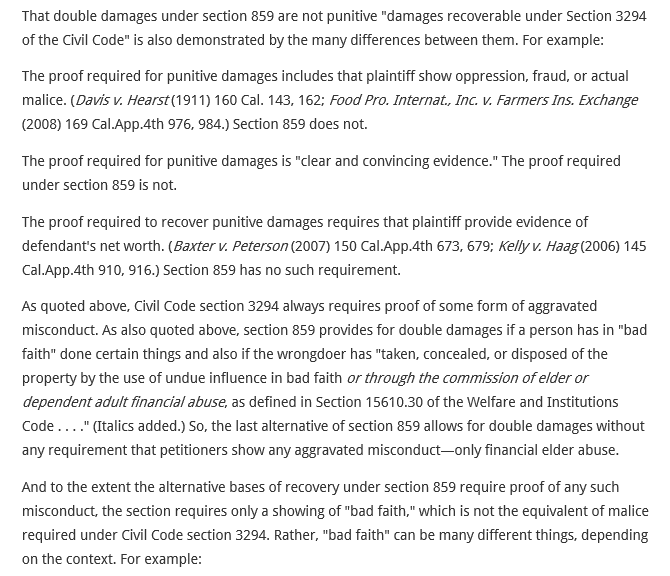
And the following is a snapshot of a relevant part of the opinion of the court in Hill v. Superior Court (Staggers):

Hill v Superior Court section 859 double damages are not punitive

.

Ombudsman Services San Mateo County – A Snapshot Of Great Accomplishments

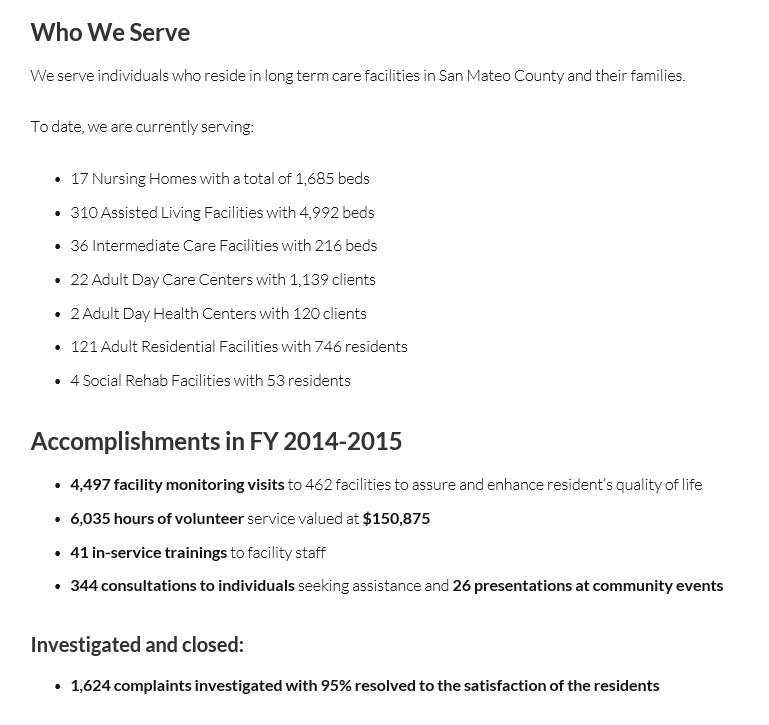
The following are two snapshots of the accomplishments of Ombudsman Services of San Mateo County. As you might be aware, Ombudsman services are mandated by law to advocate on behalf of better and proper care of residents at care facilities, to work to improve the care provided by the facility, to investigate situations and improper care, and report improper care and abuse. The following are two snapshots of activities from Ombudsman Services of San Mateo County, which is an active advocate on behalf of care facility residents – and you can view their website at the following link CLICK HERE

2016-02-18_9-37-57

2016-02-18_9-38-43