New Case – Double Damages Under Probate Code Section 859 Are Not Punitive – Why This Is Important

A new California case has held that the ability to recover 2x damages under California Probate Code section 859 does not constitute punitive damages. The case is Hill v. Superior Court (Staggers), California Court of Appeal, First Appellate District, No.A145893, decided February 18, 2016.

Without getting into a long legal discussion, why is Hill v. Superior Court (Staggers) important? Claims under California Probate Code sections 850, et seq., have become common and important. In summary, sections 850, et seq., allow certain legal claims in trust, estate (probate), conservatorship and guardian proceedings when money, personal property or real property is claimed to be due to or from an estate or trust. Sections 850, et seq., also may allow the prevailing party who wins on a claim that he or she is entitled to recover the property to recover twice the amount of the value of the property that is recovered.

In Hill v. Superior Court (Staggers) the losing party, against whom double damages were awarded, argued that double damages under Probate Code section 859 are in the nature of punitive damages, which would require the prevailing party to prove entitlement to recovery of the double damages under a higher standard (i.e., for example, by having to establish malice, oppression, fraud, etc., before being entitled to the recovery of double damages.

The Court of Appeal held that the double damages allowable under section 859 are in the nature of a penalty (upon a showing of bad faith), but are not punitive damages. The result, which is very important in these cases, is that it is easier to recover the section 859 double damages. These provisions need to be carefully considered in all Probate Code section 850, et seq., actions, including for the purpose of settlement and trial as the possibility of an award of double damages can significantly change the dynamics of a case. A claim of recovery under sections 850, et seq., might be possible in a wide variety of trust, estate (probate), conservatorship, guardianship and elder and dependent adult abuse cases.

The following is the wording of California Probate Code section 859 (which also contains a provision for the possible recovery of attorneys’ fees):

859.  If a court finds that a person has in bad faith wrongfully taken, concealed, or disposed of property belonging to a conservatee, a minor, an elder, a dependent adult, a trust, or the estate of a decedent, or has taken, concealed, or disposed of the property by the use of undue influence in bad faith or through the commission of elder or dependent adult financial abuse, as defined in Section 15610.30 of the Welfare and Institutions Code, the person shall be liable for twice the value of the property recovered by an action under this part. In addition, except as otherwise required by law, including Section 15657.5 of the Welfare and Institutions Code, the person may, in the court’s discretion, be liable for reasonable attorney’s fees and costs. The remedies provided in this section shall be in addition to any other remedies available in law to a person authorized to bring an action pursuant to this part.

And the following is a snapshot of a relevant part of the opinion of the court in Hill v. Superior Court (Staggers):
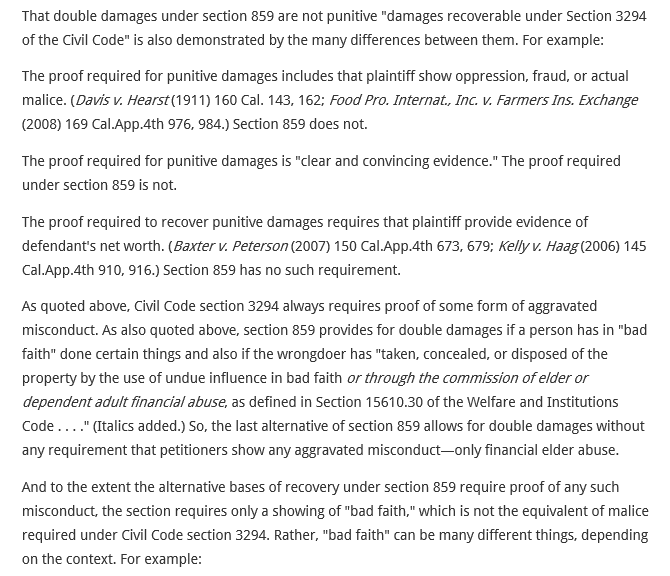
Hill v Superior Court section 859 double damages are not punitive

.

Our Elder and Dependent Adult Abuse Prevention and Remedies Are Ridiculously Inadequate and Archaic – Insufficient Resources and Boots on the Ground, and No Collaboration

Let’s talk more about elder and dependent adult abuse and protection, and why we are failing in California. Prevention and remedies are ridiculously inadequate and archaic, particularly taking into account the numbers of cases of abuse.

I first started bringing elder and dependent adult abuse cases in 1993. My cases were primarily for physical, care, mental, undue influence, duress, fraud, financial, theft, real property, trust, and will abuse. I have to say that the more that things change they also stay the same. The same types of abuse still occur, and they always will. The cases were difficult then, and they still are. These cases take time and expertise. There is often difficulty obtaining evidence. And defendants really fight these cases, always arguing that nothing wrongful occurred, that the victim rightfully knew what they were doing and of their own free will, and in physical abuse cases that the injury naturally occurred due to the victim’s naturally poor condition. In other words, everything was known and on the up-and-up. Defendants in these cases count on the prospect that you will have difficulty proving the case, and that you will go away eventually for lack of resources and time. Nothing has really changed.

We should ask, what resources are available to fight elder and dependent adult abuse?  The first line of prevention and defense includes good people who are family, friends, professionals such as doctors, bankers, caregivers, accountants and financial advisors, and sometimes other third parties. Will these people recognize the possible or actual abuse, and then also take action? Do they even know what action might be possible and who to contact?  If so, most likely only to a certain limited extent.

The next line of defense probably includes law enforcement, adult protective services and the district attorney. Most likely these people only get involved because someone in the first line of defense has contacted them. I have previously discussed the inadequacy of the second line of defense – they simply do not have the time and people power and resources to handle the numbers of possible or actual abuse cases, or to stick with the cases long-term. They can pick some cases to attempt to handle.

I would say that the third line of defense includes the private attorneys. There are resources in this category that are under utilized, at least in part because people in the first category don’t know who to contact, people in the second category don’t know who to contact and aren’t authorized to contact or won’t contact people in the third line of defense, and it is also true that private attorneys also have resources and abilities that are not unlimited and each case must also be evaluated.

Improvements can be made to the situations described above. In particular, problems and issues relating to people in the first category, the first line of prevention and defense, can be improved by getting the information out so that they can better spot abuse or possible abuse and take action. Problems and issues relating to people in the second category, the second line of defense, can be improved with additional funding or monetary resources, and by having people in the second line of defense refer people or cases to the private attorneys in the third category or third line of defense.  And efforts can be made to further educate attorneys in the third line of defense about the procedures, causes of action, and remedies that are available to them. Similarly, additional effort needs to be made to educate the courts, judges, and other legal system professionals about types of abuse, evidence that abuse has occurred, and the procedures, causes of action and remedies available.

And let me discuss one additional program, the ombudsman program, which every county in California is supposed to have, and the members/volunteers of which go into the nursing homes (SNF) and residential care facilities (RCFE) and similar entities to check on the care provided and advocate on behalf of the residents. I’m a board member of Ombudsman Services of San Mateo County, California. This is a tremendous nonprofit organization. They do great work. Ombudsman Services organizations do vary from county to county – they are run different, they have different funding, they have different numbers of volunteers, they have different training, they have different decision-making processes, and some are county-run whereas other’s are separate nonprofit entities, etc. Here is a link to Ombudsman Services of San Mateo County, http://ossmc.org/. I ask that you also donate to them if you wish.

That’s all for now. These cases really haven’t changed for over 20 years, in my experience. You might hear a commercial about reporting elder abuse, and those commercials are important, but it is really about having numbers of boots on the ground that make a difference. If the boots and referrals aren’t there, nothing will be done or remedied, and it goes on and on.

Dave Tate, Esq., San Francisco and throughout California, http://californiaestatetrust.com


Is Your Trust, Estate, Power Of Attorney, Conservatorship, Or Care Situation Contentious?

Are there disagreements and disputes in your trust, estate, power of attorney, conservatorship or care situation? That’s not unusual. In fact, based on my experience, I would have to say that it’s pretty common. But it can also be a game changer.

Generally a fiduciary such as a trustee, executor or conservator, and sometimes an attorney in fact, should always hire an attorney when challenging or difficult issues or significant assets are involved. The question is whether one of the parties who is involved in the situation has, or needs to, or may, or likely will hire an attorney with a view toward litigation? That’s a game changer when that possibility might occur or actually does.

Trust, estate, conservatorship, power of attorney, care and elder abuse situations and litigation are complicated legal practice areas that typically can involve a lot of emotional feelings and mistrust, and that require the attorney to know multiple areas of law and court procedure.

If you are a fiduciary such as a trustee, executor, conservator or attorney in fact you need to hire an attorney who can advise you properly about your responsibilities and on the administration of the trust, estate and assets, or on the care and daily living needs of the conservatee or person in need, with a view toward helping you to satisfy your responsibilities effectively and correctly, practicing prudent risk management and documentation, avoiding liability and litigation, and prevailing in court if the situation ends up in court.

If you are a beneficiary you need to hire an attorney who can steer you correctly to help you protect your rights and obtain the assets that were intended for you, and not waste your resources and the resources of the trust or of the estate, or possibly cause you to be surcharged for the attorneys’ fees of the other side, with a view toward prevailing in court if the situation ends up in court. If you are a beneficiary you also don’t want to unknowingly contest a trust or will or possibly disinherit yourself.

And if you are a trustor who is no longer trustee, or a principal under a power of attorney, or a conservatee, you need to feel and know that your physical, mental and financial needs and rights are correctly and timely cared for and protected, and you might also need to be represented by legal counsel. In fact, if the situation ends up in court, in some situations, such as in a conservatorship, you have an absolute right to be represented by an attorney, and in other situations the court should and will on its own appoint legal counsel to represent and advocate for you.

For additional information, the following is a link to my summary paper discussing trustee and beneficiary responsibilities and rights, and you can also find helpful information about other situations on other posts on this blog, CLICK HERE

Contact me if you would like to discuss your situation. You can contact me by sending me an email at davetateesq@gmail.com. Before we discuss your situation I will need to know the names of the people and attorneys involved to check for any possible conflicts.

Wishing you the very best,

Dave Tate, Esq., San Francisco and throughout California

DTatePicture_Square

From Trusts & Estates – Safeguarding Trusts from Future Ex-Spouse – Also Good Marketing for Estate Planning Attorneys

Trusts & Estates article Safeguard Trusts from Future Ex-Spouse of Beneficiary

This is a very interesting article from Trusts & Estates that I almost overlooked. It isn’t the Massachusetts case discussion that interests me, it is that I never hear estate planning attorneys discussing these topics and using these topics to tell people additional reasons why they might need a trust and how trusts can be used, and to differentiate one estate planning attorney’s services from another. Click on the following link for the article, CLICK HERE

Dave Tate, Esq., civil (business, real estate, injury), trust, estate, conservatorship and elder abuse litigation and contentious administrations, representing fiduciaries, beneficiaries and family members, San Francisco and throughout California. See also my other blog for audit committees, http://auditcommitteeupdate.com

See Discussion Paper – A Summary of California Trustee and Beneficiary Responsibilities and Rights

Whether you are a trustee/fiduciary or a beneficiary, click on the following link for my summary paper discussing California trustee and beneficiary responsibilities and rights, A Summary of California Trustee and Beneficiary Responsibilities and Rights Dave Tate Esq 01052016

Dave Tate, Esq. San Francisco and throughout California – trust, estate, conservatorship and elder and dependent adult abuse litigation and contentious administrations; civil business, real estate and personal injury litigation; audit committees, D&O, risk, compliance and investigations. My other blog, http://auditcommitteeupdate.com

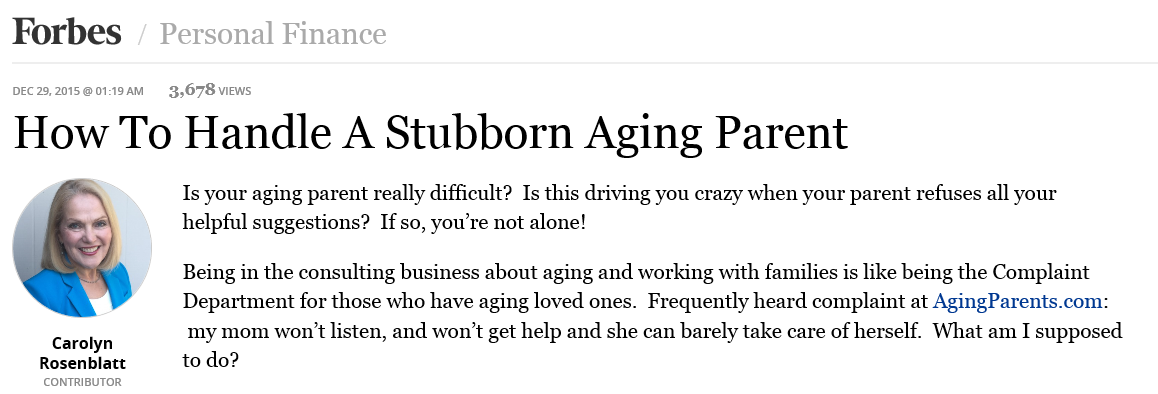
How To Handle A Stubborn Aging Parent – forwarding Carolyn Rosenblatt article

Here’s a worthwhile and encouraging post by Carolyn Rosenblatt – it’s not uncommon for an aging parent to need help, but legitimately they also want their independence. It can be difficult to reach a happy compromise. Click here for Carolyn’s article on Forbes.

Carolyn Rosenblatt article How to Handle a Stubborn Aging Parent

Dave Tate, Esq., civil (business, real estate, D&O and personal injury) and trust, estate, conservatorship and elder and dependent adult abuse litigation, San Francisco and throughout California.

Elder Abusers Use The Legal System Also

You might be surprised that elder abusers aren’t necessarily worried or scared of the legal system.

In my experience, most abusers as a personality trait believe that they can get away with the abuse because they believe that other people are stupid, or that they simply won’t be caught, or that other people won’t make the effort or don’t have the time and resources to stop them.

You might also be surprised to know that elder abusers use or try to use the legal system to help them commit the abuse. Here are a few of the ways that I have seen.

-The abuser calls the police and complains that other people, the good people, are abusing, or mistreating, stealing from, or unduly influencing the elder. The abuser tries to turn the tables on the good people so that the abuser can then have the elder victim alone.

-Similarly, the abuser calls adult protective services and complains that the good people are mistreating or stealing from the elder.

-Another example, the abuser obtains an attorney who will draft a will, or trust, or power of attorney for the elder naming the abuser, and the attorney does not understand or sufficiently care about his or her ethical and legal obligations to the elder who is the attorney’s client.

-Or the abuser files a contest of the elder’s will or trust documents.

-Except in situations of immediate theft, typically the abuser works at this for a continuous period of time taking small steps forward, influencing the elder against the good people and eventually getting the assets, documents or evidence that help the abuser.

And in another example, the abuser promises the elder victim something that the elder wants, something that will make the elder happy, such as . . . “if you sign the power of attorney I will be able to take you home,” even when it’s clear that medically or for daily care the elder should stay in the nursing home.

The list goes on. These are cases that are difficult and time consuming, and can be expensive to prosecute – it takes good people to take action.

* * * * *


San Mateo County’s New Elder and Dependent Adult Protection Team – The Good and the Insufficient

You may have heard that the San Mateo County Board of Supervisors this month passed a resolution funding the Elder and Dependent Adult Protection Team “EDAPT” (also sometimes known as or similar to “FAST” or “Financial Abuse Specialist Team” in other counties such as Los Angeles) for two years from the County’s Measure A funding. The initiative is funded with approximately $3.13 million taxpayer dollars over two years with the funding to begin July 1, 2015 and will run through June 2017. Click here for the link. The comments in this blog are my own. As you may know, I have handled trust, estate, conservatorship and elder abuse litigation cases for over 20 years. I have become a bit more expressive or activist in my comments. These comments are not criticisms of anyone who is trying to combat elder and dependent adult abuse. But the fact is that resources are inadequate to identify and then to stop and remedy abuse. And although resources will always be inadequate, one resource, private attorneys, is entirely or almost entirely unutilized in this battle. Until entities that receive reports of abuse arrange for a procedure to refer cases to private attorneys there is absolutely no way that those agencies, including Adult Protective Services (APS), the District Attorney, the police, county counsel, etc. can come close to protecting the abused and remedying the damages that they suffer. In fact, the link above seems to indicate that the new EDAPT initiative is primarily a community educational program, which does not involve legal or court system remedies.

Let me provide you with a quick example that should help to explain the situation and the grossly inadequate resources. The Link above states “Research shows that for every one case of older adult abuse [note that this apparently does not include dependent adult abuse] that is reported – there are another 24 that go unreported.”  The link also states “Reports of older adult abuse have been on the rise as the county’s older adult population continues to grow – which is estimated to grow by over 70% by 2030.” I don’t know how many incidents of abuse Adult Protective Services receives in an average month in San Mateo County – maybe one of my readers will respond with the average monthly number. Let’s just say that in an average month APS receives 30 reports of elder or older adult abuse (again, we are not even counting the additional cases of dependent adult abuse reporting). I suspect that the reports exceed 30 per month; however, if research indicates that for every report of older abuse there are another 24 that go unreported, that would be 30 x 25, or 750 incidents of adult abuse in an average month. Do you know how much time and effort it takes to stop and then remedy just one case of elder abuse through the court system? Well . . . that number does vary from case to case, but I can tell you that based on my experience in my cases, the number of hours is huge and the time (i.e., months or even years) that it can take also can be staggering. I can also fully confirm that abusers actively fight legal actions that are brought against them. They know or believe that resources are limited and inadequate, and that they might stand a reasonable chance of beating the system.

The new initiative is for two years, at an average funding of roughly $1.5 million per year. The funding started July 1, 2015, so we already have 3 months done in the first year of the initiative. I have been looking for a detailed two-year plan for the initiative – perhaps one of my readers can tell me where I can find that plan. I have written and videoed about this topic before, and the inadequate resources. Again, I fully support the efforts of everyone who is fighting elder and dependent adult abuse, but let me say that resources are inadequate, and you really, really need to bring vetted private attorneys into the effort through referrals or by whatever means makes the report receiving agencies (i.e., APS, etc.) comfortable.

Best, Dave Tate, Esq. (and licensed inactive CPA), San Mateo County, San Francisco Bay Area, and throughout California

Elder Abuse In Australia On The Rise – Government Makes A $100 Million Pledge

Click on the following link for an article out of Australia, elder abuse is domestic violence and is on the rise – the government makes a $100 million pledge: Click Here For The Article

AU Elder Abuse Article

Blog Stats. Chart – Oct. 2015: 1,000 Views/700 Visitors – 2015: 9,000 Views/6,000 Visitors

Blog Stats. - Oct. 2015