A party filing a petition in probate to enforce a no contest clause triggers the anti-SLAPP statute

David Tate, Esq., Royse Law Firm, California (Silicon Valley/Menlo Park Office, with additional offices in San Francisco, Los Angeles and Orange County), http://rroyselaw.com/

The following is a brief discussion about a new California case in which the court held that a party filing a petition in probate to enforce a no contest clause triggers the anti-SLAPP statute. If you have never been involved in the anti-SLAPP statute, it is a big deal. The case is Urick v. Urick, California Court of Appeal, Second Appellate District, Case No. B278257 (October 5, 2017).

Summary. Filing a petition for instructions in probate, claiming that a trustee or beneficiary had triggered a no contest clause by filing her prior petition to reform or modify a trust, is a claim that triggers prong one of the California anti-SLAPP statute Cal. Code Civ. Proc. §425.16, which means that the party seeking to claim and enforce that the no contest clause was triggered must be prepared to satisfy prong two of the anti-SLAPP statute which requires him to sufficiently establish a reasonable possibility of prevailing on the claim that the no contest clause was triggered and violated.

Takeaway. If you bring a claim to enforce a no contest clause based on an opposing party’s prior petition filed in probate, you must be prepared at the time of your filing to establish to the court, based on evidence and declarations, that you have a reasonable possibility of prevailing on your claim that the other party had triggered and violated the no contest clause.

Urick is also interesting for the court’s discussion whether the previously filed petition to reform or modify the trust triggered the no contest clause, including the discussion whether that previously filed petition was filed by the petitioner as a beneficiary of the trust or as the trustee of the trust and whether there was really a distinction that mattered under the facts of the case.

Other thoughts about the anti-SLAPP statute. I have been involved in Cal. Code Civ. Proc. §425.16 motions. It is my opinion that it is a deeply flawed statute except possibly in really obvious and clear situations and in those cases the party who has those defenses has other remedies such as a demurrer, motion to strike, or motion for summary judgment or summary adjudication. The anti-SLAPP statute should be revoked or very significantly amended and limited. To add further injury, the filing of an anti-SLAPP motion automatically stays all discovery unless a motion to allow and compel discovery is brought and the court grants that motion – thus, strategically a party might bring an anti-SLAPP motion simply to see if they can prevail even if their arguments and chances of prevailing are not good – and the statute further provides that if a party prevails on an anti-SLAPP motion they are entitled to attorneys’ fees whereas if a party defeats an anti-SLAPP motion the statute does not provide that they are entitled to recover attorneys’ fees. The anti-SLAPP statute is ripe for abuse or use in situations that might be counter to other public or judicial policies, which the court in Urick appeared to recognize, but as the court noted, nevertheless the statute is still on the books and is applicable unless and until the Legislature does something about the statute.

* * * * * * *

New FinCEN and Consumer Financial Protection Bureau Memo re Efforts to Combat Elder Financial Exploitation

At the bottom of this post you will find a link to a new Financial Crimes Enforcement Network (FinCEN) and Consumer Financial Protection Bureau memorandum about efforts to combat elder financial exploitation, which the memo identifies as the illegal or improper use of an older person’s funds, property or assets. And I have also included additional links below. As the memo notes, “Financial institutions can play a key role in detecting, responding to, and preventing EFE [Elder Financial Exploitation]. The memo also encourages collaboration between financial institutions, law enforcement and APS [Adult Protective Services]. This is a topic that I have handled in many actual cases, and about which I have given presentations and written blog posts. I have also seen a recent article discussing the rather large percentage of incidents in which physical elder abuse is not reported by medical facilities such as hospitals.

It has long been my view that the collaboration effort must also include private attorneys, for the simple reason that law enforcement and APS simply do not have the resources to handle the numbers of cases, or how long it takes to prosecute them to obtain recovery. Reporting is one thing, prosecuting the cases is an entirely different matter. Law enforcement and APS are not staffed to obtain recovery through the court system. The district attorney and attorney general are staffed to prosecute these cases through the court system, but again, the resources available are inadequate. These cases can involve complicated legal and evidentiary issues including mental capacity, undue influence, dependence, consent, fiduciary and other duties, burden of proof, etc.

In addition to the below link to the FinCEN/Financial Protection Bureau memorandum, I have also provided below a few links to some of my prior posts on this topic and elder abuse.

Best regards, David Tate, Esq., Royse Law Firm, Menlo Park office, http://rroyselaw.com/

Click to access 201708_cfpb-treasury-fincen_memo_elder-financial-exploitation.pdf

Elder Abusers Use The Legal System Also – Video http://wp.me/p1wbl8-jp

Elder and Dependent Adult Resources are Ridiculously Inadequate and Archaic http://wp.me/p1wbl8-cV

Elder Abuse and Protection Slides 2015 http://wp.me/p1wbl8-dm

Counties Need to Refer Elder Abuse Cases to Private Attorneys – Video http://wp.me/p1wbl8-ke

Everyday is elder abuse prevent day – cartoon video http://wp.me/p1wbl8-lE

Everyday is elder abuse prevention day – video cartoon – please pass it along

Here’s a different presentation approach – please do pass it along to your contacts and people who would be interested. This is an important topic that needs more discussion. Thank you. Dave Tate, Esq. (San Francisco and California)

Can You Stop An Aging Parent From Self-Neglect At Home – by Carolyn Rosenblatt

The following is a good discussion by Carolyn Rosenblatt, on a topic that is ongoing for many, many families – can you stop an aging parent from self-neglect at home? The link to Carolyn’s article is provided below.

When is it self-neglect or self-abuse, and what can or do you do about it?

Unless you have the cooperation of the parent (and other family members), and the needed financial, insurance coverage, and time resources, and know who to contact, the issues are even more difficult to resolve. I see many family members who are dealing with these issues in trust, power of attorney, and conservatorship situations. What are the responsibilities/duties and rights, and what options are available and can be achieved? I am also aware of one California case involving a finding of elder abuse in a situation where family members did not take action to try to remedy the situation.

These issues are or can be difficult even with cooperation and resources. To see Carolyn’s article, CLICK HERE.

Dave Tate, Esq. San Francisco and California

I’m Getting Back To Using Video – A Video About My Practice Areas

Greetings all. I am getting back to using video more often, and another new initiative which I will be telling you about shortly. Moving forward I am trying to do one video a week, and then the other posts will be in writing.  I have done a quick video about my practice areas. Enjoy and tell others. Thanks. Dave Tate, Esq., San Francisco / California, (415) 917-4030.

New Case – How Far Can A Court Go To Interpret A Trust – Ammerman v. Callender

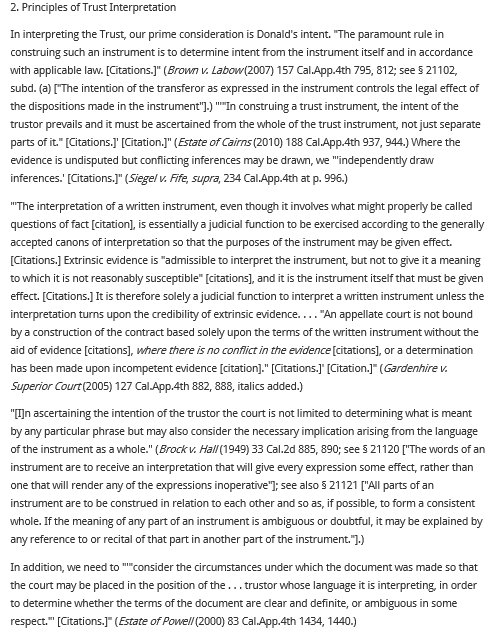
In Ammerman v. Callender (March 24, 2016, Case No. G049880) the California Court of Appeal for the Fourth Appellate District was called upon to determine the extent to which the lower trial court could interpret the intent of the trustor and to change the terms of the trust to be in accord with the intent that the trial court determined. Below I have pasted relevant wording from the Appellate Court discussing the principles of the court’s ability to interpret the trust.

You should note that this is an appellate level court decision, other California appellate courts have issued decisions that are not necessarily entirely in accord, California Supreme Court decisions may differ and overrule this decision, and in significant regard, even when reading the below posted language, how far to interpret the trustor’s intent and the extent to which the introduction of extrinsic evidence will be allowed to express the trustor’s intent remain at the discretion of the trial judge.

Two principles do appear certain, (1) it is the intent of the trustor that should prevail, and (2) the court cannot rewrite the terms of the trust unless there is sufficient evidence, based on the wording of the trust or based on extrinsic evidence, or based on both, that the wording of the language in the trust is in conflict, or is ambiguous, or fails to address the present situation, or in some manner fails to express the trustor’s intent, and even in those circumstances the court cannot simply go ahead and rewrite the terms unless the evidence taken as a whole indicates that the trustor so intended the new terms.

It would logically also seem that the more radical the new or different terms are from the current terms of the trust, the greater the evidence would need to be that the trustor really, truly did intend the application of the new or different terms. Further, I continue to disagree with these being judge-determined cases – a jury trial should be available for the interpretation of intent and extrinsic evidence.

Below, at the bottom of this blog post, I have pasted relevant wording from the decision discussing principles of trust interpretation.

Dave Tate, Esq., San Francisco and California, tel.: (415) 917-4030, http://tateattorney.com, http://californiaestatetrust.com, http://auditcommitteeupdate.com, trust, estate, probate, real estate, conservatorship, power of attorney, elder and dependent adult, and business litigation; administrations guiding fiduciaries and beneficiaries; audit committees and D&O.

DTatePicture_Square

The following is relevant wording from the decision in Ammerman v. Callender.

Ammerman v. Callender Principles of Trust Interpretation

New Case – Hospital That Was Systematically Understaffed Supported Cause Of Action For Elder Abuse – Fenimore V. Regents Of The University Of California

This is an important new case, but you do need to read the facts and opinion carefully to determine whether your situation fits. Here is a pdf of the opinion Fenimore v. The Regents of the University of California.

It is arguable that this opinion expands the situations where an elder abuse claim can be stated.

For more than 20 years there has been a tug-of-war between ordinary negligence including medical or care malpractice on the one hand and elder abuse on the other hand. And that tension will continue; however, very slowly the courts are more often holding that elder abuse can be alleged in a medical or care situation where there are systemic deficiencies such as, for example, lack of staffing and inadequate training, particularly where those deficiencies violate a statutory duty, requirement or standard of care.

As the underlying opinion in Fenimore applies in the circumstance of systemic violation of a statutory duty, arguably this case, as it applies to elder abuse, could be cited in a whole host of care and other situations including but not limited to nursing homes, RCFE/assisted living, fiduciary care duties, fiduciary financial duties, and more.

Dave Tate, Esq. San Francisco and California – civil real property and business, trust, estate, conservatorship, power of attorney and elder abuse litigation, and helping fiduciaries and beneficiaries in administrations. http://californiaestatetrust.com, and audit committees and D&O http://auditcommitteeupdate.com.

Broad Process Conservatee and Fiduciary/Conservator Decision Making

The California Fiduciaries Code of Ethics and the National Guardianship Association Standards of Practice provide requirements for professional fiduciaries, which are also helpful to guide non-professional fiduciaries. The following is a summary of the broad process for conservatee and fiduciary/conservator decision making in the Code of Ethics and the Standards of Practice – of course the Code of Ethics and the Standards of Practice contain much greater coverage of these topics and each situation much stand and be evaluated separately and by itself – the below discussion about informed consent, substituted judgment and best interest covers the broad process approach. I also find it interesting that I have never heard a discussion by a Court about this or a different process for conservatee and fiduciary or conservator decision making. Comparing this to board of director deliberations, perhaps this might, at least in small part, be analogized to the business judgment rule?

1. Informed Consent – The decision should first be made by informed consent if possible.

A person’s (the conservatee’s) agreement or decision to allow or to have something happen that is based on a full disclosure of facts needed to make the decision intelligently, i.e., knowledge of the risks involved, alternatives, etc.

In other words, the individual choice or decision by the conservatee, that the conservatee is capable of making, unless doing or allowing so would violate the fiduciary’s duties to the conservatee or impose unreasonable expense to the estate.

2. Substituted Judgment – Second, if informed consent cannot be obtained, the decision is made by substituted judgment if possible.

The principle of decision making that requires implementation of the course of action that comports with the individual person’s (the conservatee’s) known wishes expressed before incapacity, provided the conservatee was once capable of developing views relevant to the matter at issue and reliable evidence of those views remains.

In other words, the decision is made or action taken or not taken, by the fiduciary, based on the ascertained desires and wishes, if any, of the conservatee, as expressed or demonstrated by the conservatee while the conservatee had capacity to so express or demonstrate, relevant to the current subject matter at issue, unless doing or allowing so would violate the fiduciary’s duties to the conservatee or impose unreasonable expense to the estate.

3. Best Interest – If informed consent, first, and substituted judgment, second, are not available or possible, the decision is made based on best interest.

The course of action that maximizes what is best for a person (the conservatee) and that includes consideration of the least intrusive, most normalizing, and least restrictive course of action possible given the needs of the conservatee.

New Story – Charity requests an accounting after all assets are distributed – nothing left to pay for it

Here’s a new story that I heard about recently – it’s not one of my cases.

The decedent died and the successor trustee began administering the trust. The trustee then made prior partial distributions to all of the beneficiaries including the charity, none of whom objected or requested additional information or an accounting. Over time the trustee finished the administration of the trust and then distributed the remaining assets to the same beneficiaries. No assets remain in trust.

The charity beneficiary has now requested an accounting – not that they believe anything is wrong – they just want an accounting to be sure.

The trustee had a couple of options for how to make the final distribution: (1) do it as the trustee did; (2) get a waiver of accounting and information (and consent) from each beneficiary (see Cal. Probate Code sections 16060 through 16069), (3) prepare and provide an accounting to each beneficiary and obtain a waiver and consent; or (4) prepare an accounting and submit a petition to the court for an order approving the accounting.

Unless in some situations the trust provides otherwise, the statute of limitations on an action against a fiduciary trustee for breach of duty is three years, but also could be longer in cases where wrongful actions were hidden and it could not be expected that the beneficiary knew or should have known about the wrongful actions.

Each case is different, there isn’t one correct or absolutely wrong way to handle the above situation, but only (4) will (in most cases) clear the trustee from future actions and liability.

In the above situation the trustee now has to provide the requested accounting and information, but without the funds being available in the trust to pay for it. There might also be a possible need or requirement for beneficiary return of assets that have already been distributed – but that possibility also raises the issue whether return of assets can be compelled.

These situations require risk management, due diligence and evaluation of the various options available.


Investment Advisors – Having Your Client Agree To A Designated Helper For The Advisor To Contact

I have provided below a link to a discussion and a service by Carolyn Rosenblatt for investment advisors in situations where the mental capacity of an elder client might be questioned, and in situations of possible undue influence or elder abuse. As you might know, investment advisors have been encouraged to enact policies and processes for these situations. There might be additional legislation in this area later this year, or at least legislation relating to advisor fiduciary duty. Please click on the below link, and then also click on the additional link at the bottom of that page to view the 10 step video. These policies and processes are good ideas and are needed – and they might arguably also already be legally required under standard of care, prudent due diligence, and elder abuse reporting requirements.

As I have previously posted, however, the designated helper also will need to know an attorney that she or he can contact to remedy the situation through the court system. Reporting to adult protective services or the police in appropriate situations might or might not provide emergency relief, but APS and the police do not have the people, time, and expertise resources to pursue a case through the legal system. And here is a link to my elder abuse and protection presentation slides http://wp.me/p1wbl8-dm

Here is the link to Carolyn’s discussion

The Confidentiality Conundrum: Can You Call A Third Party When Your Client Shows Signs Of Dementia?

Thanks. Dave Tate, Esq., San Francisco and California