I have consolidated blogs – future posts on this topic will be made at http://tateattorney.com – thank you. David Tate, Esq.

I have consolidated blogs – future posts on this topic will be made to http://tateattorney.com. Please click on http://tateattorney.com

* * * *

Thank you for viewing this discussion. Please do pass this blog and blog post and information to other people who would be interested as it is only through collaboration and sharing that great things and success are more quickly achieved. If you are interested in discussing anything that I have said in the discussion above or in either of my two blogs (see blog addresses below), or if you simply want to reach out or are seeking assistance, it is best to reach me by email at dave@tateattorney.com.

David Tate, Esq. (and inactive CPA)

Trust, estate, probate, will, fiduciary and elder abuse disputes, litigation, trials and law – probate, trust, estate, will, power of attorney, elder abuse, real property and conservatorship disputes, conflicts and litigation, challenging and contentious administrations, and personalities, people and relationships, mental and physical health, limitations and capacity, undue influence and fraud; and and mediator services.

Business litigation and internal business and co-ownership disputes, litigation, trials and law, and contentious officer, director, board and audit and governance committee, D&O, conflict of interest, workplace, and governance disputes, conflicts and litigation; and mediator services. Legal authority, duties, rights, conflicts of interest, governance, diligence, compliance, legal risk management, and personalities, people and relationships; and mediator services.

Governance, law, legal risk management processes, compliance and success, audits and auditing, internal controls, executive officers, boards, directors, audit and governance committees, investigations, publicity rights, AI, defamation and First Amendment, legislation, statutes and laws, regulations, and headline news, and issue, people and relationship effective meetings, discussions and deliberations, debates and debating, communications, and wording and use of words.

Real property disputes, litigation, trials and law – primarily co-ownership and joint-ownership disputes, conflicts and litigation, and sales and purchases that go wrong, and mediator services.

Mediator and mediator and dispute resolution services (evaluative and facilitative).

  • Trust, estate, probate, conservatorship, elder and dependent abuse, etc.
  • Business, breach of contract/commercial, owner, shareholder, investor, etc.
  • D&O, board, audit and governance committee, accountant and CPA related.
  • Other: workplace and employment, environmental, trade secret.
  • Law and legal issues relating to authority, duties, rights, conflicts of interest, governance, diligence, compliance, risk management, disputes, evidence, liability, litigation, and mediation and resolution services.

Remember, every case and situation is different. It is important to obtain and evaluate all of the evidence that is available, and to apply that evidence to the applicable standards and laws. You do need to consult with an attorney and other professionals about your particular situation. This post is not a solicitation for legal or other services inside of or outside of California, and, of course, this post only is a summary of information that changes from time to time, and does not apply to any particular situation or to your specific situation. So . . . you cannot rely on this post for your situation or as legal or other professional advice or representation, or as or for my opinions and views on the subject matter.

Also note – sometimes I include links to or comments about materials from other organizations or people – if I do so, it is because I believe that the materials are worthwhile reading or viewing; however, that does not mean that I do not or that I might not have a different view about some or even all of the subject matter or materials, or that I necessarily agree with, or agree with everything about or relating to, that organization or person, or those materials or the subject matter.

Please also subscribe to this blog and my other blog (see below), and connect with me on LinkedIn and Twitter.

My two blogs are:

http://tateattorney.com – business, D&O, audit committee, governance, compliance, etc. – previously at http://auditcommitteeupdate.com

Trust, estate, conservatorship, elder and elder abuse, etc. litigation and contentious administrations http://californiaestatetrust.com

David Tate, Esq. (and inactive California CPA) – practicing only as an attorney in California.

Can a defense of a contested trust amendment trigger a no contest clause?

Can a defense of a contested trust amendment trigger a no contest clause? In Key v. Tyler the Court recently answered “yes” it may, depending on the facts and circumstances of the case (California Court of Appeal, 2nd District, Case No. B322246 (Filed 5/28/24)).

In Key v. Tyler the Trustors (Thomas and Elizabeth) executed their original Trust in 1999. The trust contained a no-contest clause which in part stated as follows:

“. . . if any devisee, legatee or beneficiary under this Trust, or any legal heir of the Trustors or person claiming under any of them directly or indirectly (a) contests either Trustor’s Will, this Trust, or any other trust created by a Trustor, or in any manner attacks or seeks to impair or invalidate any of their provisions,. . . then in that event Trustors specifically disinherit each such person, and all such legacies, bequests, devises, and interest given under this Trust to that person shall be forfeited as though he or she had predeceased the Trustors without issue, and shall augment proportionately the shares of the Trust Estate passing under this Trust to, or in trust for, such of the Trustors’ devisees, legatees and beneficiaries who have not participated in such acts or proceedings.”

The Trustors had three children: Tyler, Key, and a third sister who was not involved in the litigation.

In 2003 the Trustors subsequently executed an Amendment to the Trust – the 2003 Amendment was a one-page document that made some dispositive changes but did not restate or entirely change the provisions in the 1999 Trust – thus, the 1999 Trust remained relevant and applicable except as changed by the provisions in the one-page 2003 Amendment. The 2003 Amendment did not contain a no contest clause.

Husband Thomas subsequently died in 2003, and surviving spouse Elizabeth purportedly executed another Amendment in 2007. Pursuant to the Court “Tyler used her influence over Elizabeth to obtain the 2007 Amendment.” Beneficiary Key filed an action and successfully invalidated the 2007 Amendment on the ground that Tyler unduly influenced their mother into executing the 2007 Amendment. Against Key’s action Tyler defended the 2007 Amendments which differed from some of the provisions in the original 1999 Trust. Tyler also was a beneficiary under the 1999 Trust but would have inherited differently under the 2007 Amendment if that Amendment had not been invalidated.

Key v. Tyler is a long 20+ page Opinion which contains many relevant discussions on legal issues. However, I am writing about the Opinion here because of the discussion relating to the no contest clause in the 1999 Trust and the consequences of the litigation pertaining to the 2007 Amendment.

The Court held that Tyler’s defense of the 2007 Amendment was a contest of the 1999 Trust, and that Tyler not only did not recover under the 2007 Amendment which the Court invalidated, but also disinherited herself from what she would have recovered under the original 1999 Trust or under the 2003 Amendment pursuant to the broadly worded no contest clause that was contained in the earlier original 1999 Trust. In other words, as a result of losing on the 2007 Amendment, and there being a broadly worded no contest clause in the original 1999 Trust, Tyler lost everything and recovered nothing.

Takeaway: careful consideration needs to be given to the existence of no contest clauses contained in any and all possibly relevant trust and estate disposition instruments and documents, and to the specific wording of each possibly applicable no contest clause, as even defending a later in time subsequent instrument also may in appropriate circumstances trigger a no contest clause in an earlier instrument.

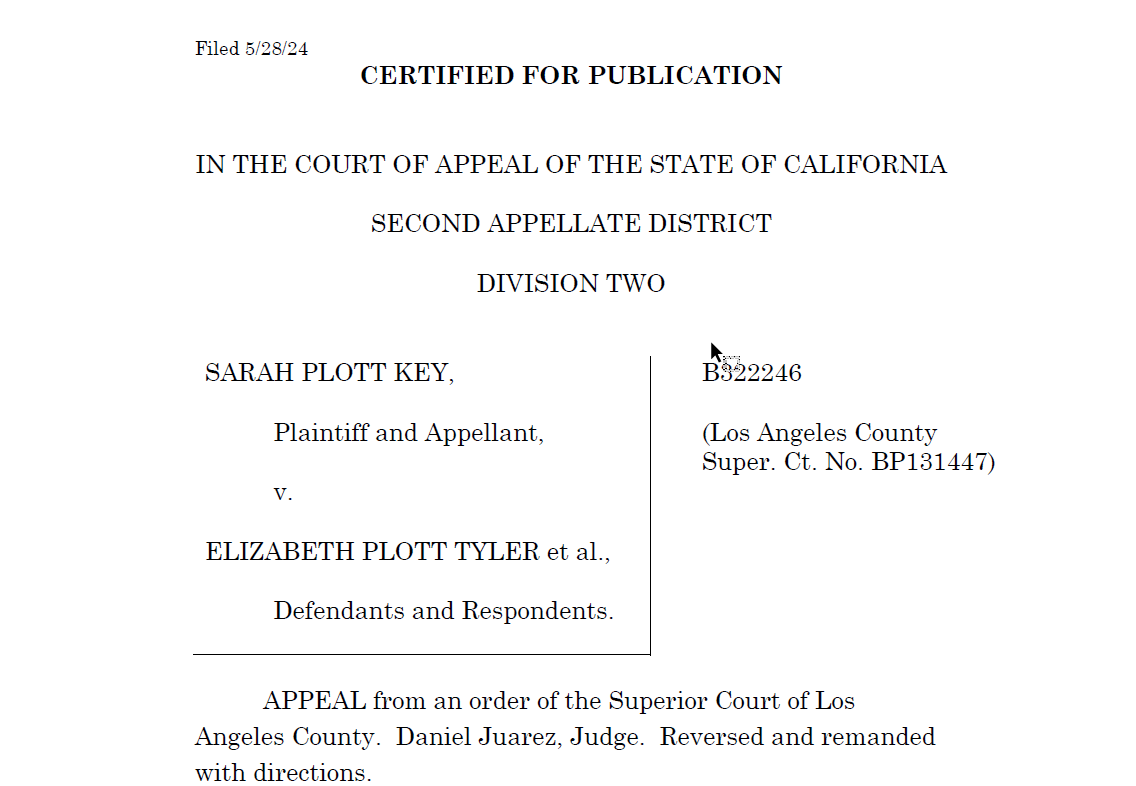
The following is a case caption scan from the Opinion in Key v. Tyler

* * * *

Thank you for viewing this discussion. Please do pass this blog and blog post and information to other people who would be interested as it is only through collaboration and sharing that great things and success are more quickly achieved. If you are interested in discussing anything that I have said in the discussion above or in either of my two blogs (see blog addresses below), or if you simply want to reach out or are seeking assistance, it is best to reach me by email at dave@tateattorney.com.

David Tate, Esq. (and inactive CPA)

Probate Court and administration related disputes and litigation – probate, trust, estate, will, power of attorney, elder abuse, real property and conservatorship disputes, conflicts and litigation, and challenging and contentious administrations, and personalities and relationships; and mediator services.

Business litigation and internal business and co-ownership disputes, and contentious officer, director, board and audit and governance committee, D&O, conflict of interest, workplace, and governance disputes, conflicts and litigation; and mediator services. Legal authority, duties, rights, conflicts of interest, governance, diligence, compliance, and risk Management.

Real property disputes and litigation – primarily co-ownership and joint-ownership disputes, conflicts and litigation, and sales and purchases that go wrong; and mediator services.

Mediator services and dispute resolution (evaluative and facilitative).

Trust, estate, probate, conservatorship, elder and dependent abuse, etc.

Business, breach of contract/commercial, owner, shareholder, investor, etc.

D&O, board, audit and governance committee, accountant and CPA related.

Other: workplace and employment, environmental, trade secret.

Law and legal issues relating to authority, duties, rights, conflicts of interest, governance, diligence, compliance, risk management, disputes, liability, litigation, and mediation and resolution services.

Remember, every case and situation is different. It is important to obtain and evaluate all of the evidence that is available, and to apply that evidence to the applicable standards and laws. You do need to consult with an attorney and other professionals about your particular situation. This post is not a solicitation for legal or other services inside of or outside of California, and, of course, this post only is a summary of information that changes from time to time, and does not apply to any particular situation or to your specific situation. So . . . you cannot rely on this post for your situation or as legal or other professional advice or representation, or as or for my opinions and views on the subject matter.

Also note – sometimes I include links to or comments about materials from other organizations or people – if I do so, it is because I believe that the materials are worthwhile reading or viewing; however, that does not mean that I do not or that I might not have a different view about some or even all of the subject matter or materials, or that I necessarily agree with, or agree with everything about or relating to, that organization or person, or those materials or the subject matter.

Please also subscribe to this blog and my other blog (see below), and connect with me on LinkedIn and Twitter.

My two blogs are:

http://tateattorney.com – business, D&O, audit committee, governance, compliance, etc. – previously at http://auditcommitteeupdate.com

Trust, estate, conservatorship, elder and elder abuse, etc. litigation and contentious administrations http://californiaestatetrust.com

David Tate, Esq. (and inactive California CPA) – practicing only as an attorney in California.

David W. Tate, Esq. – blog posts re the new California directed trust provisions

David W. Tate, Esq. – blog posts re the new California directed trust provisions.
From October 30, 2023 through February 27, 2024, I made several blog posts in which I
discussed the new California directed trust provisions. Below I have provided those posts in one
document for ease of reading, beginning with the first post on October 30, 2023, and ending with
the last two posts on February 27, 2024. There are a total of seven posts.
David Tate, Esq. (and inactive CPA) Email: dave@tateattorney.com
Note: I have joined the McDowall Cotter law firm (San Mateo, California) https://www.mcdlawyers.net/

My practice primarily includes the following:

Probate Court related disputes and litigation – probate, trust, estate, will, power of attorney, elder abuse, real property and conservatorship disputes, conflicts and litigation, and challenging and contentious administrations.

Business disputes and litigation – primarily breach of contract litigation, internal co-ownership disputes, and contentious officer, director, board committee, conflict of interest, workplace, and governance disputes, conflicts, and litigation.

Real property disputes and litigation – primarily co-ownership and joint-ownership disputes, conflicts and litigation, and sales and purchases that go wrong.

Mediator services.

The following are my seven, recent California directed trust posts:

Remember, every case and situation is different. It is important to obtain and evaluate all of the evidence that is available, and to apply that evidence to the applicable standards and laws. You do need to consult with an attorney and other professionals about your particular situation. This post is not a solicitation for legal or other services inside of or outside of California, and, of course, this post only is a summary of information that changes from time to time, and does not apply to any particular situation or to your specific situation. So . . . you cannot rely on this post for your situation or as legal or other professional advice or representation, or as or for my opinions and views on the subject matter.

Also note – sometimes I include links to or comments about materials from other organizations or people – if I do so, it is because I believe that the materials are worthwhile reading or viewing; however, that does not mean that I do not or that I might not have a different view about some or even all of the subject matter or materials, or that I necessarily agree with, or agree with everything about or relating to, that organization or person, or those materials or the subject matter.

* * * * *

California probate case holds that free room and board are “remuneration” for the presumption of fraud or undue influence against a care custodian

By way of background, in relevant part California Probate Code sections 21380(a)(3) and (4) provide as follows (a full copy of section 21380 is provided at the end of this post):

“21380. Presumption of fraud or undue influence for certain enumerated transfers; burden of proof; costs and attorney’s fees

(a) A provision of an instrument making a donative transfer [e.g., such as a will, trust, transfer on death deed, etc.] to any of the following persons is presumed to be the product of fraud or undue influence:

* * * * *

(3) A care custodian of a transferor who is a dependent adult, but only if the instrument was executed during the period in which the care custodian provided services to the transferor, or within 90 days before or after that period.

(4) A care custodian who commenced a marriage, cohabitation, or domestic partnership with a transferor who is a dependent adult while providing services to that dependent adult, or within 90 days after those services were last provided to the dependent adult, if the donative transfer occurred, or the instrument was executed, less than six months after the marriage, cohabitation, or domestic partnership commenced.”

California Probate Code section 21362 defines the terms “Care custodian” and “health and social services” as follows:

“21362. “Care custodian” and “health and social services” defined

(a) “Care custodian” means a person who provides health or social services to a dependent adult, except that “care custodian” does not include a person who provided services without remuneration if the person had a personal relationship with the dependent adult (1) at least 90 days before providing those services, (2) at least six months before the dependent adult’s death, and (3) before the dependant adult was admitted to hospice care, if the dependent adult was admitted to hospice care. As used in this subdivision, “remuneration” does not include the donative transfer at issue under this chapter or the reimbursement of expenses.

(b) For the purposes of this section, “health and social services” means services provided to a dependent adult because of the person’s dependent condition, including, but not limited to, the administration of medicine, medical testing, wound care, assistance with hygiene, companionship, housekeeping, shopping, cooking, and assistance with finances.”

The recent case Robinson v. Gutierrez (December 26, 2023) 98 Cal. App. 5th 278 involved a situation in which the person who is alleged to have been a care custodian allegedly received free room and board for those services but received no direct payment or other other benefit. The Court was called upon in a case of first impression to determine whether free room and board in exchange for care services are “remuneration” for the purpose of Cal. Probate Code sections 21380 and 21362. The court held that “yes” they are.

The Court’s holding includes a many-page discussion about the legislative intent and also about the use of the word remuneration in other circumstances and in general. Thus, for example, as part of those discussions the Court stated:

“These definitions show that the terms “remuneration,” “pay,” and “compensation” can be interchangeable. As used in section 21362 “remuneration” refers to a form of compensation given in exchange for the provision of care services. The dictionary sources indicate that “remuneration” refers to compensation in the form of money or some other thing of equivalent value. Thus, on its face, the term includes compensation in the form of room and board or other noncash benefits in exchange for the provision of care services.”

Similarly, the Court also stated:

“But because “remuneration” as used in section 21362 can reasonably be read to encompass money, other types of benefits, or both, we turn to the statute’s legislative history and purposes to discern legislative intent. This review further convinces us that the Legislature in this instance intended that remuneration would include room and board given in exchange for care and social services.”

Why is Robinson v. Gutierrez important? The use of fraud and undue influence to obtain a person’s assets upon the person’s death are rampant. And these are challenging cases to bring because a primary witness, the decedent whose assets are at issue, is deceased. Burdens of proof and presumptions are very important in these cases. Further, although the Court in Robinson v. Gutierrez was presented with a free room and board situation, the Court discussed the meaning of the term “remuneration” more broadly in the context of Cal. Probate Code sections 21380 and 21362. Thus, depending on the specific facts and circumstances that are at issue, it might be arguable that any number and manner of other of circumstances other than free room and board might also constitute “remuneration.”

For your additional information, the following is the full copy of Cal. Probate Code section 21380 (and see also the entirety of Cal. Probate Code sections 21380-21392):

“21380. Presumption of fraud or undue influence for certain enumerated transfers; burden of proof; costs and attorney’s fees

(a) A provision of an instrument making a donative transfer to any of the following persons is presumed to be the product of fraud or undue influence:

(1) The person who drafted the instrument.

(2) A person who transcribed the instrument or caused it to be transcribed and who was in a fiduciary relationship with the transferor when the instrument was transcribed.

(3) A care custodian of a transferor who is a dependent adult, but only if the instrument was executed during the period in which the care custodian provided services to the transferor, or within 90 days before or after that period.

(4) A care custodian who commenced a marriage, cohabitation, or domestic partnership with a transferor who is a dependent adult while providing services to that dependent adult, or within 90 days after those services were last provided to the dependent adult, if the donative transfer occurred, or the instrument was executed, less than six months after the marriage, cohabitation, or domestic partnership commenced.

(5) A person who is related by blood or affinity, within the third degree, to any person described in paragraphs (1) to (3), inclusive.

(6) A cohabitant or employee of any person described in paragraphs (1) to (3), inclusive.

(7) A partner, shareholder, or employee of a law firm in which a person described in paragraph (1) or (2) has an ownership interest.

(b) The presumption created by this section is a presumption affecting the burden of proof. The presumption may be rebutted by proving, by clear and convincing evidence, that the donative transfer was not the product of fraud or undue influence.

(c) Notwithstanding subdivision (b), with respect to a donative transfer to the person who drafted the donative instrument, or to a person who is related to, or associated with, the drafter as described in paragraph (5), (6), or (7) of subdivision (a), the presumption created by this section is conclusive.

(d) If a beneficiary is unsuccessful in rebutting the presumption, the beneficiary shall bear all costs of the proceeding, including reasonable attorney’s fees.”

* * * *

Thank you for viewing this discussion. Please do pass this blog and blog post and information to other people who would be interested as it is only through collaboration and sharing that great things and success are more quickly achieved. If you are interested in discussing anything that I have said in the discussion above or in either of my two blogs (see blog addresses below), or if you simply want to reach out or are seeking assistance, it is best to reach me by email at dave@tateattorney.com.

David Tate, Esq. (and inactive CPA)

  • Business litigation and disputes – business, breach of contract/commercial, co-owners, shareholders, investors, founders, workplace and employment, environmental, D&O, governance, boards and committees.
  • Trust, estate and probate court litigation and disputes – trust, estate, probate, elder and dependent abuse, conservatorship, POA, real property, mental health and care, mental capacity, undue influence, conflicts of interest, and contentious administrations.
  • Governance, boards, audit and governance committees, investigations, auditing, ESG, etc.
  • Mediator and facilitating dispute resolution (evaluative and facilitative):
    • Trust, estate, probate, conservatorship, elder and dependent abuse, etc.
    • Business, breach of contract/commercial, owner, shareholder, investor, etc.
    • D&O, board, audit and governance committee, accountant and CPA related.
    • Other: workplace and employment, environmental, trade secret.

Remember, every case and situation is different. It is important to obtain and evaluate all of the evidence that is available, and to apply that evidence to the applicable standards and laws. You do need to consult with an attorney and other professionals about your particular situation. This post is not a solicitation for legal or other services inside of or outside of California, and, of course, this post only is a summary of information that changes from time to time, and does not apply to any particular situation or to your specific situation. So . . . you cannot rely on this post for your situation or as legal or other professional advice or representation, or as or for my opinions and views on the subject matter.

Also note – sometimes I include links to or comments about materials from other organizations or people – if I do so, it is because I believe that the materials are worthwhile reading or viewing; however, that does not mean that I do not or that I might not have a different view about some or even all of the subject matter or materials, or that I necessarily agree with, or agree with everything about or relating to, that organization or person, or those materials or the subject matter.

Please also subscribe to this blog and my other blog (see below), and connect with me on LinkedIn, Facebook and Twitter.

My two blogs are:

http://tateattorney.com – business, D&O, audit committee, governance, compliance, etc. – previously at http://auditcommitteeupdate.com

Trust, estate, conservatorship, elder and elder abuse, etc. litigation and contentious administrations http://californiaestatetrust.com

David Tate, Esq. (and inactive California CPA) – practicing only as an attorney in California.

Elder Abuse Restraining Orders To Prevent Isolation And Financial Elder Abuse – California Assembly Bill No. 1243, and White v. Wear

Elder abuse restraining orders are in the California news. See my prior February 7, 2022, post discussing recently enacted California Assembly Bill No. 1243, New law expands legal standing in California to petition for a restraining order to stop and prevent elder and dependent adult isolation abuse at https://wordpress.com/post/californiaestatetrust.com/2385.

The following is a discussion about the March 8, 2022, restraining order decision in White v. Wear (March 8, 2022, E076352) ____ Cal. App. 5th ________, in which the court upheld an elder abuse restraining order that precluded the respondent from making or facilitating any change to the estate plan of her 94-year-old stepfather.

In White v. Wear the Court of Appeal held that the trial court did not abuse its discretion in entering a restraining order against a step child who tried to unduly influence her mother’s elderly husband to change his estate plan to benefit the mother and the step child. California has long had statutes prohibiting elder and dependent adult abuse – however, there still are relatively few court decisions that interpret or apply those statutes. In White v. Wear the Court discussed restraining orders under California Welfare and Institutions Code section 15657.03 under which a court may issue a restraining order to prevent threatened or actual physical and financial abuse of an elder or a dependent adult.

Quoting from White v. Wear, the following is additional overview from the Court’s Opinion:

“The parties to this appeal are no strangers to this court. This case is yet another skirmish in a long series of disagreements about the control of the multi-million-dollar estate[1] of nonagenarian[2] Thomas S. Tedesco.[3] Plaintiff and respondent Laura White is one of Thomas’s three biological daughters and a cotrustee of his living trust. (Conservatorship of Tedesco (Sept. 19, 2019, E070316) [nonpub. opn.] review denied Dec. 18, 2019, S258835 (Conservatorship, E070316).) Defendant and appellant Debra Wear aka Debbie Basara Wear is one of Thomas’s stepdaughters. In 2013, Thomas suffered serious health issues, which resulted in significant cognitive impairment, leaving him susceptible to being unduly influenced by anyone close to him. Gloria Tedesco, Thomas’s second wife, began denying White and her sisters access to their father, causing him to believe that they were stealing from him. Wear assisted Gloria, her mother, in unduly influencing Thomas via contacting, or facilitating access to, attorneys in order to change Thomas’s estate plan to disinherit his biological family in favor of Gloria and her family. Thus, on August 13, 2015, a permanent conservator of Thomas’s estate was appointed.

Despite the existence of the conservatorship, Wear continued to assist Gloria in taking actions to unduly influence Thomas to change his 30-plus-year estate plan. Consequently, upon White’s petition, the superior court issued an elder abuse restraining order (EARO), restraining Wear for three years from, among other things, financially abusing Thomas, contacting him (either directly or indirectly), facilitating any change to his estate plan, coming within 100 yards of him, and possessing any guns, other firearms, and ammunition. (Welf. & Inst. Code,[4] § 15657.03.) Wear contends the EARO is void because (1) the judge was disqualified and (2) he violated due process by substantially amending the allegations in the petition and prohibiting her from possessing firearms and ammunition. She further asserts the petition fails to state a cause of action for elder financial abuse. We agree the court erred in including a firearms and ammunition restriction in the EARO and direct the court to strike it. Otherwise, we affirm.[5]

Slowly, over time, California is adding additional teeth to its elder and dependent adult abuse statutes and cases, and to the toolbox that attorneys and other professionals can use to prevent and remedy elder and dependent adult abuse. If you scroll through this blog you will find other blog posts discussing conservatorships, elder and dependent adult abuse, mental and physical capacity and limitations, undue influence, litigation, mediation, and other related topics.

* * * * * * *

Best to you,

David Tate, Esq. (and inactive CPA)

  • Litigation, Disputes and Trials – Business, Contract/Commercial, Owner, and Founder; and Trust, Estate, Elder/Dependent Abuse, Conservatorships, POA, Real Property, Health and Care, Contentious Administrations, etc.
  • Mediator
  • D&O, Governance, Workplace, Boards, Committees, and Executives, Investigations, Internal Controls and Auditing, Law, Laws and Legislation, Responsibilities and Duties, Rights, Liability, and Damages, etc.

Remember, every case and situation is different. It is important to obtain and evaluate all of the evidence that is available, and to apply that evidence to the applicable standards and laws. You do need to consult with an attorney and other professionals about your particular situation. This post is not a solicitation for legal or other services inside of or outside of California, and, of course, this post only is a summary of information that changes from time to time, and does not apply to any particular situation or to your specific situation. So . . . you cannot rely on this post for your situation or as legal or other professional advice or representation.

Also note – sometimes I include links to or comments about materials from other organizations or people – if I do so, it is because I believe that the materials are worthwhile reading or viewing; however, that doesn’t mean that I don’t or might not have a different view about some or even all of the subject matter or materials, or that I necessarily agree with, or agree with everything about or relating to, that organization or person, or those materials or the subject matter.

Thank you for reading this post. I ask that you also pass it along to other people who would be interested as it is through collaboration that great things and success occur more quickly. And please also subscribe to this blog and my other blog (see below), and connect with me on LinkedIn and Twitter.

My two blogs are:

http://tateattorney.com – business, D&O, audit committee, governance, compliance, etc. – previously at http://auditcommitteeupdate.com

Trust, estate, conservatorship, elder and elder abuse, etc. litigation and contentious administrations http://californiaestatetrust.com

David Tate, Esq. (and inactive California CPA) – practicing as an attorney in California only.

New law expands legal standing in California to petition for a restraining order to stop and prevent elder and dependent adult isolation abuse

California Assembly Bill No. 1243, signed by Governor Newsom  on September 23, 2021, in relevant part expands the definition of an “interested party” who has legal standing to petition the court for a restraining order to enjoin (i.e., stop and prevent) elder and dependent adult isolation abuse. Assembly Bill No. 1243 is effective beginning January 1, 2023.

For the purpose of seeking the restraining order to enjoin (i.e., to stop and prevent) the isolation, pursuant to Assembly Bill No. 1243, beginning January 1, 2023 the term interested party will be expanded to include the following: “Interested party” means an individual with a personal, preexisting relationship with the elder or dependent adult. Thus, for example, if the requisite factual circumstances exist, friends and family members will now (beginning January 1, 2023) have legal standing to file a petition requesting the court to issue an order enjoining the wrongdoer from isolating the elder or dependent adult victim.

Elder and dependent adult cases present challenging legal issues relating to proof and remedies. And the elder or dependent adult victim can feel torn and pulled in different emotional and relationship directions. For example, situations are common where a wrongdoer is trying to unduly influence or take financial advantage of and to be alone with and isolate the elder or dependent adult victim so the wrongdoer can more easily badmouth others or take or steal or get the victim to change her or his estate planning documents, while good family members and friends are also trying to protect the elder or dependent adult and to keep the wrongdoer away. I have seen in these situations a wrongdoer who tries to use the law to help the wrongdoer to be able to continue to see and be with the elder or dependent adult victim including petitioning the court for an order to prevent the good people from keeping the wrongdoer away. And the victim is torn because she or he mistakenly believes the wrongdoer is actually a benevolent friend or family member.

Although California law does tend to extend legal standing in elder and dependent adult abuse cases more broadly than the laws in some other states (such as Florida, for example, where it is still too limited), even in California legal standing needs to be expanded to the greatest extent possible so that wrongdoers aren’t able to hide behind the law as a shield, and Assembly Bill No. 1243 will be helpful in that regard (beginning January 1, 2023). But, of course, this new provision would be even more helpful if it is made effective immediately.  

The following are select relevant wording provisions from Assembly Bill No. 1243:

THE PEOPLE OF THE STATE OF CALIFORNIA DO ENACT AS FOLLOWS:

SECTION 1.

(a) It is the intent of the Legislature to prevent domestic violence, including elder and dependent adult abuse, and particularly to preserve the physical and mental health of vulnerable Californians.

            * * * * *

(b) The Legislature finds and declares that one way perpetrators of domestic violence, including elder and dependent adult abuse, are able to continue with their abuse is by preventing trusted friends and family members from seeing or contacting a vulnerable adult. As the vulnerable adult is isolated, it becomes more and more difficult for others to identify signs of abuse. The isolation also allows the perpetrator to potentially take over finances and hide any indications that they are doing so.

            * * * * *

A court order is not required for an elder or dependent adult to engage in visitation from anyone from whom the elder or dependent adult desires visitation.

(c) The Legislature further finds and declares that it is extremely important that the health and well-being of a vulnerable adult be front and center in any decision affecting them.

(d) It is the intent of the Legislature that the changes made by this act ensure that vulnerable adults are able to protect and preserve their physical and mental health, by making certain that these vulnerable adults are able to maintain important familial and social connections that they desire, and that a perpetrator does not cut off those relationships in an attempt to take advantage of the vulnerable adult.

            * * * * *

SEC. 3.

Section 15657.03 is added to the Welfare and Institutions Code, to read:

15657.03.

 (a) (1) An elder or dependent adult who has suffered abuse, as defined in Section 15610.07, may seek protective orders as provided in this section.

(2) (A) A petition may be brought on behalf of an abused elder or dependent adult by a conservator or a trustee of the elder or dependent adult, an attorney-in-fact of an elder or dependent adult who acts within the authority of a power of attorney, a person appointed as a guardian ad litem for the elder or dependent adult, or other person legally authorized to seek the relief.

(B) (i) Subject to clause (ii), if the petition alleges abuse of an elder or dependent adult in the form of isolation, the term “other person legally authorized to seek the relief” as used in subparagraph (A) includes an interested party as defined in paragraph (3) of subdivision (b) [DTate: see below].

(ii) Clause (i) shall apply only for the purpose of seeking an order enjoining isolation under subparagraph (E) of paragraph (5) of subdivision (b).

            * * * * *

(b) For purposes of this section:

(1) “Abuse” has the meaning set forth in Section 15610.07.

(2) “Conservator” means the legally appointed conservator of the person or estate of the petitioner, or both.

(3) “Interested party” means an individual with a personal, preexisting relationship with the elder or dependent adult. A preexisting relationship may be shown by a description of past involvement with the elder or dependent adult, time spent together, and any other proof that the individual spent time with the elder or dependent adult.

            * * * * *

(5)(E) (i) After notice and a hearing only, an order enjoining a party from abusing an elder or dependent adult by isolating them. An order may be issued under this subparagraph to restrain the respondent for the purpose of preventing a recurrence of isolation if the court finds by a preponderance of the evidence, to the satisfaction of the court, that the following requirements are met:

(I) The respondent’s past act or acts of isolation of the elder or dependent adult repeatedly prevented contact with the interested party.

(II) The elder or dependent adult expressly desires contact with the interested party. A court shall use all means at its disposal to determine whether the elder or dependent adult desires contact with the person and has the capacity to consent to that contact.

(III) The respondent’s isolation of the elder or dependent adult from the interested party was not in response to an actual or threatened abuse of the elder or dependent adult by the interested party or the elder or dependent adult’s desire not to have contact with the interested party.

(ii) The order may specify the actions to be enjoined, including enjoining the respondent from preventing the interested party from in-person or remote online visits with the elder or dependent adult, including telephone and online contact.

(iii) An order enjoining isolation under this section is not required for an elder or dependent adult to visit with anyone with whom the elder or dependent adult desires visitation.

(iv) An order enjoining isolation shall not be issued under this section if the elder or dependent adult resides in a long-term care facility, as defined in Section 9701, or a residential facility, as defined in Section 1502 of the Health and Safety Code. In those cases, action may be taken under appropriate federal law.

(v) An order enjoining isolation shall not be issued under this section if the elder or dependent adult is a patient of a health facility as defined in subdivision (a), (b), or (f) of Section 1250 of the Health and Safety Code. In those cases, action may be taken under other appropriate state or federal law.

            * * * * *

* * * * * * *

Best to you,

David Tate, Esq. (and inactive CPA)

  • Litigation and Disputes – Business, Contract, Owner, and Founder; and Trust, Estate, Elder/Dependent Abuse, Conservatorships, POA, Real Property, Administrations, etc.
  • Mediator
  • D&O, Governance, Workplace, Boards, Committees, and Executives, Investigations, Internal Controls and Auditing, etc.

Remember, every case and situation is different. It is important to obtain and evaluate all of the evidence that is available, and to apply that evidence to the applicable standards and laws. You do need to consult with an attorney and other professionals about your particular situation. This post is not a solicitation for legal or other services inside of or outside of California, and, of course, this post only is a summary of information that changes from time to time, and does not apply to any particular situation or to your specific situation. So . . . you cannot rely on this post for your situation or as legal or other professional advice or representation.

Thank you for reading this post. I ask that you also pass it along to other people who would be interested as it is through collaboration that great things and success occur more quickly. And please also subscribe to this blog and my other blog (see below), and connect with me on LinkedIn and Twitter.

My two blogs are:

http://tateattorney.com – business, D&O, audit committee, governance, compliance, etc. – previously at http://auditcommitteeupdate.com

Trust, estate, conservatorship, elder and elder abuse, etc. litigation and contentious administrations http://californiaestatetrust.com

David Tate, Esq. (and inactive California CPA) – practicing in California only.

⁃  Litigation, disputes and trials (primarily in the following areas):

Commercial and business, and business owner, investor, shareholder, D&O, officer, director, governance, accountings, lost income, profits and royalties, and business-related;

Trust, estate, elder abuse, POA, conservatorship, contentious administrations, ethics, etc.;

Workplace and employment, and real property; and

Various other cases and areas (environmental contamination, accidents, insurance, etc.).

⁃  Boards and committees including audit and governance committees, investigations, independence, conflicts, governance, diligence, risk management, ESG, etc. – representation and advising re conduct, authority, duties and responsibilities, rights, and liability.

⁃  Services as a mediator, and dispute resolution.

BATNA doesn’t get you to settlement or resolution – instead, looking for answers does –

BATNA is an acronym that stands for Best Alternative To a Negotiated Agreement. It is defined as the best or most advantageous alternative that a negotiating or mediating party can take or has if negotiations and reaching settlement or resolution are failing or are not moving forward and if it is believed that settlement is breaking down cannot be reached. BATNA was presented in the book Getting to YES: Negotiating Agreement Without Giving In (first published in 1981), and it continues to be used as a consideration that a negotiating or mediating party can and should use when deciding whether or not to engage in negotiation or mediation, or whether or not to continue negotiating or mediating when things seem to have stalled or reached an impasse.

Whereas considering BATNA (i.e., why a party should negotiate or keep negotiating) is a good means of moving the parties or a party back from a precipice or position wherein negotiations or mediation breakdown or breakdown at least temporarily, BATNA doesn’t get you to settlement – instead, moving beyond or back from BANTA, being openminded, continuing to explore options, looking for answers, considering the negatives and unknowns, and moving forward toward resolution do move the parties toward settlement and resolution or at least in part on some of the issues.

Thus, the parties, and the mediator need to consider the toolbox of options, and approaches and ways for the parties to continue talking and moving forward from the current position and from their current positions toward resolution or resolutions.

Parties can move off of their positions – or can be willing or induced to move off of their positions, by any number of means, such as, for example:

Persuasion;

Moving within the or their perceived global range of options;

Expanding the or their global range of options;

Disclosing or making known more about or what was previously known about their global range of options;

Force or threat, so to speak;

Changed circumstances;

Optics or disclosure to or about outside stakeholders or influencers;

Additional examination, discovery, evidence or related information, documents, or disclosure;

Additional understanding about the applicable law, burdens of proof, and presumptions;

Additional information about the possible trier of fact; and

More – that is, the long list depends on the particular situation at issue.

Best to you. David Tate, Esq. (and inactive CPA)

——————————————————————–

Remember, every case and situation is different. It is important to obtain and evaluate all of the evidence that is available, and to apply that evidence to the applicable standards and laws. You do need to consult with an attorney and other professionals about your particular situation. This post is not a solicitation for legal or other services inside of or outside of California, and, of course, this post only is a summary of information that changes from time to time, and does not apply to any particular situation or to your specific situation. So . . . you cannot rely on this post for your situation or as legal or other professional advice or representation.

Thank you for reading this post. I ask that you also pass it along to other people who would be interested as it is through collaboration that great things and success occur more quickly. And please also subscribe to this blog and my other blog (see below), and connect with me on LinkedIn and Twitter.

My two blogs are:

Business, D&O, audit committee, governance, compliance, etc. http://auditcommitteeupdate.com

Trust, estate, conservatorship, elder and elder abuse, etc. litigation and contentious administrations http://californiaestatetrust.com

Best to you, David Tate, Esq. (and inactive California CPA) – practicing in California only

Litigation, Disputes, Mediator & Governance: Business, Trust/Probate, Real Property, Governance, Elder Abuse, Workplace, Investigations, Other Areas

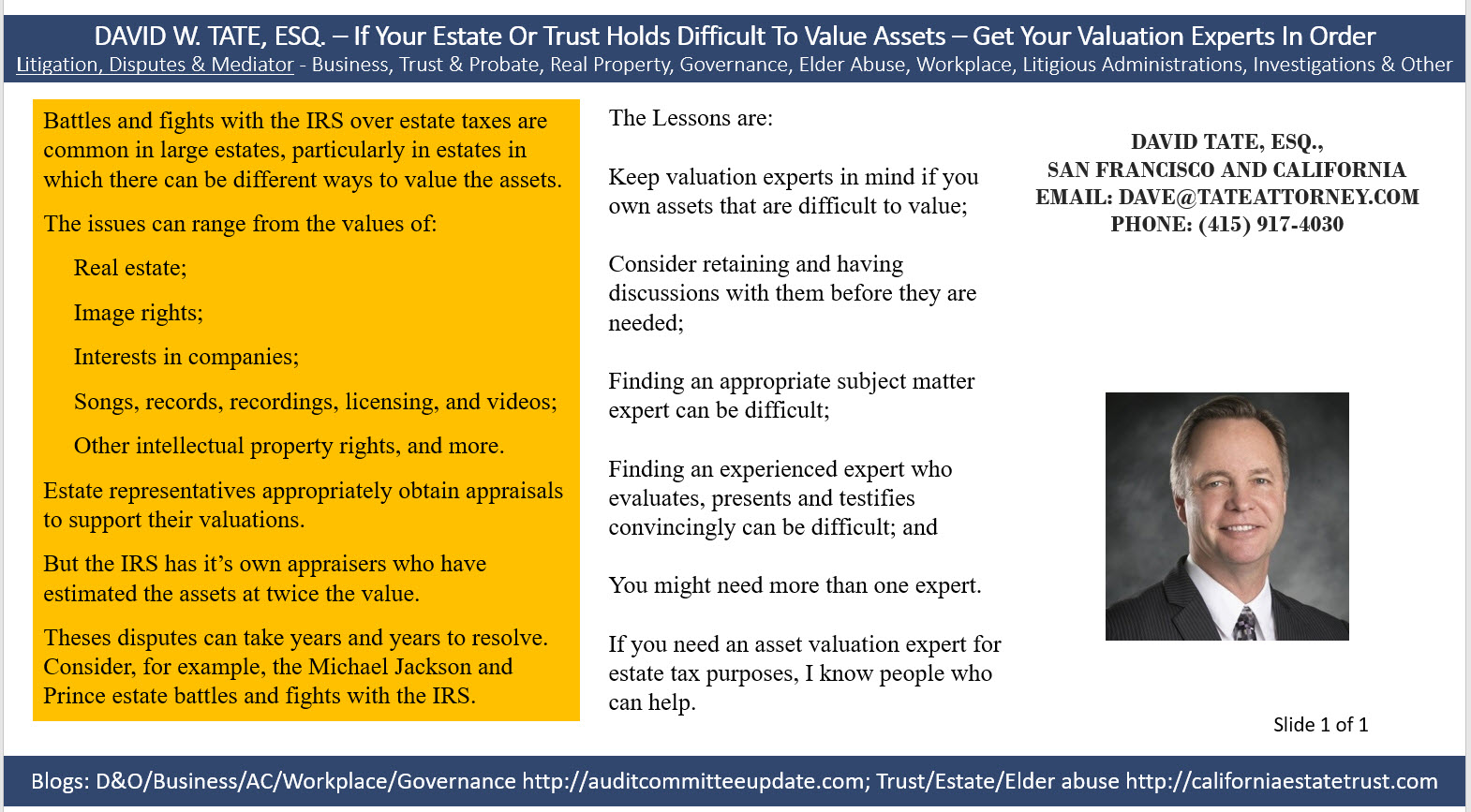
If Your Estate Or Trust Holds Difficult To Value Assets – Get Your Valuation Experts In Order (Slide)

View the above jpg, or click on the below link for a more clear view.

Best to you. David Tate, Esq. (and inactive CPA)

——————————————————————–

Remember, every case and situation is different. It is important to obtain and evaluate all of the evidence that is available, and to apply that evidence to the applicable standards and laws. You do need to consult with an attorney and other professionals about your particular situation. This post is not a solicitation for legal or other services inside of or outside of California, and, of course, this post only is a summary of information that changes from time to time, and does not apply to any particular situation or to your specific situation. So . . . you cannot rely on this post for your situation or as legal or other professional advice or representation.

Thank you for reading this post. I ask that you also pass it along to other people who would be interested as it is through collaboration that great things and success occur more quickly. And please also subscribe to this blog and my other blog (see below), and connect with me on LinkedIn and Twitter.

My two blogs are:

Business, D&O, audit committee, governance, compliance, etc. http://auditcommitteeupdate.com

Trust, estate, conservatorship, elder and elder abuse, etc. litigation and contentious administrations http://californiaestatetrust.com

Best to you, David Tate, Esq. (and inactive California CPA) – practicing in California only

Litigation, Disputes, Mediator & Governance: Business, Trust/Probate, Real Property, Governance, Elder Abuse, Workplace, Investigations, Other Areas


As the mediator – I facilitated a trust dispute settlement yesterday (and into the night)

Success stories are good to report. As the mediator I helped the parties and their counsel reach settlement in a trust dispute case yesterday and last night. I cannot say anything specific about the case or the mediation, of course. There were multiple contentious issues about which the parties held strong viewpoints. But all of the parties and their counsel prepared well for the mediation and kept working toward resolution into the night. The parties and their counsel are to be congratulated for their successful resolution – and they will be much better off and happier having resolved their dispute.

Best to you. David Tate, Esq.

——————————————————————–

Remember, every case and situation is different. It is important to obtain and evaluate all of the evidence that is available, and to apply that evidence to the applicable standards and laws. You do need to consult with an attorney and other professionals about your particular situation. This post is not a solicitation for legal or other services inside of or outside of California, and, of course, this post only is a summary of information that changes from time to time, and does not apply to any particular situation or to your specific situation. So . . . you cannot rely on this post for your situation or as legal or other professional advice or representation.

Thank you for reading this post. I ask that you also pass it along to other people who would be interested as it is through collaboration that great things and success occur more quickly. And please also subscribe to this blog and my other blog (see below), and connect with me on LinkedIn and Twitter.

Best to you, David Tate, Esq. (and inactive California CPA) – practicing in California only

Litigation, Disputes, Mediator & Governance: Business, Trust/Probate, Real Property, Governance, Elder Abuse, Investigations, Other Areas

Blogs: Trust, estate/probate, power of attorney, conservatorship, elder and dependent adult abuse, nursing home and care, disability, discrimination, personal injury, responsibilities and rights, and other related litigation, and contentious administrations http://californiaestatetrust.com

Business, D&O, board, director, audit committee, shareholder, founder, owner, and investor litigation, governance and governance committee, responsibilities and rights, compliance, investigations, and risk management  http://auditcommitteeupdate.com

My law practice primarily involves the following areas and issues:

Trust, Estate, Probate Court, Elder and Dependent Adult, and Disability Disputes and Litigation

  • Trust and estate disputes and litigation, and contentious administrations representing fiduciaries, beneficiaries and families; elder abuse; power of attorney disputes; elder care and nursing home abuse; conservatorships; claims to real and personal property; and other related disputes and litigation.

Business, Business-Related, and Workplace Disputes and Litigation: Private, Closely Held, and Family Businesses; Public Companies; Nonprofit Entities; and Governmental Entities

  • Business v. business disputes including breach of contract; unlawful, unfair and fraudulent business practices; fraud, deceit and misrepresentation; unfair competition; licensing agreements, breach of the covenant of good faith and fair dealing; etc.
  • Misappropriation of trade secrets.
  • M&A disputes.
  • Founder, officer, director and board, investor, shareholder, creditor, VC, control, governance, decision making, fiduciary duty, conflict of interest, independence, voting, etc., disputes.
  • Buy-sell disputes.
  • Funding and share dilution disputes.
  • Accounting, lost profits, and royalty disputes and damages.
  • Insurance coverage and bad faith.
  • Access to corporate and business records disputes.
  • Employee, employer and workplace disputes and processes, discrimination, whistleblower and retaliation, harassment, defamation, etc.

Investigations, Governance, and Responsibilities and Rights

  • Corporate, business, nonprofit and governmental internal investigations.
  • Board, audit committee, governance committee, and special committee governance and processes, disputes, conflicts of interest, independence, culture, ethics, etc.; and advising audit committees, governance committees, officers, directors, and boards.

Mediator Services and Conflict Resolution

* * * * *  
Buskirk v. Buskirk (August 14, 2020) 53 Cal. App. 5th 523 – holding that personal jurisdiction rules are the same for trust proceedings as they are for civil proceedings – i.e., California’s jurisdictional reach is long

The following is a summary of Buskirk v. Buskirk which is a recent and important case that discussed the reach of California’s jurisdiction in trust/probate court cases.

Buskirk v. Buskirk (August 14, 2020) 53 Cal. App. 5th 523 – holding that personal jurisdiction rules are the same for trust proceedings as they are for civil proceedings – i.e., California’s jurisdictional reach is long, personal jurisdiction depends on the connections that the defendant, and/or the facts, and/or the assets that are at issue, had or have with California

Buskirk affirms the view of personal jurisdiction that I have followed in probate court cases – i.e., that California’s jurisdictional reach is long, but, of course, it is not unlimited. Broadly viewed, the approach is: (1) was or is the defendant located in California, or (2) to what extent did the relevant facts or actions occur in California, or (3) to what extent were or are the assets that are at issue located in California? In Buskirk for example, the court held that California does have jurisdiction over the settlor/trustee although she used to be but now no longer was located in California. The court evaluated the history of the settlor/trustee’s actions in California, the relevant facts and actions that had occurred in California, and the extent that the assets that were at issue were located in California.

The opinion in Buskirk also is helpful because it is fairly long and detailed as to the various different facts that were involved and that the Court considered. There are a lot of facts in Buskirk that are also present or that could also be present in a typical California probate court case. Below you will find a summary of the opinion including some quotes from the court.

“As a matter of state law, personal jurisdiction rules are the same for civil and trust proceedings. [See Prob. Code § 17004 . . . .]”

California courts may exercise jurisdiction to determine matters concerning trust property located in California—particularly land—even if the trust is administered elsewhere.

California courts may exercise jurisdiction on any basis consistent with the state or federal Constitutions. Cal. Civ. Proc. Code § 410.10.

Court focuses on the defendants’ relationship to the forum state when assessing personal jurisdiction.

Jurisdiction is proper if a defendant has minimum contacts with the state such that the lawsuit does not offend traditional notions of fair play and substantial justice.

Personal jurisdiction can be all-purpose (also called “general”) or case-linked (also called “specific”).

With case-linked jurisdiction, the court may adjudicate only those disputes relating to defendants’ contacts with the forum.

Case-linked jurisdiction is proper when: (1) defendants have purposefully availed themselves of forum benefits; (2) the controversy relates to the defendants’ contacts with the forum; and (3) the exercise of jurisdiction comports with fair play and substantial justice.

When considering purposeful availment prong of case-linked jurisdiction test, court considers whether the defendants’ conduct connects them to the forum in a meaningful way.

Defendants purposefully avail themselves of a forum’s benefits, such that case-linked jurisdiction is proper, if they intentionally direct their activities at a forum such that, by virtue of the benefit the defendants receive, they should reasonably expect to be subject to jurisdiction there.

A defendant need not physically enter California at all to be subject to personal jurisdiction in California.

“A defendant need not physically enter California at all to be subject to personal jurisdiction here. (Halyard Health, Inc. v. Kimberly-Clark Corp. (2019) 43 Cal.App.5th 1062, 1075, 256 Cal.Rptr.3d 915.) Nor can the mother undo her lifelong California contacts by moving to a new state. No matter where they now live, Respondents’ activities have involved a trust that was created and managed in California, that is governed by California law, and that continues to hold interests in California real property. Respondents have purposefully availed themselves of the California forum.”

“Next we tackle the second prong about “relatedness”: whether the son’s claims relate to Respondents’ contacts with California. We look for a substantial connection between Respondents’ forum activities and the son’s claims. (Vons, supra, 14 Cal.4th at pp. 452, 456, 58 Cal.Rptr.2d 899, 926 P.2d 1085.)”

“To defeat exercise of case-linked jurisdiction on fairness grounds, the defendant must present a compelling case that exercising jurisdiction would be unreasonable.”

“Venue is separate from personal jurisdiction. Witkin Library Reference: 2 Witkin, Cal. Procedure (5th ed. 2008) Jurisdiction, § 158 [Ownership, Possession, or Use of Property.]”

“Among other findings, the trial court specifically found most of the Trust properties currently are in Idaho, the son is no longer a Trust beneficiary, and the mother has moved to Idaho. We accept those factual findings and do not question them.”

“Mother intentionally connected with California for her own benefit, such that connection satisfied purposeful availment prong of case-linked jurisdiction over mother in son’s action for accounting of family real estate trust, where mother was lifelong California resident, created trust with her husband in California and chose California law to govern trust, trust held interests in California real estate, mother had filed four lawsuits in California involving trust property, and, since leaving California, mother had engaged in transactions aimed at extinguishing the trust’s interests in the California real estate.”

“Daughters’ connections with California satisfied purposeful availment prong of case-linked jurisdiction in son’s action for accounting of family real estate trust, where daughters were successor beneficiaries and successor trustees of the trust, which originated in California, was governed by California law, and held interest in California real estate, daughters participated in trust transactions, and daughters physically came to California to get their mother, who was trustor, and to move her to Idaho, which triggered the trust changes at issue.”

“Uncle’s connections with California satisfied purposeful availment prong of case-linked jurisdiction in son’s action for accounting of family real estate trust, where uncle had role in managing trust, which originated in California, was governed by California law, and held interest in California real estate, uncle also participated in the trust’s real estate transactions, and uncle assisted in moving trustor mother from California to Idaho, which was event that changed trust’s operation.”

“Son’s claims for accounting of family real estate trust and for removal of trustees related to mother’s, uncle’s, and daughters’ contacts with California, as required for court to assert case-specific jurisdiction over them; mother, uncle, and daughter were connected to California through the trust, which was the topic of the son’s suit, suit asserted that they harmed son and the trust by engaging in below-market California land deals and that mother created an impermissible conflict of interest, son claimed the transactions rendered them unfit to serve as trustees, and son sought appointment of professional fiduciary as trustee and claimed he had been refused an accounting.”

“Exercise of case-linked jurisdiction over mother, uncle, and daughters was fair in son’s action for accounting of family real estate trust; son was resident of California, mother previously had chosen to litigate in California regarding trust, daughters or their agents came to California to move mother to Idaho, uncle was successor trustee and managed its affairs for mother, who had lived in California for 89 years, and while mother was elderly and one daughter had cancer, court would make reasonable accommodations.”

* * * * *

———————————————————————-

Remember, every case and situation is different. It is important to obtain and evaluate all of the evidence that is available, and to apply that evidence to the applicable standards and laws. You do need to consult with an attorney and other professionals about your particular situation. This post is not a solicitation for legal or other services inside of or outside of California, and, of course, this post only is a summary of information that changes from time to time, and does not apply to any particular situation or to your specific situation. So . . . you cannot rely on this post for your situation or as legal or other professional advice or representation.

Thank you for reading this post. I ask that you also pass it along to other people who would be interested as it is through collaboration that great things and success occur more quickly. And please also subscribe to this blog and my other blog (see below), and connect with me on LinkedIn and Twitter.

Best to you, David Tate, Esq. (and inactive California CPA) – practicing in California only

Litigation, Disputes, Mediator & Governance: Business, Trust/Probate, Real Property, Governance, Elder Abuse, Investigations, Other Areas

Blogs:

Trust, estate/probate, power of attorney, conservatorship, elder and dependent adult abuse, nursing home and care, disability, discrimination, personal injury, responsibilities and rights, and other related litigation, and contentious administrations http://californiaestatetrust.com

Business, D&O, board, director, audit committee, shareholder, founder, owner, and investor litigation, governance and governance committee, responsibilities and rights, compliance, investigations, and risk management  http://auditcommitteeupdate.com

My law practice primarily involves the following areas and issues:

Trust, Estate, Probate Court, Elder and Dependent Adult, and Disability Disputes and Litigation

  • Trust and estate disputes and litigation, and contentious administrations representing fiduciaries, beneficiaries and families; elder abuse; power of attorney disputes; elder care and nursing home abuse; conservatorships; claims to real and personal property; and other related disputes and litigation.

Business, Business-Related, and Workplace Disputes and Litigation: Private, Closely Held, and Family Businesses; Public Companies; Nonprofit Entities; and Governmental Entities

  • Business v. business disputes including breach of contract; unlawful, unfair and fraudulent business practices; fraud, deceit and misrepresentation; unfair competition; licensing agreements, breach of the covenant of good faith and fair dealing; etc.
  • Misappropriation of trade secrets.
  • M&A disputes.
  • Founder, officer, director and board, investor, shareholder, creditor, VC, control, governance, decision making, fiduciary duty, conflict of interest, independence, voting, etc., disputes.
  • Buy-sell disputes.
  • Funding and share dilution disputes.
  • Accounting, lost profits, and royalty disputes and damages.
  • Insurance coverage and bad faith.
  • Access to corporate and business records disputes.
  • Employee, employer and workplace disputes and processes, discrimination, whistleblower and retaliation, harassment, defamation, etc.

Investigations, Governance, and Responsibilities and Rights

  • Corporate, business, nonprofit and governmental internal investigations.
  • Board, audit committee, governance committee, and special committee governance and processes, disputes, conflicts of interest, independence, culture, ethics, etc.; and advising audit committees, governance committees, officers, directors, and boards.

Mediator Services and Conflict Resolution

* * * * *