New California case – California lacks personal jurisdiction over a Utah resident on a cross-complaint against her individually as a third party for intentional interference with prospective economic advantage, although the real property was located in California, and the Utah resident was appointed guardian ad litem for her mother in California

Keri Jensen v. Trine Jensen (Court of Appeal, Second Appellate District, B2896111, January 24, 2019), is very fact specific, so its value is mostly in the court’s legal evaluation as applied to this specific case. Frankly, I am a bit surprised by the court’s holding. Daughter Trine came to California and moved her mother back to Utah to stay with Trine. Trine was also appointed as guardian ad litem for her mother in California. Mother sued other daughter Keri in California relating to a parcel of real property that had been co-owned by mother and daughter Keri. In that lawsuit Keri then cross-complained against Trine personally and individually, not as guardian ad litem, for intentional interference with prospective economic advantage claiming that Trine took advantage of mom’s advancing dementia and coerced mom to sever the joint tenancy in the California real property.

Trine filed a motion to quash for lack of personal jurisdiction which the trial court granted and the court of appeal upheld. Since the parties apparently agreed that Trine was not subject to general jurisdiction in California, the court evaluated whether Trine purposefully availed herself of the California forum benefits, whether the controversy is related to or arises out of the Trine’s contacts in California, and whether California’s assertion of personal jurisdiction over Trine would comport with fair play and substantial justice.

It seems to me that this case is a close call as the real property is located in California. The court in dicta also made the point that Trine was not sued in California as guardian ad litem. I also note that there would be jurisdiction over Trine in Utah. The case also has other less relevant facts and is interesting reading relating to possible undue influence.

Thanks for reading this post. If you have found value in this post, I ask that you also pass it along to other people who would be interested as it is through collaboration that great things and success occur more quickly. And please also subscribe to this blog and my other blog (see below), and connect with me on LinkedIn and Twitter.

Every case situation is different. You do need to consult with professionals about your particular situation. This post is not a solicitation for services inside of or outside of California, and, of course, this post only is a summary of information that changes from time to time, and does not apply to any particular situation or to your specific situation. So . . . you cannot rely on this post for your situation.

Best to you, David Tate, Esq. (and inactive California CPA) – practicing in California only

Blogs: California trust, estate, and elder abuse litigation and contentious administrations http://californiaestatetrust.com; D&O, audit committee, governance and risk management http://auditcommitteeupdate.com

New California case upholds the substantial benefit doctrine for payment and recovery of attorneys’ fees and expert witness fees from the entire trust and the shares of all of the beneficiaries

In Smith v. Szeyller (Court of Appeal, Second Appellate District, B281758, January 16, 2019), the court held that the probate court’s award approving payment of attorneys’ fees and expert witness fees from the trust to the beneficiary who challenged the trustees’ accounting and management of the trust was appropriate under the substantial benefit doctrine. The beneficiary who challenged the trustees’ accounting and management of the trust prevailed, thus benefiting the trust and all beneficiaries of the trust although only the one beneficiary challenged the accounting and management. As the trust and all of its beneficiaries benefited from the successful challenge, it was appropriate that the attorneys’ fees and expert witness fees be paid and reimbursed from the assets of the entire trust and the shares of each of the beneficiaries thereof.

Note: I used this doctrine after a successful week-long trial in one of my cases.

Thanks for reading this post. If you have found value in this post, I ask that you also pass it along to other people who would be interested as it is through collaboration that great things and success occur more quickly. And please also subscribe to this blog and my other blog (see below), and connect with me on LinkedIn and Twitter.

Every trust situation is different. You do need to consult with professionals about your particular situation. This post is not a solicitation for services inside of or outside of California, and, of course, this post only is a summary of information that changes from time to time, and does not apply to any particular situation or to your specific situation. So . . . you cannot rely on this post for your situation.

Best to you, David Tate, Esq. (and inactive California CPA) – practicing in California only

Blogs: California trust, estate, and elder abuse litigation and contentious administrations http://californiaestatetrust.com; D&O, audit committee, governance and risk management http://auditcommitteeupdate.com

California Trustee – Some Of The Things That Could Keep You Up At Night

Trustee responsibilities are extensive and they arise from different sources including the wording of the trust itself, statutes, and case law. Of course, you have to cover all areas of your trustee responsibility, but here is my list of primary issues that could keep me up at night as a trustee. If you are a trustee, you want to do it right. If you are a beneficiary, you want to receive that to which you are entitled. And there can be a lot of angst, stress, misunderstanding, and disagreement in these situations. A significant part of my practice includes trust, estate, and elder abuse litigation and disputes – including contentious administrations. This list is not in any particular order. You might also notice that I update and republish this discussion from time to time as it includes important points that can apply to most trust administrations.

  1. Do you understand what the trust says and requires? This might sound basic, but it isn’t always.
  2. Have you marshalled and safeguarded the assets that are in or that are supposed to be in the trust? Are the assets in the trust, and are they under your control?
  3. Do you really understand your legal responsibilities including not only the wording and requirements in the trust, but also what the probate code and case law require of you? As a trustee you are a fiduciary. You have one of the highest standards of care, responsibility, liability and unbiased fairness and good faith required by law.
  4. Do you have a game plan for the steps required to accomplish the administration of the trust, including the time and timing that it will take? Completing the administration typically takes longer than most people would think. And this alone can cause disagreements, stress, and disputes. There is a court case on this issue, and there are court cases on many of these issues – basically, the case held that a trustee needs to conduct the administration process reasonably expeditiously, but the court decided to not to say that the administration must be “fast” or “quick” or completed in the “fastest” manner. In other words, there is a degree of reasonableness here.
  5. Are the trust assets being invested, managed and recorded properly and prudently? You need to evaluate and manage the returns and the risks, in accord with the wording of the trust and your statutory and case law fiduciary duties. So, for example, the stock market goes up and down. If the market goes down, is your approach to the portfolio management designed to help you avoid liability for losses, not just because the market went down, but also because you have implemented a portfolio approach and might allow you to net losses against gains? And are your investments prudently diversified, also taking into consideration possible risks? You will find additional posts on this blog about investment responsibilities.
  6. Do you have and use the proper fiduciary demeanor and decision-making approach required of a trustee?
  7. Is the trust cash flow prudently managed? You might, for example, through no fault of your own have a trust with declining asset values or liquidity issues, or there might simply be expense and distribution timing issues.
  8. Do you know what to do if you have beneficiaries who are disagreeing with your decisions, or who are threatening litigation, or who have initiated litigation?
  9. Do you know what information you must or possibly should provide to the beneficiaries and when to provide it, including, for example, possible accountings and other information? Even if an accounting isn’t required, sometimes I recommend that a trustee prepare an accounting or some form of an accounting anyway. And, of course, under all circumstances you should and usually must keep accurate and complete records. Even if an accounting is not required, or is not required to be prepared to cover a particular period of time, it is not uncommon for courts to require that an accounting be prepared anyway. And, court and probate code compliant accountings include specific and detailed requirements.
  10. Do you understand that you have personal liability exposure for the actions that you take or don’t take as the trustee? You are required to be prudent with risk management. Also consider possible fiduciary insurance coverage although in most situations it isn’t required or necessary.
  11. Do you know what additional planning opportunities exist or might exist, such as for tax purposes? Similarly, are you aware of new or changing tax, probate code, planning, and investment statutes and rules? And have you calendared important planning and compliance dates?
  12. Do you know how to prudently handle distributions and the timing of distributions? Do you know how to wrap things up and conclude the administration?
  13. Do you know what to do if there is a dispute about how the administration is being handled? This is important. As a trustee you can get yourself into even greater difficulty depending on how you handle disputes and disagreements. And for administration attorneys, I have written about changes to the Rules of Professional Conduct that were implemented on November 1, 2018, and that should be considered in appropriate circumstances.
  14. And last on this list, are you represented by the necessary and appropriate professionals to advise you on your fiduciary duties, trust administration management, compliance, taxes, investments, insurance, asset protection and preservation, communicating with beneficiaries, and other important or possibly important issues?

Thanks for reading this post. Every trust situation is different. You do need to consult with professionals about your particular situation. This post is not a solicitation for services inside of or outside of California, and, of course, this post only is a summary of information that changes from time to time, and does not apply to any particular situation or to your specific situation. So . . . you cannot rely on this post for your situation.

Best to you, David Tate, Esq. (and inactive California CPA) – practicing in California only

Blogs: California trust, estate, and elder abuse litigation and contentious administrations http://californiaestatetrust.com; D&O, audit committee, governance and risk management http://auditcommitteeupdate.com

If you have found value in this post, I ask that you also pass it along to other people who would be interested as it is through collaboration that great things and success occur more quickly. And please also subscribe to this blog and my other blog (see above), and connect with me on LinkedIn or Twitter.

New California Rule of Professional Conduct 3.7 – Lawyer as Witness – As Applied to Estate Planning and Trust and Estate Administration Lawyers

On November 1, 2018, California enacted new rules of professional conduct for lawyers. The new rules make many changes, one of which is Rule 3.7 (lawyer as witness). The prior rule (Rule 5-210) applied only to a lawyer as a witness at trial in jury trial proceedings. New Rule 3.7 does not make that distinction – new Rule 3.7 applies to both jury trial and bench or judge trial proceedings. The following is an essentially verbatim summary of new Rule 3.7:

Rule 3.7(a)(lawyer as witness):

  1. Is the lawyer acting as an advocate (i.e., in my view, is the lawyer representing a client) in a trial or an evidentiary hearing?
  2. If the answer is yes to number 1, is the lawyer likely to be a witness?
  3. If the answers are yes to numbers 1 and 2, does the lawyer’s testimony relate to a contested issue or matter?
  4. If the answers are yes to numbers 1, 2, and 3, does the lawyer’s testimony relate to other than the nature and value of legal services rendered in the case?
  5. If the answers are yes to numbers 1, 2, 3, and 4, has the lawyer obtained informed written consent from the client?

Rule 3.7(b): A lawyer may act as advocate in a trial in which another lawyer in the lawyer’s firm is likely to be called as a witness unless precluded from doing so by rule 1.7 or rule 1.9.

The following is a more detailed discussion that reflects more of the practicalities of the lawyer being involved in or possibly becoming involved in a probate court proceeding in which the lawyer is a witness or might become a witness who will provide testimony or might provide testimony relating to a contested issue or matter or relating to an issue or matter that might become contested? I have stated the Rule in this manner because (1) there are situations in which the Rule is not triggered, and (2) there are situations in which the Rule is triggered, and (3) there are situations in which the Rule might be triggered or might become triggered. In situations (2) and (3) consideration should be given to obtaining informed written consent and the wording and timing of such, whether informed written consent is even an option under the Rule, and whether informed written consent or some other action such as disengagement is best under the situation, and the timing of such.

As probate court proceedings are bench or judge proceedings, for which, with limited exceptions, jury trials usually are not available, it is now important to consider the possible applicability of new Rule 3.7 in all probate court proceedings including those proceedings which have not yet reached the trial stage. New Rule 3.7 already has been a potential issue in some of my cases – Rule 3.7 will or may apply in some probate court proceedings, whereas in others it will not.

Every probate court proceeding and case is different – whether or not Rule 3.7 applies will need to be evaluated on a proceeding by proceeding and case by case basis and might need to be considered at various different times in the course of a proceeding or case as the situation could be fluid and changing.

Note that I am differentiating between a probate court proceeding and a probate court case although the two might be considered the same – many probate court proceedings are never formally scheduled for trial or evidentiary hearing – nevertheless, even when a trial or evidentiary hearing has not been formally scheduled, a reading of Rule 3.7 suggests that the possible applicability of the Rule should still be considered and an evaluation made whether the lawyer is or might be or become an advocate at a trial or evidentiary hearing or proceeding, and whether the lawyer is or might likely be a witness.

Repeating myself somewhat, because this is a situation or question that could arise more often, you will also note that Rule 3.7 can bring into consideration the possibility of conflict waiver, which raises a host of other issues to consider including, for example, the possible timing of a discussion about that possibility (such as possible discussion in an engagement letter), whether an actual conflict waiver should be considered and the timing of such, and, if a conflict waiver is required or desired, whether such a waiver is actually allowable under the circumstances of the proceeding or case, and whether such a waiver is the best or most prudent course of action compared to other possible options including possible disengagement.

New Rule of Professional Conduct 3.7 states as follows:

Rule 3.7 Lawyer as Witness

(a) A lawyer shall not act as an advocate in a trial in which the lawyer is likely to be a witness unless:

(1) the lawyer’s testimony relates to an uncontested issue or matter;

(2) the lawyer’s testimony relates to the nature and value of legal services rendered in the case; or

(3) the lawyer has obtained informed written consent from the client. If the lawyer represents the People or a governmental entity, the consent shall be obtained from the head of the office or a designee of the head of the office by which the lawyer is employed.

(b) A lawyer may act as advocate in a trial in which another lawyer in the lawyer’s firm is likely to be called as a witness unless precluded from doing so by rule 1.7 or rule 1.9.

You should also read the discussions and comments, and the cited case, provided under Rule 3.7 to understand and to get a feel for whether the Rule 3.7 applies in your proceeding or case, and, if so, how to approach the possible client written consent option under the facts of your proceeding or case, and possible other options and situations, including disengagement and court discretionary authority to disqualify an attorney even if written consent is obtained (see, e.g., Lyle v. Superior Court).

It is not uncommon for the estate planning attorney or firm to also be involved in subsequent post-death administration which also can be or can become a probate court proceeding. Thus, if the proceeding is a probate court proceeding, pursuant to new Rule 3.7, you must first evaluate whether the lawyer is or might be or become acting as “an advocate” representative, and whether the lawyer is or might likely become a witness providing testimony (declaration?) relating to a contested issue or matter at trial or at an evidentiary hearing or proceeding?

These questions should be carefully evaluated on a proceeding by proceeding or case by case basis. Depending on your evaluation of these issues, next evaluate on a proceeding by proceeding or case by case basis: (1) does the lawyer’s testimony relate to a contested or possibly contested matter or to an uncontested matter; (2) does the lawyer’s testimony relate (solely relate?) to the nature and value of legal services rendered in the case; and (3) has or will or should the client provide written consent (see also the discussion above)? And, if client written consent is an option, you will also need to consider the wording of the (informed) written consent.

Will the impact of new Rule 3.7 be earthshaking? Rule 3.7 needs to be considered on a proceeding by proceeding and case by case basis. New Rule 3.7 already is or could be applicable in many probate court proceedings and cases. The overall impact will need to be determined over time, and on a county by county and probate judge by probate judge basis. However, in probate court proceedings or cases in which the lawyer is likely or could become likely to be a witness (for example, such as in will and trust contests or possible contests, and possibly in other proceedings or cases in which there is an objection or opposition, or possibly a likely objection or opposition) Rule 3.7 might apply or at least should be considered as possibly applying including the options available.

In appropriate cases you should also consider Rule 3.7(b) which states “A lawyer may act as advocate in a trial in which another lawyer in the lawyer’s firm is likely to be called as a witness unless precluded from doing so by rule 1.7 or rule 1.9.”

I will be writing subsequent posts on these issues as they can be important to estate planning and administration attorneys, and in proceedings and cases, and these are and will continue to be developing areas. Please also note that I will also be discussing other rules, cases, decisions, and issues, including possible client duties, that can or might apply in a particular situation, including, for example, Rules 1.6, 1.7, 1.9, and 1.10, which pertain to client confidential information, possible conflicts between current clients, possible conflicts between a former client and a current client, and new Rule 1.10 pursuant to which conflicts can be imputed between different attorneys in the same law firm.

Thanks for reading this post. Every trust situation is different. You do need to consult with professionals about your particular situation. This post is not a solicitation for services inside of or outside of California, and, of course, this post only is a summary of information that changes from time to time, and does not apply to any particular situation or to your specific situation. So . . . you cannot rely on this post for your situation.

Best to you, David Tate, Esq. (and inactive California CPA) – practicing in California only

Blogs: California trust, estate, and elder abuse litigation and contentious administrations http://californiaestatetrust.com; D&O, audit committee, governance and risk management http://auditcommitteeupdate.com

If you have found value in this post, I ask that you also pass it along to other people who would be interested as it is through collaboration that great things and success occur more quickly. And please also subscribe to this blog and my other blog (see above), and connect with me on LinkedIn or Twitter.

From Frameworks Institute – Elder Abuse Toolkit

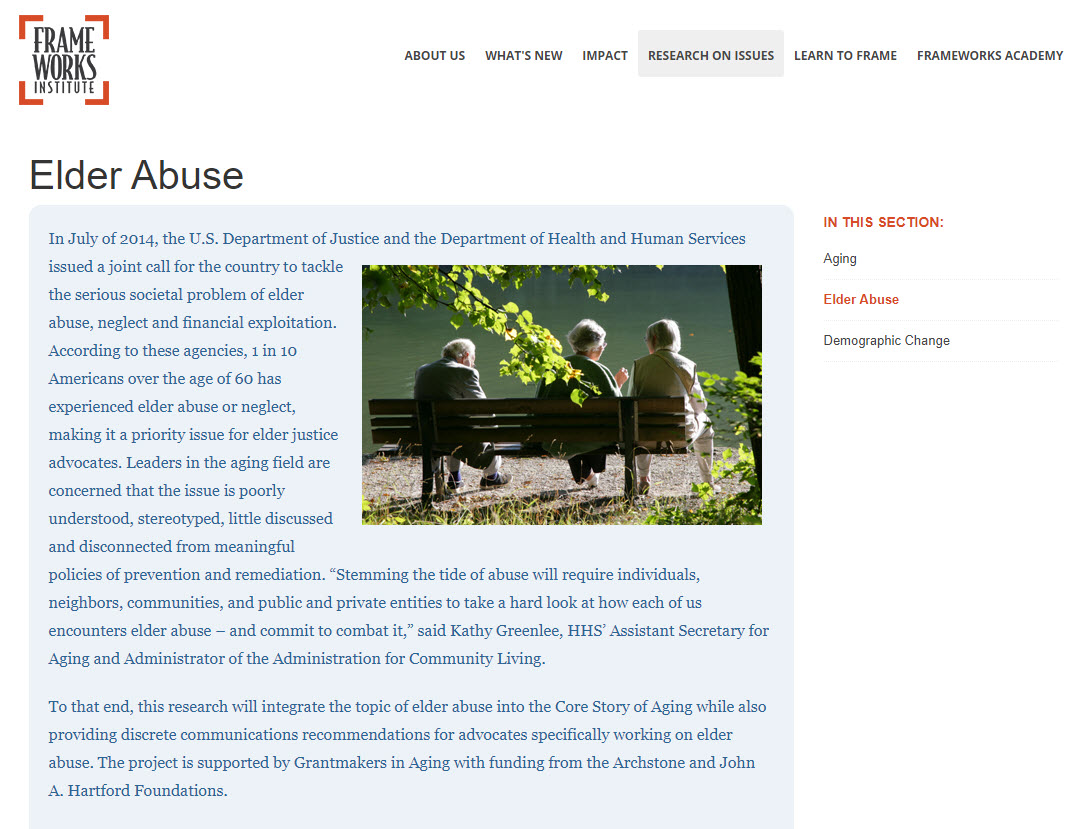
The Frameworks Institute has developed a toolkit which analyzes problems with society’s view of elder abuse and recommends alternative more effective approaches to discussing elder abuse. The following is a link to the Frameworks Institute, Elder Abuse website page, and a screenshot of the initial website page. Best to you – David Tate, Esq.

Here is the link to the Frameworks Institute, Elder Abuse website page, http://frameworksinstitute.org/elder-abuse.html

And the following is a screenshot of the initial website page:


Don’t delay: allegations of incompetence could give beneficiary standing, but delay in taking action could bar a beneficiary from contesting a trust or will at a later date (laches), Drake v. Pinkham

Drake v. Pinkham (California Court of Appeal, Third District, Case No. C068747, decided May 28, 2013, ordered for publication June 21, 2013).

This case involves a daughter’s (Gina) contest of two of her mother’s (Josephine) trust amendments (amendments dated 2001 and 2004) on the grounds that at the time of the amendments Josephine lacked mental capacity, was unduly influenced by a second daughter (Janice), and did not understand the amendments or her estate.  On a motion for summary judgment the trial court found that Gina’s contest was barred by the statute of limitations and principles of collateral estoppel.  On appeal, the Court of Appeal did not consider the statute of limitations or collateral estoppel issues, but instead found that Gina’s contest was barred by the defense of laches.

Gina filed her contest after her mother’s October 2009 death.  However, several years earlier, in 2005, Gina had filed a petition requesting the court to confirm her appointment as co-trustee under the terms of the trust and amendments dated 1992, 1993 and 1999.  Gina claimed that Josephine lacked the ability to care for herself or act as trustee and Janice’s alleged undue influence over her – Gina alleged that after the death of Josephine’s husband Theodore Janice began progressively isolating Josephine to the point that Gina no longer had contact with her mother, and that Janice had complete control over Josephine including her finances and was acting as the sole trustee of the trust.  Filed an objection to Gina’s 2005 petition and attached to her objection copies of her 2001 and 2004 trust amendments. The 2001 Fourth Amendment eliminated Gina as a beneficiary and named Janice as the sole successor trustee, and the 2004 Fifth Amendment designated Janice as Josephine’s acting co-trustee and sole successor trustee.  At that time in 2005 Gina did not challenge the 2001 or 2004 amendments.  Instead, Gina entered into a settlement agreement in which Josephine represented that she was the sole acting trustee, and in her capacity as such on behalf of all successor trustees, she agreed not to sell, encumber, lease, rent, transfer or otherwise take any action affecting any real property of the trust without prior notice to Gina and Janice as provided in the trust.

On appeal the Court addressed several important issues that could have ramifications or that might at least be considered in cases where issues exist relating to mental capacity, undue influence, and understanding of the trust or will documents and the nature of the estate and its assets.

  1. On appeal Gina argued as a defense that in 2005 she did not have standing to contest the 2001 and 2004 amendments pursuant to Cal. Probate Code sections 17200 and 15800 because the trust was still revocable in 2005.  The Court of Appeal noted that under sections 17200 and 15800 a beneficiary lacks standing to challenge a trust so long as the “trust is revocable and the person holding the power to revoke the trust is competent.”  The Court held that it was not persuaded by Gina’s argument, holding that since Gina alleged in 2005 that Josephine was incompetent, those allegations by Gina in 2005 took the matter outside of the terms of section 15800, and with those allegations Gina had standing in 2005 to contest the trust amendments, although at trial she still would have had the burden of proving her contest of the amendments.
  2. The Court further held that laches barred Gina from contesting the 2001 and 2004 amendments after her mother died in 2009.  In pertinent part, the Court discussed that the defense of laches requires unreasonable delay plus either acquiescence in the act about which plaintiff complains or prejudice to the defendant resulting from any delay – and that any delay is measured from the time that the plaintiff knew or should have known about the alleged claim.  In 2005 Gina had the usual rights of a trust beneficiary and beneficiary legal standing if Gina simply alleged that Josephine was incompetent, which Gina did in fact allege in 2005.  Further, “Finally, Gina’s failure to bring the action until after Josephine had passed away was necessarily prejudicial where, as here, each and every cause of action set forth in the underlying petition centered on Josephine – her mental capacity, defendant’s influence over her, and her understanding of the Fourth [2001] and Fifth [2004] Amendments and her estate.  (See Bono v. Clark (2002) 103 Cal.App.4th 1409, 1420 [the death of an important witness may constitute prejudice]; Stafford v. Ballinger (1962) 199 Cal. App.2d 289, 296 [same].”

Take away from Drake v. Pinkham, assuming that the case is not further appealed to the California Supreme Court.

  1. As always, before you file any pleading, claim, allegation or paper with any court relating to a trust, will or other document with a no contest clause or to which a no contest clause applies, you must evaluate and make sure that the filing will not trigger the no contest clause.  If such a clause is triggered, the result might be that you are disinherited.  These are complicated issues – you need to consult with an attorney on these issues.
  2. A simple allegation that the trustor is incompetent might allow or provide the trust beneficiary or potential beneficiary with legal standing and certain beneficiary rights in an otherwise revocable trust under Cal. Probate Code sections 17200, 15800, the terms of the trust, accounting and information provisions, and other statutes.  Of course, the proof of those claims must still be established by the evidence.
  3. Allegations and claims, statements, and knowledge of facts by a beneficiary or potential beneficiary, or facts that a beneficiary or potential beneficiary should know, could trigger a requirement that the beneficiary or potential beneficiary bring suit and not delay bringing suit to enforce his or her rights and entitlements, or be barred from doing so later pursuant to the defense of laches such as if the testator dies or the testator’s mental competency declines as time passes.
  4. The defense of laches, i.e., delay, and case law relating to laches now take on renewed potential importance in trust, will, conservatorship and power of attorney litigation.  For example, if a beneficiary or potential beneficiary knows of a trust or will, or a trust amendment or will codicil, that is contrary to the beneficiary’s rights or interests, and the beneficiary simply believes that the trustor or testator might have had capacity issues or might have been unduly influenced, or that testamentary document seems contrary to what the trustor or testator would have naturally done or wanted or understood about his or her assets or estate, might that beneficiary or potential beneficiary be required to file a legal action on those possible claims without delay, or be barred by laches from doing so at a later time?  I have seen trust, will, conservatorship and power of attorney situations where people have delayed taking action – under the holding in Drake v. Pinkham they now need to consider the possible effect of delay and possible laches defenses against them if they do delay in bringing a legal action.

Best to you, David Tate, Esq.

Disclaimer and Warning.  This blog post and the contents and information contained in the post are not legal advice, do not create or cause an attorney client relationship with your or anyone else, and do not relate or pertain to any person, entity or factual situation, and I do not know the facts of your situation.  The contents of this blog post are only a summary of information which could change over time.  I have not advised you about your situation, and you definitely should consult with an attorney for your particular situation.

* * * * *


David Tate Presentation About Trustee and Beneficiary Responsibilities and Rights, and Contentious Trust Administrations and Other Situations (May 24, 2018)

Attend My Upcoming Presentation About Trustee and Beneficiary Responsibilities and Rights, and Contentious Trust Administrations and Other Situations

Date: May 24, 2018

Time: 6:00 P.M. – 7:45 P.M.

Location: Royse Law Firm, PC, 149 Commonwealth Drive, Ste. 1001, Menlo Park, CA 94025, (650) 813-9700

I will be presenting a discussion about California trustee and beneficiary responsibilities and rights, and contentious trust administrations on May 24, 2018, from 6 p.m. to 7:45 p.m., at the Royse Law Firm, PC, at 149 Commonwealth Drive, Ste. 1001, Menlo Park, CA 94025, (650) 813-9700. The presentation is free. At the bottom of this post I have provided a link to register if you would like to attend. Please also tell other people who would be interested. The presentation and handout are detailed, but the discussion is primarily directed toward non-lawyers and other people who are not experts in the subject areas.

The presentation covers the following primary topic areas. Many of the discussion areas also apply to wills and estates:

  1. Overview of trust interpretation, responsibilities and rights
  2. Investments and management
  3. Accountings and information
  4. Uncertainties and disputes
  5. Additional select trust, estate, elder, and planning issues depending on the attendees, such as conservatorships, elder abuse, powers of attorney, mental capacity, transfers to prohibited people, when a trustor dies, planning, etc.

Please click on the following link for additional detail and to register to attend the presentation, and please also tell other people who would be interested: https://www.eventbrite.com/e/trustees-beneficiaries-responsibilities-rights-and-handling-disputes-tickets-44921355985


Another disturbing nursing home story, in addition the Florida IRMA SNF deaths – need for ERM, leadership, transparency, reporting, and follow-up

I have also posted this discussion at http://lawriskgov.com

Below, at the bottom of this blog, I have pasted a video at a nursing home that I came across on Yahoo. First some disclaimers – by now we should all be aware that watching snippets or portions of a video does not tell the whole story, knowing the whole story could present a different situation, we don’t know all that was said or that occurred, and, of course, I have no personal knowledge of these events, but am simply passing this along.

That having been said, the video and information presented are disturbing.

At her deposition the supervising nurse testified that what occurred is different than what the video shows, and acknowledges or admits this, and she admits that the nurses or nursing assistants on scene acted wrongfully and should have been fired if the truth had been known.

If not for the video the truth would not have come to light.

An issue arose whether it was legal to install a secret video recording device in the resident’s room. It is my understanding that a nursing home resident is a resident, not a patient, and that the nursing home, and their particular room is their home.

The lawyer mentions that he cannot say anything about the settlement agreement with the nursing home. In California, except in limited circumstances, Code of Civil Procedure §2017.310 makes a confidential settlement agreement unlawful if the factual foundation presents a case of elder or dependent adult abuse.

California also has a criminal elder abuse statute at Penal Code §368. I’m not saying that the acts in the video were criminal – based on what is being shown, in a court of law more likely the acts would be considered medical malpractice in nature, but could still be civil elder abuse.

The nursing home would raise a whole host of defenses to liability, including, for example, possibly, that the plaintiffs or prosecution cannot show with evidence that the actions of the nursing home actually caused the resident’s death. But there also could be issues about burden of proof, and it is possible that the burden of showing no wrongful conduct could be shifted to the defendant nursing home.

We could go on and on with this. There is a lot more that I would like to know, including, for example, about the policies and procedures of the nursing home at the time of the incident, and about the investigation that the nursing home did at the time of the incident and whether that investigation, if any was done, was sufficient and performed appropriately and in good faith?

I would also like to know about the “new management” of the nursing home, and about current policies and procedures, and whether the events of this occurrence were presented to the public or kept secret by the state nursing home regulatory authorities.

These stories and what occurs later in time get buried by the now constant 24 hour news and social media cycle – do you remember the hurricane IRMA story about the 8 nursing home residents who died because the air conditioning went out, but then weren’t transferred by the nursing home to a safe facility (such as, for example, possibly the nearby hospital) – well . . . what has happened since that time in the investigation, and so that something like that will not occur again?

That’s all for now. I’m David Tate. I’m a California litigation attorney. I also handle governance and risk management. You need to consult with an attorney or appropriate professional about your situation. This blog post and/or video or audio is not an advertisement or solicitation for services inside or outside of California. Thanks for listening or reading.

Here is the link to the nursing home video,

https://www.yahoo.com/lifestyle/disturbing-video-shows-dying-wwii-vet-neglected-nursing-home-193149764.html

David Tate, Esq., Royse Law Firm, Menlo Park, California office, with offices in northern and southern California. http://rroyselaw.com

See also my blogs at http://lawriskgov.com and at http://auditcommitteeupdate.com

Royse Law Firm – Practice Area Overview – San Francisco Bay Area and Los Angeles Basin

  • Corporate and Securities, Financing and Formation
  • Corporate Governance, D&O, Boards and Committees, Audit Committees, Etc.
  • Intellectual Property – Patents, Trademarks, Copyrights, Trade Secrets
  • International
  • Immigration
  • Mergers & Acquisitions
  • Labor and Employment
  • Litigation (I broke out the litigation because this is my primary area of practice)
  •             Business
  •             Intellectual Property – Patents, Trademarks, Copyrights, Trade Secrets
  •             Trade Secrets, NDA, Accounting Issues, Fraud, Lost Income, Royalties, Etc.
  •             Privacy, Internet, Hacking, Speech, Etc.
  •             Labor and Employment
  •             Mergers & Acquisitions
  •             Real Estate
  •             Owner, Founder, Investor, Board & Committee, Shareholder, D&O, Etc.
  •             Insurance Coverage and Bad Faith
  •             Lender/Debtor
  •             Investigations
  •             Trust, Estate, Conservatorship, Elder Abuse, and Contentious Administrations
  • Real Estate
  • Tax (US and International) and Tax Litigation
  • Technology Companies and Transactions Including AgTech, HealthTech, Etc.
  • Wealth and Estate Planning, Trust and Estate Administration, and Disputes and Litigation

Audit Committee 5 Lines of Defense 10222017 David W. Tate, Esq. jpg


A party filing a petition in probate to enforce a no contest clause triggers the anti-SLAPP statute

David Tate, Esq., Royse Law Firm, California (Silicon Valley/Menlo Park Office, with additional offices in San Francisco, Los Angeles and Orange County), http://rroyselaw.com/

The following is a brief discussion about a new California case in which the court held that a party filing a petition in probate to enforce a no contest clause triggers the anti-SLAPP statute. If you have never been involved in the anti-SLAPP statute, it is a big deal. The case is Urick v. Urick, California Court of Appeal, Second Appellate District, Case No. B278257 (October 5, 2017).

Summary. Filing a petition for instructions in probate, claiming that a trustee or beneficiary had triggered a no contest clause by filing her prior petition to reform or modify a trust, is a claim that triggers prong one of the California anti-SLAPP statute Cal. Code Civ. Proc. §425.16, which means that the party seeking to claim and enforce that the no contest clause was triggered must be prepared to satisfy prong two of the anti-SLAPP statute which requires him to sufficiently establish a reasonable possibility of prevailing on the claim that the no contest clause was triggered and violated.

Takeaway. If you bring a claim to enforce a no contest clause based on an opposing party’s prior petition filed in probate, you must be prepared at the time of your filing to establish to the court, based on evidence and declarations, that you have a reasonable possibility of prevailing on your claim that the other party had triggered and violated the no contest clause.

Urick is also interesting for the court’s discussion whether the previously filed petition to reform or modify the trust triggered the no contest clause, including the discussion whether that previously filed petition was filed by the petitioner as a beneficiary of the trust or as the trustee of the trust and whether there was really a distinction that mattered under the facts of the case.

Other thoughts about the anti-SLAPP statute. I have been involved in Cal. Code Civ. Proc. §425.16 motions. It is my opinion that it is a deeply flawed statute except possibly in really obvious and clear situations and in those cases the party who has those defenses has other remedies such as a demurrer, motion to strike, or motion for summary judgment or summary adjudication. The anti-SLAPP statute should be revoked or very significantly amended and limited. To add further injury, the filing of an anti-SLAPP motion automatically stays all discovery unless a motion to allow and compel discovery is brought and the court grants that motion – thus, strategically a party might bring an anti-SLAPP motion simply to see if they can prevail even if their arguments and chances of prevailing are not good – and the statute further provides that if a party prevails on an anti-SLAPP motion they are entitled to attorneys’ fees whereas if a party defeats an anti-SLAPP motion the statute does not provide that they are entitled to recover attorneys’ fees. The anti-SLAPP statute is ripe for abuse or use in situations that might be counter to other public or judicial policies, which the court in Urick appeared to recognize, but as the court noted, nevertheless the statute is still on the books and is applicable unless and until the Legislature does something about the statute.

* * * * * * *

What documents does a trustee provide relating to the Probate Code §§16060.5, 16061.7 and 16061.8 notice requirements?

The following discussion is about the requirements of California Probate Code §§16060.5, 16061.7 and 16061.8, and what documents must be provided by the trustee if the trustee voluntarily provides copies of documents, such as with the section 16061.7/16071.8 notice, or if a beneficiary or heir requests copies of documents. Upon request, or voluntarily if the trustee so elects, the trustee is required to provide copies of the terms of the trust. Below I have copied and pasted parts of a legal discussion on this topic, without the specific facts of the situation – so the below discussion is rather dry, but you can envision that documents and what they say can and will vary from case to case. Immediately below is an overall summary based on reading the statutes, case law, and legislative committee history. Further below I have summarized the statutes, a few cases on legislative intent, and some of the legislative committee comments.  You can ignore the underline and bold in the below materials – those were added in the original materials, but they are not necessarily relevant for this discussion. Fun reading. This is or should be an important topic of discussion for trustees, beneficiaries, estate planning attorneys, estate/trust administration attorneys, and Judges. David Tate, Royse Law Firm, Menlo Park Office but with offices in northern and southern California.

————————————————————–

California Probate Code §§16060.5, 16061.7 and 16061.8 provide that a trustee shall provide beneficiaries and heirs with a notice, and with the “terms of the trust” either voluntarily or upon request, and that if the trustee timely and completely does so, beneficiaries and heirs are then required to make a decision whether to contest the trust within the allowable time period. The provisions and requirements of §§16060.5, 16061.7 and 16061.8 are important, and any waiver of the notice and information providing requirement is against public policy, particularly in light of the 120-day limitation deadline for filing a contest action. As no two trusts and trust situations are identical, the application of §§16060.5, 16061.7 and 16061.8, including whether the trustee has satisfied those requirements must be a factual determination that must be made on a case-by-case basis, based on the facts of the case and the requirements of Probate Code §§16060.5, 16061.7 and 16061.8 as provided therein and the legislative intent.

————————————————————–

In relevant part, California Probate Code §16061.7 requires that:

(a) A trustee shall serve a notification by the trustee as described in this section in the following events:

(1) When a revocable trust or any portion thereof becomes irrevocable because of the death of one or more of the settlors of the trust, or because, by the express terms of the trust, the trust becomes irrevocable within one year of the death of a settlor because of a contingency related to the death of one or more of the settlors of the trust.

(2) Whenever there is a change of trustee of an irrevocable trust.

* * * *

(b) The notification by the trustee required by subdivision (a) shall be served on each of the following:

(1) Each beneficiary of the irrevocable trust or irrevocable portion of the trust, subject to the limitations of Section 15804.

(2) Each heir of the deceased settlor, if the event that requires notification is the death of a settlor or irrevocability within one year of the death of the settlor of the trust by the express terms of the trust because of a contingency related to the death of a settlor.

* * * * *

(e) The notification by trustee shall be served by mail to the last known address, pursuant to Section 1215, or by personal delivery.

(f) The notification by trustee shall be served not later than 60 days following the occurrence of the event requiring service of the notification by trustee, or 60 days after the trustee became aware of the existence of a person entitled to receive notification by trustee, if that person was not known to the trustee on the occurrence of the event requiring service of the notification. If there is a vacancy in the office of the trustee on the date of the occurrence of the event requiring service of the notification by trustee, or if that event causes a vacancy, then the 60-day period for service of the notification by trustee commences on the date the new trustee commences to serve as trustee.

(g) The notification by trustee shall contain the following information:

(1) The identity of the settlor or settlors of the trust and the date of execution of the trust instrument.

(2) The name, mailing address and telephone number of each trustee of the trust.

(3) The address of the physical location where the principal place of administration of the trust is located, pursuant to Section 17002.

(4) Any additional information that may be expressly required by the terms of the trust instrument.

(5) A notification that the recipient is entitled, upon reasonable request to the trustee, to receive from the trustee a true and complete copy of the terms of the trust.

(h) If the notification by the trustee is served because a revocable trust or any portion of it has become irrevocable because of the death of one or more settlors of the trust, or because, by the express terms of the trust, the trust becomes irrevocable within one year of the death of a settlor because of a contingency related to the death of one or more of the settlors of the trust, the notification by the trustee shall also include a warning, set out in a separate paragraph in not less than 10-point boldface type, or a reasonable equivalent thereof, that states as follows:

You may not bring an action to contest the trust more than 120 days from the date this notification by the trustee is served upon you or 60 days from the date on which a copy of the terms of the trust is mailed or personally delivered to you during that 120-day period, whichever is later.”

(i) Any waiver by a settlor of the requirement of serving the notification by trustee required by this section is against public policy and shall be void. (Underline and bold added)

————————————————————–

California Probate Code §16061.8 provides that:

“No person upon whom the notification by the trustee is served pursuant to this chapter, whether the notice is served on him or her within or after the time period set forth in subdivision (f) of Section 16061.7, may bring an action to contest the trust more than 120 days from the date the notification by the trustee is served upon him or her, or 60 days from the day on which a copy of the terms of the trust is mailed or personally delivered to him or her during that 120-day period, whichever is later.” (Underline and bold added)

————————————————————–

As used in §§16061.7 and 16061.8, and throughout Article 3 which includes Probate Code §§16060 through 16069, pursuant to Probate Code §16060.5 the term “terms of the trust” means:

“ . . . the written trust instrument of an irrevocable trust or those provisions of a written trust instrument in effect at the settlor’s death that describe or affect that portion of a trust that has become irrevocable at the death of the settlor. In addition, “terms of the trust” includes, but is not limited to, signatures, amendments, disclaimers, and any directions or instructions to the trustee that affect the disposition of the trust. “Terms of the trust” does not include documents which were intended to affect disposition only while the trust was revocable. If a trust has been completely restated, “terms of the trust” does not include trust instruments or amendments which are superseded by the last restatement before the settlor’s death, but it does include amendments executed after the restatement. “Terms of the trust” also includes any document irrevocably exercising a power of appointment over the trust or over any portion of the trust which has become irrevocable.” (Underline and bold added)

————————————————————–

It is well-known that some trustees and trust administration attorneys play games with the statutory notice requirement – some trustees intentionally or by ignorance fail to provide required disclosure or they try to keep the true terms of the trust secret from the recipient beneficiaries and heirs, whereas other trustees and their administration attorneys endeavor to provide full notice and disclosure. One might ask, why would a trustee not provide full disclosure? The answers are simple, for example, the trustee has an ulterior primary motive, or the trustee favors certain beneficiaries or heirs over other beneficiaries or heirs, or the trustee believes that the beneficiary or heir will be less likely to contest the trust if he or she does not have full information, or the trustee is simply mistaken.

————————————————————–

Statutes are to be interpreted in accord with the intent of the Legislature. The fundamental task of statutory construction is to determine and follow the legislative intent so as to effectuate the purpose of the law, including both the policy expressed in its terms and the object implicit in its history should be recognized. Cal. Code Civ. Proc. §1859; People v. Cruz (1996) 13 Cal. 4th 764, 774-775; Walnut Creek Manor v. Fair Employment & Housing Commission (1991) 54 Cal. 3d 245, 268; In re Schaefer (1981) 116 Cal. App. 3d 588, 597. Determining legislative intent is to be the fundamental, cardinal rule of statutory construction. Tyrone v. Kelley (1973) 9 Cal. 3d 1, 10-11.The object that a statute seeks to achieve and the evil that it seeks to prevent are of prime consideration in its interpretation. Sierra Club v. City of Hayward (1981) 28 Cal. 3d 840, 860-861; Dubins v. Regents of University of California (1994) 25 Cal. App. 4th 77, 83. When the Legislature enacts a remedial statute, courts must construe it liberally to promote its purposes, to protect the persons within its purview, and to suppress the mischief within its spirit and policy. Tetra Pak, Inc. v. State Board of Equalization (1991) 234 Cal. App. 3d 1751, 1756. Courts consider legislative history as an extrinsic aid to help elucidate legislative intent. City of San Jose v. Superior Court (1993) 5 Cal. 4th 47, 54; Jevne v. Superior Court (2005) 35 Cal. 4th 935, 948; District of Columbia v. Heller (2008) 554 U.S. 570, 605. Courts also look to legislative history to confirm the Court’s reading of the statute- common sense suggests that inquiry into statutory construction benefits from reviewing additional information rather than ignoring it. Samantar v. Yousuf (2010) 560 U.S. 305, 315-323; Wisconsin Pub. Intervenor v. Mortier (1991) 501 U.S. 597, 611-612 n.4.

————————————————————–

In this case a Senate Judiciary Committee Report with the date September 5, 1997, states (and other Committee Reports similarly state), for example:

“SECTION 23 — Trustee Notification — Probate Code Sections 16061.5 and 16061.7

Existing law requires a trustee, upon reasonable request by a beneficiary, to provide the beneficiary with certain information about the trust and its administration relevant to the beneficiary’s interest in the trust.

This bill would require trustees to notify beneficiaries of a trust by mail or personal delivery when there is a change of trustees and notify beneficiaries and heirs of whom they have actual knowledge when a revocable trust become irrevocable.

The sponsor asserts that the experience of practitioners is that failure to notify beneficiaries of the existence or terms of trusts frequently leads to or exacerbates conflict between trustees and beneficiaries. It is also increasingly common for persons to use revocable as will substitutes. In these cases, the sponsor believes that prompt notification of the heirs of a deceased settlor will reduce the incidence of trustees concealing trust assets and even the existence of trusts.”

————————————————————–

And further, an apparently early in the legislative process or initial Assembly Committee on Judiciary Report also states, for example:

“SEC. 32 & 33 – – Trustee Notification – – Probate Code §§16061.5 and 16061.7

Existing law requires a trustee, upon reasonable request by a beneficiary, to provide the beneficiary with certain information about the trust and its administration relevant to the beneficiary’s interest in the trust. In spite of this requirement, the experience of practitioners is that failure to notify beneficiaries of the existence or terms of trusts frequently leads to or exacerbates conflict between trustees and beneficiaries.

This bill would clarify the statutory mandate on trustees by requiring them to notify beneficiaries of a trust when there is a change of trustees and notify beneficiaries and heirs when a revocable trust becomes irrevocable.”

————————————————————–

The Cal. Probate Code §82 definition of the term “trust” includes “additions thereto”:

California Probate Code §82 states as follows:

(a) “Trust” includes the following:

(1) An express trust, private or charitable, with additions thereto, wherever and however created.

See also Townsend v. Townsend (2009) 171 Cal. App. 4th 389, 405, in which the court held that the Probate Code §82 definition of the term “additionsincludes “additions of property to the Trust.”

————————————————————–

Further, an “instrument” means a will, trust, deed, or other writing that designates a beneficiary or makes a donative transfer. California Probate Code §45.

————————————————————–

Probate Code provisions pertaining to powers of appointment can be found at Probate Code §§600-695, in particular §640 (manifestation of intent), §650 (general power of appointment) and §651 (special power of appointment).


* * * * *