And so SB 1338 CARE Court has passed (and will be signed by the Governor) . . . and now the work to be done will begin . . .

The California Community Assistance, Recovery, and Empowerment (CARE) Court Program legislation (SB 1338) has passed the Legislature, and it certainly will be signed by Governor Newsom as the act has his support. Here is a link to the Governor’s statement on the passage of CARE Court https://www.gov.ca.gov/2022/08/31/governor-newsom-statement-on-the-legislatures-passage-of-care-court/.

I wrote a blog about the SB 1338 in May although I seldom write about legislation before it is enacted. But the CARE Court is a significant piece of legislation and I knew that it had strong support, and some opposition. Indeed, the details in the legislation have changed, and have increased significantly since May (printing SB 1338 from the legislative website is 25 pages, whereas in PDF form SB 1338 is 52 pages).

The CARE Court does not start immediately; however, as the CARE Court has to be put in place, further designed and implemented at the county level, a significant (perhaps tremendous) amount of work has to be done. Although SB 1338 is lengthy, it does not represent or arise to the level of being the plan and court rules for final implementation. As stated in SB 1338: “A first cohort of counties, which shall include the Counties of Glenn, Orange, Riverside, San Diego, Stanislaus, and Tuolumne, and the City and County of San Francisco, shall begin no later then October 1, 2023, unless the county is provided additional time pursuant to paragraph (2) of subdivision (c).” To the extent that I am able to relatively easily follow progress that is being made, I will do so, and I will be commenting about this legislation and developments in future blog posts.

This legislation pertains to difficult issues, and to people with difficult health, mental and physical conditions and situations, and it also pertains to personal and constitutional rights. California already has in place conservatorship processes (both LPS and general conservatorships), and there also are already rights, duties and responsibilities relating to principal/agent, power of attorney, trustee/beneficiary, executor/beneficiary, doctor/patient and healthcare provider, and other similar relationships. To the extent that a CARE Court issues an order or directive, unless it is very truly voluntarily entered into, most likely it will be or at least could be considered to be an order or directive, or some sort of limitation on personal rights by the government.

More to follow after the Governor signs this legislation and the work begins.

Thank you for reading. Please pass this along to other people who would be interested.

* * * * * * *

Best to you,

David Tate, Esq. (and inactive CPA)

  • Business litigation and disputes – business, breach of contract/commercial, co-owners, shareholders, investors, founders, workplace and employment, environmental, D&O, governance, boards and committees.
  • Trust, estate and probate court litigation and disputes – trust, estate, probate, elder and dependent abuse, conservatorship, POA, real property, mental health and care, mental capacity, undue influence, conflicts of interest, and contentious administrations.
  • Governance, boards, audit and governance committees, investigations, auditing, ESG, etc.
  • Mediator and facilitating dispute resolution:
    • Trust, estate, probate, conservatorship, elder and dependent abuse, etc.
    • Business, breach of contract/commercial, owner, shareholder, investor, trade secret, etc.
    • D&O, board, audit and governance committee, accountant and CPA related.
    • Other: workplace and employment, environmental.

Remember, every case and situation is different. It is important to obtain and evaluate all of the evidence that is available, and to apply that evidence to the applicable standards and laws. You do need to consult with an attorney and other professionals about your particular situation. This post is not a solicitation for legal or other services inside of or outside of California, and, of course, this post only is a summary of information that changes from time to time, and does not apply to any particular situation or to your specific situation. So . . . you cannot rely on this post for your situation or as legal or other professional advice or representation.

Also note – sometimes I include links to or comments about materials from other organizations or people – if I do so, it is because I believe that the materials are worthwhile reading or viewing; however, that doesn’t mean that I don’t or might not have a different view about some or even all of the subject matter or materials, or that I necessarily agree with, or agree with everything about or relating to, that organization or person, or those materials or the subject matter.

Thank you for reading this post. I ask that you also pass it along to other people who would be interested as it is through collaboration that great things and success occur more quickly. And please also subscribe to this blog and my other blog (see below), and connect with me on LinkedIn and Twitter.

My two blogs are:

http://tateattorney.com – business, D&O, audit committee, governance, compliance, etc. – previously at http://auditcommitteeupdate.com

Trust, estate, conservatorship, elder and elder abuse, etc. litigation and contentious administrations http://californiaestatetrust.com

David Tate, Esq. (and inactive California CPA) – practicing only as an attorney in California.

New California trust case: Meiri v. Shamtoubi – trust beneficiary triggered the no contest clause and lost her inheritance when she filed her contest petition more than 120 days after the section 16061.7 notice

In Meiri v. Shamtoubi the beneficiary was treated as having predeceased the trustor (i.e., lost her inheritance) where the beneficiary triggered the no contest clause by filing a petition that was a direct contest of the trust, and it was held that her contest was brought without probable cause because she filed her contest more than 120 days after the section 16061.7 notice. Meiri v. Shamtoubi, California Court of Appeal, Second Appellate District, July 25, 2022, Case No. B310619.

The holding in Meiri probably appears straightforward or perhaps even obvious, but that isn’t necessarily correct.

The contest petition alleged undue influence and fraud both of which constitute direct contests of the trust pursuant to Cal. Probate Code section 21310. Appellant made various arguments that the allegations in the petition were not a direct contest of the trust. The Court held that whether or not a petition constitutes a direct contest is determined by the allegations that are asserted and not by what the petition is called or when the petition is filed.  

The decision also contains a discussion about how “probable cause” or “without probable cause” are to be evaluated and determined under Cal. Probate Code section 21311. The Court held that filing the contest petition more than 120 days after services of the section 16061.7 notice (in violation of the statutory 120-day filing deadline) constituted filing the contest petition without probable cause because the contest petition was filed after the statutory deadline.

Contestant argued that whether or not there was probable cause must be determined by the substance of the matter rather than procedural impediments, and that the statute specifically references the opportunity for further investigation and discovery. The Court held that any legally sufficient bar to relief – whether procedural (e.g., a statute of limitations defect) or substantive – is sufficient to satisfy the section 21311(b) “without probable cause” criteria.

I do have some concern or caution that the Court’s apparently straightforward view or approach under the facts in Meiri might be different under different facts. For example, a few years ago I had a case in which the contest of the trust also was filed more than 120 days after service of the section 16061.7 notice but we successfully argued that the 16061.7 notice was invalid because the trustee failed to disclose all of the terms of trust – in our case the trustee did provide a copy of the trust, there were also other terms of the trust that the trustee did not provide which needed to be provided so that the beneficiary had sufficient information to determine whether or not to contest the trust.   

Thanks for reading. Please pass this along to other people who would be interested.

* * * * * * *

Best to you,

David Tate, Esq. (and inactive CPA)

  • Business litigation and disputes – business, breach of contract/commercial, co-owners, shareholders, investors, founders, workplace and employment, environmental, D&O, governance, boards and committees.
  • Trust, estate and probate court litigation and disputes – trust, estate, probate, elder and dependent abuse, conservatorship, POA, real property, mental health and care, mental capacity, undue influence, conflicts of interest, and contentious administrations.
  • Governance, boards, audit and governance committees, investigations, auditing, ESG, etc.
  • Mediator and facilitating dispute resolution:
    • Trust, estate, probate, conservatorship, elder and dependent abuse, etc.
    • Business, breach of contract/commercial, owner, shareholder, investor, trade secret, etc.
    • D&O, board, audit and governance committee, accountant and CPA related.
    • Other: workplace and employment, environmental.

Remember, every case and situation is different. It is important to obtain and evaluate all of the evidence that is available, and to apply that evidence to the applicable standards and laws. You do need to consult with an attorney and other professionals about your particular situation. This post is not a solicitation for legal or other services inside of or outside of California, and, of course, this post only is a summary of information that changes from time to time, and does not apply to any particular situation or to your specific situation. So . . . you cannot rely on this post for your situation or as legal or other professional advice or representation.

Also note – sometimes I include links to or comments about materials from other organizations or people – if I do so, it is because I believe that the materials are worthwhile reading or viewing; however, that doesn’t mean that I don’t or might not have a different view about some or even all of the subject matter or materials, or that I necessarily agree with, or agree with everything about or relating to, that organization or person, or those materials or the subject matter.

Thank you for reading this post. I ask that you also pass it along to other people who would be interested as it is through collaboration that great things and success occur more quickly. And please also subscribe to this blog and my other blog (see below), and connect with me on LinkedIn and Twitter.

My two blogs are:

http://tateattorney.com – business, D&O, audit committee, governance, compliance, etc. – previously at http://auditcommitteeupdate.com

Trust, estate, conservatorship, elder and elder abuse, etc. litigation and contentious administrations http://californiaestatetrust.com

David Tate, Esq. (and inactive California CPA) – practicing only as an attorney in California.

Happy and peaceful heavenly birthday Deb (Tate) Trotta – I wish you were free from control, but unfortunately not yet as your ashes, personal property, etc., are all still controlled against your wishes (in Martin County, Florida)

Deb, I am writing and wanted to say this to you in my loving memory of you and in celebration of your heavenly birthday as you cannot be present in physical body. Your life was ended too short and before your time. The battle goes on: Estate of Deborah Ann Tate Trotta, Circuit Court in and for Martin County, Florida, Case No. 21001209CPAXMX.

As I have learned in many of my cases, the passing of time, and discovery, often confirm the ultimate truth. And I wanted to say to you that that is also true in your situation following your death (whatever the contributing causation in fact actually was or were).

I say this in hindsight (although basically I don’t believe in hindsight, and you also never would have asked anyway), but I do wish that I knew and that I sent to you whatever amount of money would have made you comfortable with simply leaving your situation and the relationship in which you lacked access to and control over your financial assets after 20+ years of marriage.

But the passing of time does often show the truth. A misleading and incomplete narrative was being driven, and I believe also gaslighting, prior to and after your body being found on September 12, 2021. By the way, I was also told (soon after your body was found) that you died on September 11 and that the Medical Examiner was incorrect with September 12, but then I was denied access to your phone and your supposed September 11, text, etc.

Depending on the facts of the case in some circumstances there truly are legitimate legal reasons for arguing about a decedent’s wishes (i.e., when there really is a dispute, and if assets, property and information are not being kept secret, and are being safeguarded). However, and I am sorry, Deb, that your situation and bad relationship were worse than I understood them to be as there is no legal or human justification for the now continuing control and possession over you (i.e., including over your ashes and personal property), or for denying your wishes which were stated and which are confirmed, and are obvious under the circumstances of your bad relationship.

There is simply no redeemable quality for someone who you were divorcing to possess and control you and your ashes and personal property including Tate ancestry and legacy items, and to not allow your ashes to be spread in California or for your personal property to go to the Tate family. You and I could start discussing personality traits and behaviors, but not here or today.

I wish that you had felt able to leave earlier in the relationship. I can only guess at how really, really bad your argument with husband was on September 11 (per the Sheriff’s Report and other testimony).

Deb, in loving memory I wish you a happy and peaceful heavenly birthday, and also provide my prayers for you and for all of the others who are with you. Love Dave

* * * * *

Deb’s obituary and her beloved Annie:

Thanks for reading. Please pass this along to other people who would be interested.

* * * * * * *

Best to you,

David Tate, Esq. (and inactive CPA)

  • Business litigation and disputes – business, breach of contract/commercial, co-owners, shareholders, investors, founders, workplace and employment, environmental, D&O, governance, boards and committees.
  • Trust, estate and probate court litigation and disputes – trust, estate, probate, elder and dependent abuse, conservatorship, POA, real property, mental health and care, mental capacity, undue influence, conflicts of interest, and contentious administrations.
  • Governance, boards, audit and governance committees, investigations, auditing, ESG, etc.
  • Mediator and facilitating dispute resolution:
    • Trust, estate, probate, conservatorship, elder and dependent abuse, etc.
    • Business, breach of contract/commercial, owner, shareholder, investor, trade secret, etc.
    • D&O, board, audit and governance committee, accountant and CPA related.
    • Other: workplace and employment, environmental.

Remember, every case and situation is different. It is important to obtain and evaluate all of the evidence that is available, and to apply that evidence to the applicable standards and laws. You do need to consult with an attorney and other professionals about your particular situation. This post is not a solicitation for legal or other services inside of or outside of California, and, of course, this post only is a summary of information that changes from time to time, and does not apply to any particular situation or to your specific situation. So . . . you cannot rely on this post for your situation or as legal or other professional advice or representation.

Also note – sometimes I include links to or comments about materials from other organizations or people – if I do so, it is because I believe that the materials are worthwhile reading or viewing; however, that doesn’t mean that I don’t or might not have a different view about some or even all of the subject matter or materials, or that I necessarily agree with, or agree with everything about or relating to, that organization or person, or those materials or the subject matter.

Thank you for reading this post. I ask that you also pass it along to other people who would be interested as it is through collaboration that great things and success occur more quickly. And please also subscribe to this blog and my other blog (see below), and connect with me on LinkedIn and Twitter.

My two blogs are:

http://tateattorney.com – business, D&O, audit committee, governance, compliance, etc. – previously at http://auditcommitteeupdate.com

Trust, estate, conservatorship, elder and elder abuse, etc. litigation and contentious administrations http://californiaestatetrust.com

David Tate, Esq. (and inactive California CPA) – practicing only as an attorney in California.

New California Case: Bruno v. Hopkins – the Probate Court can charge a petitioning party for the trustee’s attorneys’ fees and costs when the petition to remove the trustee is brought in bad faith

Bruno v. Hopkins is a long, 32-page decision (California Court of Appeal, Sixth Appellate District, June 13, 2022, H044960). The primary holding is that when a party in bad faith petitions to remove a trustee (and thus loses on that petition), pursuant to Cal. Probate Code section 15642(d), the court can charge the losing petitioning party with the attorneys’ fees and costs incurred by the trustee, and those attorneys’ fees and costs can be recovered against the petitioning party personally and not limited to the petitioning party’s share in the trust.

In relevant part, Cal. Probate Code section 15642(d) provides as follows:

Probate Code section 15642:  

(a) A trustee may be removed in accordance with the trust instrument, by the court on its own motion, or on petition of a settlor, cotrustee, or beneficiary under Section 17200.

(b) The grounds for removal of a trustee by the court include the following:

* * * *

(c) If, pursuant to paragraph (6) of subdivision (b), the court finds that the designation of the trustee was not consistent with the intent of the settlor or was the product of fraud or undue influence, the person being removed as trustee shall bear all costs of the proceeding, including reasonable attorney’s fees.

(d) If the court finds that the petition for removal of the trustee was filed in bad faith and that removal would be contrary to the settlor’s intent, the court may order that the person or persons seeking the removal of the trustee bear all or any part of the costs of the proceeding, including reasonable attorney’s fees.

Bruno also discusses what is “bad faith,” apparently holding that bad faith in the context of section 15642(d) involves a subjective determination of the contesting or petitioning party’s state of mind, and whether she or he acted with an improper purpose or for an improper motive. The case also contains a discussion of the facts pursuant to which it was found that the petition to remove the trustee was brought in bad faith, and that discussion in part also pertained to the credibility of witnesses and the reliability of the contesting or petitioning party’s expert witnesses. Finally, Bruno also discusses cases in which a petitioning beneficiary’s share of the trust was charged with the trustee’s attorneys’ fees and cost under the equitable powers of the court to protect a trust or an estate. Although that theory for recovery of the trustee’s attorneys’ fees and costs did not apply in Bruno because in Bruno the contesting or petitioning party did not have a beneficiary share in the trust, Bruno does in part discuss equitable powers of a probate court and appears to affirm at least some of those powers in dicta, citing, for example, Rudnick v. Rudnick and Pizarro v. Reynoso.

Thanks for reading. Please pass this along to other people who would be interested.

* * * * * * *

Best to you,

David Tate, Esq. (and inactive CPA)

  • Business litigation and disputes – business, breach of contract/commercial, co-owners, shareholders, investors, founders, workplace and employment, environmental, D&O, governance, boards and committees.
  • Trust, estate and probate court litigation and disputes – trust, estate, probate, elder and dependent abuse, conservatorship, POA, real property, mental health and care, mental capacity, undue influence, conflicts of interest, and contentious administrations.
  • Governance, boards, audit and governance committees, investigations, auditing, ESG, etc.
  • Mediator and facilitating dispute resolution:
    • Trust, estate, probate, conservatorship, elder and dependent abuse, etc.
    • Business, breach of contract/commercial, owner, shareholder, investor, trade secret, etc.
    • D&O, board, audit and governance committee, accountant and CPA related.
    • Other: workplace and employment, environmental.

Remember, every case and situation is different. It is important to obtain and evaluate all of the evidence that is available, and to apply that evidence to the applicable standards and laws. You do need to consult with an attorney and other professionals about your particular situation. This post is not a solicitation for legal or other services inside of or outside of California, and, of course, this post only is a summary of information that changes from time to time, and does not apply to any particular situation or to your specific situation. So . . . you cannot rely on this post for your situation or as legal or other professional advice or representation.

Also note – sometimes I include links to or comments about materials from other organizations or people – if I do so, it is because I believe that the materials are worthwhile reading or viewing; however, that doesn’t mean that I don’t or might not have a different view about some or even all of the subject matter or materials, or that I necessarily agree with, or agree with everything about or relating to, that organization or person, or those materials or the subject matter.

Thank you for reading this post. I ask that you also pass it along to other people who would be interested as it is through collaboration that great things and success occur more quickly. And please also subscribe to this blog and my other blog (see below), and connect with me on LinkedIn and Twitter.

My two blogs are:

http://tateattorney.com – business, D&O, audit committee, governance, compliance, etc. – previously at http://auditcommitteeupdate.com

Trust, estate, conservatorship, elder and elder abuse, etc. litigation and contentious administrations http://californiaestatetrust.com

David Tate, Esq. (and inactive California CPA) – practicing only as an attorney in California.

FinCEN Elder Financial Exploitation Advisory – June 15, 2022 – what it really means is that people need estate planning attorneys and diligent financial institutions, and to have and designate trusted people and contacts

I have provided below a scan of the FinCEN June 15, 2022 Advisory on Elder Financial Exploitation. What struck me from the advisory is that there really isn’t anything new – the numbers of reported incidents of elder financial abuse and exploitation are huge, and those are just the cases that were reported to FinCEN.

Here is the paragraph about the numbers of filed Suspicious Activity Reports (SARs) related to EFE (elder financial exploitation), which I presume also doesn’t include victims or potential victims who would be classified as dependent adults (i.e., people under the age 65, and thus, not elders):

“In 2021, financial institutions filed 72,000 Suspicious Activity Reports (SARs) related to EFE. As referenced in the advisory, this represents an increase of 10,000 SARs over the previous year’s filings. The Consumer Financial Protection Bureau (CFPB)’s estimate of the dollar value of suspicious transactions linked to EFE has similarly increased—from $2.6 billion in 2019 to $3.4 billion in 2020. This is the largest year-to-year increase since 2013.”

I have provided below the scan of the entire advisory. However, as I have long said, there is no way that governmental or other authorities can address or even evaluate and prosecute the numbers of incidents that are reported, including financial, physical, and mental abuse and exploitation of elders and dependent people. And some estimates are that the incidents that go unreported are 5-10 times the numbers that are reported. People need estate planning attorneys to help them name or appoint and designate trusted people and contacts who will help them and take action if the need arises. And people need diligent financial and investment institutions that will take appropriate protective actions, and who will also contact the trusted people and contacts.

Thanks for reading. Please pass this along to other people who would be interested.

* * * * * * *

Best to you,

David Tate, Esq. (and inactive CPA)

  • Litigation, Disputes and Trials – Business, Contract/Commercial, Owner, Founder, Shareholder and Investor; Trust, Estate, Probate, Elder/Dependent Abuse, Conservatorships, POA, Real Property, Health and Care, and Contentious Administrations, etc.
  • Mediator and Dispute Resolution
  • D&O, Governance, Workplace/Employment, Officers, Boards, Investigations, IP, Auditing and Internal Controls, Law, Legislation, Communications, Authority, Duties, Responsibilities, Rights and Liability, Risk and Success Management, and Dispute Resolution and Mediation, etc.

Remember, every case and situation is different. It is important to obtain and evaluate all of the evidence that is available, and to apply that evidence to the applicable standards and laws. You do need to consult with an attorney and other professionals about your particular situation. This post is not a solicitation for legal or other services inside of or outside of California, and, of course, this post only is a summary of information that changes from time to time, and does not apply to any particular situation or to your specific situation. So . . . you cannot rely on this post for your situation or as legal or other professional advice or representation.

Also note – sometimes I include links to or comments about materials from other organizations or people – if I do so, it is because I believe that the materials are worthwhile reading or viewing; however, that doesn’t mean that I don’t or might not have a different view about some or even all of the subject matter or materials, or that I necessarily agree with, or agree with everything about or relating to, that organization or person, or those materials or the subject matter.

Thank you for reading this post. I ask that you also pass it along to other people who would be interested as it is through collaboration that great things and success occur more quickly. And please also subscribe to this blog and my other blog (see below), and connect with me on LinkedIn and Twitter.

My two blogs are:

http://tateattorney.com – business, D&O, audit committee, governance, compliance, etc. – previously at http://auditcommitteeupdate.com

Trust, estate, conservatorship, elder and elder abuse, etc. litigation and contentious administrations http://californiaestatetrust.com

David Tate, Esq. (and inactive California CPA) – practicing only as an attorney in California.
Conservatorship Issues And Compliance Can Create Choices or Decisions, Uncertainties, Disputes, And Opportunities For Resolution (California)

In a conservatorship there are a lot of moving parts, issues and relationships before the petition is filed, during the adjudication of the petition, and at all later times during the administration and review.

The following are some of the typical potential moving parts, issues and relationships that you will or may find in a California conservatorship.

  • Are there options that are less restrictive than a conservatorship?
  • Is it a conservatorship of the estate?
  • Is it a conservatorship of the person?
  • Does the proposed conservatee have or need an attorney?
  • Will it be a court trial or a jury trial?
  • Is there an issue about who the conservator will be?
  • Are there placement or housing issues?
  • Are there medical care and treatment, or related capacity issues?
  • Are there medication issues?
  • Are there daily living needs issues?
  • Are there caregiver issues?
  • Are there other issues pertaining to the proposed conservatee or the proposed conservatee’s abilities and capacity?
  • Are there conservator special power issues?
  • Who are all of the people who are involved in the dispute and the various issues?
  • Are there relationship issues between the people who are involved?
  • Are there spouse or domestic partner, or girlfriend or boyfriend issues?
  • Are there visitation issues?
  • Are there elder or dependent adult abuse issues – financial, physical, undue influence, emotional, abandonment, etc.?
  • Are there expert witnesses and expert witness issues?
  • Are there liquidity or sufficiency of assets issues?
  • Are there estate planning or benefits needs?
  • Are there voting issues?
  • Are there married or marrying issues?
  • What facts and circumstances and issues are fluid, i.e., changing (undoubtedly some are)?
  • What options are available for each of the issues that are still in dispute?
  • What burden of proof standards apply?
  • Are there possible restraining order issues – see my 2022 blog posts (click link below) discussing California Assembly Bill No. 1243 (in part expanding the definition of an “interested party” who has legal standing to petition the court for a restraining order to enjoin (i.e., to stop and prevent) elder and dependent adult isolation abuse, and recent case White v. Wear at https://wordpress.com/post/californiaestatetrust.com/2464.

Also consider whether aspects of California Assembly Bill No. 1194, Conservatorship, might apply. Assembly Bill No. 1194 is long, has many sections, and amends many sections of the Probate Code or makes new sections. Some of the provisions do not necessarily become mandatory immediately – typical wording that is included in many of the new provisions states something similar to: “A superior court shall not be required to perform any duties imposed pursuant to this section until the legislature makes an appropriation identified for this purpose.” Nevertheless, as to a certain extent the Probate Court in each Superior Court sometimes can operate as it wishes, although not “required” to perform the specified duties, a Probate Court still might decide to do so prior to an appropriation being made by the legislature. If a Probate Court decides to perform the new duties earlier than required to do so, the Probate Court should be sure to make that decision known to practicing attorneys, the public, and others.

Some of the new provisions in Assembly Bill No. 1194 apply to conservatorships in general, whereas other provisions specifically apply only to limited conservatorships, or temporary conservatorships, or other specific situations.    

You can find other conservatorship related posts throughout this blog. Conservatorships are a developing area of law. The new provisions in Assembly Bill No. 1194 strengthen conservatee and prospective conservatee rights, which is appropriate given that a conservatorship is a state action that limits the conservatee’s constitution rights of freedom and personal choice. It is also true that, in the real world, recognizing and specifying the additional rights most likely will create or cause new processes and procedures which might well cause fewer conservatorships to be granted, more conservatorships might be terminated, conservatorships that are ordered might involve fewer limitations or restrictions on conservatees, and additional court time and attention might be required in conservatorship cases. The result might also be that if there are fewer conservatorships, people who would have been but who are not being conserved might need additional help or assistance from an attorney in fact under a power of attorney, or from a trustee, or from a spouse or domestic partner, family and friends.

The following are two significant sections in Assembly Bill No. 1194 which are effective immediately. The first section amends Probate Code section 1471. The second section amends Probate Code section 1863.

The amendment to Probate Code section 1471 specifies that a conservatee or a prospective conservatee, or a person alleged to lack legal capacity is entitled to be represented by an attorney, whether the attorney is the public defender or private counsel, and that the conservatee or prospective conservatee also in most situations is entitled to be represented by an attorney of her or his choice (or, perhaps, by the choice of her or his attorney in fact?). Amended section 1471 also appears to require the court to appoint legal counsel for the conservatee, prospective conservatee or person alleged to lack legal capacity even when legal counsel wasn’t requested – see section 1471(b).

The amendment to Probate Code section 1863 is perhaps even more significant. Amended sections 1863(c) and (d) provide that when a court is determining whether the granting of a conservatorship is appropriate, and when reviewing the appropriateness of a conservatorship continuing or not (which is required at least annually and sometimes can be required more often), unless the court determines by clear and convincing evidence that the conservatee meets the criteria for the appointment of a conservator or still meets that criteria (i.e., that the order for a conservatorship is appropriate), and that the conservatorship and the powers that have been granted to the conservator are the least restrictive means of providing help and assistance to the conservatee or prospective conservatee, the court shall terminate the conservatorship or modify the terms to be the least restrictive.

As the clear and convincing standard is a higher standard of proof than for example the preponderance of the evidence, the result might be fewer conservatorships being granted, or less restrictive conservatorship terms, or more conservatorships being terminated. As in many circumstances a conservatee or prospective conservatee also is entitled to have a trial on the matter (i.e., with witness testimony instead of the judge simply making a decision from the bench), and also might be entitled to have a trial by jury instead of simply by the judge, there is the prospect that more conservatorship cases will result in trials, and in jury trials (see also section 1471(e) in reference to the attorney being a “zealous, independent advocate representing the wishes of their client”).   

See also my November 10, 2021, post in which I copied and pasted the new amended Probate Code sections 1471 and 1863 https://wordpress.com/post/californiaestatetrust.com/2367

If you are interested in conservatorship topics, for additional posts search by using the word “conservatorship” on the home page of this blog.

Thanks for reading.

* * * * * * *

Best to you,

David Tate, Esq. (and inactive CPA)

  • Litigation, Disputes and Trials – Business, Contract/Commercial, Owner, Founder, Shareholder and Investor; Trust, Estate, Probate, Elder/Dependent Abuse, Conservatorships, POA, Real Property, Health and Care, and Contentious Administrations, etc.
  • Mediator and Dispute Resolution
  • D&O, Governance, Workplace/Employment, Officers, Boards, Investigations, IP, Auditing and Internal Controls, Law, Legislation, Communications, Authority, Duties, Responsibilities, Rights and Liability, Risk and Success Management, and Dispute Resolution and Mediation, etc.

Remember, every case and situation is different. It is important to obtain and evaluate all of the evidence that is available, and to apply that evidence to the applicable standards and laws. You do need to consult with an attorney and other professionals about your particular situation. This post is not a solicitation for legal or other services inside of or outside of California, and, of course, this post only is a summary of information that changes from time to time, and does not apply to any particular situation or to your specific situation. So . . . you cannot rely on this post for your situation or as legal or other professional advice or representation.

Also note – sometimes I include links to or comments about materials from other organizations or people – if I do so, it is because I believe that the materials are worthwhile reading or viewing; however, that doesn’t mean that I don’t or might not have a different view about some or even all of the subject matter or materials, or that I necessarily agree with, or agree with everything about or relating to, that organization or person, or those materials or the subject matter.

Thank you for reading this post. I ask that you also pass it along to other people who would be interested as it is through collaboration that great things and success occur more quickly. And please also subscribe to this blog and my other blog (see below), and connect with me on LinkedIn and Twitter.

My two blogs are:

http://tateattorney.com – business, D&O, audit committee, governance, compliance, etc. – previously at http://auditcommitteeupdate.com

Trust, estate, conservatorship, elder and elder abuse, etc. litigation and contentious administrations http://californiaestatetrust.com

David Tate, Esq. (and inactive California CPA) – practicing only as an attorney in California.
Updated questions to consider to help facilitate dispute and litigation mediation and resolution . . .

I have attached as a pdf below my updated questions to consider to help facilitate dispute and litigation mediation and resolution . . . I hope that you find it useful. Please also pass it along to other people who would be interested. Dave Tate, Esq. (and inactive CPA).

* * * * * * *

Best to you,

David Tate, Esq. (and inactive CPA)

  • Litigation, Disputes and Trials – Business, Contract/Commercial, Owner, Founder, Shareholder and Investor; Trust, Estate, Probate, Elder/Dependent Abuse, Conservatorships, POA, Real Property, Health and Care, and Contentious Administrations, etc.
  • Mediator and Dispute Resolution
  • D&O, Governance, Workplace/Employment, Officers, Boards, Investigations, IP, Auditing and Internal Controls, Law, Legislation, Communications, Authority, Duties, Responsibilities, Rights and Liability, Risk and Success Management, and Dispute Resolution and Mediation, etc.

Remember, every case and situation is different. It is important to obtain and evaluate all of the evidence that is available, and to apply that evidence to the applicable standards and laws. You do need to consult with an attorney and other professionals about your particular situation. This post is not a solicitation for legal or other services inside of or outside of California, and, of course, this post only is a summary of information that changes from time to time, and does not apply to any particular situation or to your specific situation. So . . . you cannot rely on this post for your situation or as legal or other professional advice or representation.

Also note – sometimes I include links to or comments about materials from other organizations or people – if I do so, it is because I believe that the materials are worthwhile reading or viewing; however, that doesn’t mean that I don’t or might not have a different view about some or even all of the subject matter or materials, or that I necessarily agree with, or agree with everything about or relating to, that organization or person, or those materials or the subject matter.

Thank you for reading this post. I ask that you also pass it along to other people who would be interested as it is through collaboration that great things and success occur more quickly. And please also subscribe to this blog and my other blog (see below), and connect with me on LinkedIn and Twitter.

My two blogs are:

http://tateattorney.com – business, D&O, audit committee, governance, compliance, etc. – previously at http://auditcommitteeupdate.com

Trust, estate, conservatorship, elder and elder abuse, etc. litigation and contentious administrations http://californiaestatetrust.com

David Tate, Esq. (and inactive California CPA) – practicing only as an attorney in California.

Spouse, partner, or other person exploitation by control and possession of the information and assets . . . a possible issue for estate planning attorneys, and FINRA, investment, and financial professionals.

The disputes in most of my litigation cases arise from genuine disagreement over an issue of fact or law – e.g., factually, what happened, what didn’t happen, what should have happened, what was intended, and what laws, presumptions, burdens of proof, and rules of evidence apply?

Unfortunately, a growing number of cases in which I represent clients arise from an element of wrongful control, possession, or dominance by the other person or persons. The person who wrongfully controls, possesses, dominates or manipulates, i.e., the abuser, has power, at least temporarily, and sometimes seems to enjoy or relish having that position of power and control. The person who is not in control or possession, or who is being dominated, and possibly even threatened, gaslighted or lied to, i.e., the victim, is put to the difficult decision of what, if anything, to do about the situation. Typically, the abuser seeks to control the narrative. Often the victim is at a disadvantage which is being exploited, including, for example, a lack of money resources, mental or physical limitations, dependency or a feeling of dependency, being scared, coerced, intimidated or threatened, or perhaps feeling or being isolated or alone – in these situations, a trusted contact person, someone who the victim has designated (such as a trustee or an attorney in fact), family members and friends need to provide help and support to the victim. Unfortunately, sometimes the supposed trusted contact or designated person is the abuser. There is no limit to possible scenarios.

In California an estate planning attorney who represents joint clients owes a duty to each client – for example, important information that is communicated to the attorney by one of the joint clients should be, or at least might need to be, communicated by the attorney to the other joint client. Thus, although an estate planning attorney does not have an affirmative duty to evaluate or assess whether there exists wrongful or inappropriate control, possession, dominance or manipulation by one joint client against the other joint client, the attorney might well be in a position whereby she or he becomes aware of information that might indicate a wrongful or inappropriate relationship between the joint clients, and the likelihood of becoming aware of that information might increase depending on the particular questions that the attorney asks each of the joint clients, the information that the attorney gathers, and the attorney separately, independently meeting with each client.

The attorney is then put to a decision or choices depending on the circumstances. Certainly, yes, discuss the situation and the information with, and advise the possible disadvantaged or victim client. However, if the disadvantaged or victim client doesn’t authorize the attorney to help or to tell a trusted contact person of the disadvantaged for victim client, the attorney cannot do so. And, if the disadvantaged or victim client decides to not take protective action, or perhaps even decides to put or to keep the controlling or possessive client in control (although perhaps out of fear or a feeling of helplessness), the attorney will need to decide whether to continue representation or to withdraw from the representation and engagement.

FINRA’s recent heightened rulemaking relating to the possibility that a client is being subjected to a wrongful or inappropriate relationship is more focused on senior and adult financial exploitation and abuse – specifically applying to “specified adults”: customers who are age 65 or older or who are age 18 and older who the FINRA member reasonably believes has a mental or physical impairment that renders the customer unable to protect his or her own interests (see FINRA Rule 2165).

Recently enacted FINRA rules require a FINRA member to ask (perhaps even encourage) the customer to designate a trusted contact person who the FINRA member can contact when the member reasonably believes that financial exploitation of the specified adult customer has occurred, is occurring, has been attempted or will be attempted (see FINRA Rule 4512). However, the customer does not have to designate a trusted contact person, and, similar to the estate planning situation, the customer might in fact designate the abuser or might designate a person who later becomes an abuser, or might even name that person to be the customer’s agent to have control and to make decisions for the customer.

A FINRA member is required to know her or his customer (see FINRA Rule 2090 (“Know Your Customer”), Rule 2111 (“Suitability”), Rule 4512 (“Customer Account Information”), and perhaps Rule 2010 (“Standards of Commercial Honor and Principles of Trade”). SEC Regulation Best Interest (effective September 10, 2019) and related SEC Rules and interpretations also contain extensive broker-dealer compliance and diligence requirements, and also for those persons who are associated with the broker-dealer. Thus, similar to the estate planning attorney, broker-dealers and FINRA members might well be in a position whereby they become aware of information that might indicate a wrongful or inappropriate relationship between the joint clients, particularly in light of the questions that are asked of the clients, the information that is gathered, and broker-dealer and FINRA member/customer meetings. Also similar to the estate planning attorney, broker-dealers and FINRA members may then be put to having to make decisions or to different options and choices depending on the circumstances. However, contrary to the estate planning attorney, even absent customer consent, at least under FINRA Rule 2165 the FINRA member does or may have important temporary hold and reporting options. Note that the FINRA Rules and SEC Regulation Best Interest are detailed and extensive, and any specific discussion exceeds the scope of this post.

These obviously are developing and important issues and areas. More to follow.

* * * * * * *

Best to you,

David Tate, Esq. (and inactive CPA)

  • Litigation, Disputes and Trials – Business, Contract/Commercial, Owner, Founder, Shareholder and Investor; Trust, Estate, Probate, Elder/Dependent Abuse, Conservatorships, POA, Real Property, Health and Care, and Contentious Administrations, etc.
  • Mediator and Dispute Resolution
  • D&O, Governance, Workplace/Employment, Officers, Boards, Investigations, IP, Auditing and Internal Controls, Law, Legislation, Communications, Authority, Duties, Responsibilities, Rights and Liability, Risk and Success Management, and Dispute Resolution and Mediation, etc.

Remember, every case and situation is different. It is important to obtain and evaluate all of the evidence that is available, and to apply that evidence to the applicable standards and laws. You do need to consult with an attorney and other professionals about your particular situation. This post is not a solicitation for legal or other services inside of or outside of California, and, of course, this post only is a summary of information that changes from time to time, and does not apply to any particular situation or to your specific situation. So . . . you cannot rely on this post for your situation or as legal or other professional advice or representation.

Also note – sometimes I include links to or comments about materials from other organizations or people – if I do so, it is because I believe that the materials are worthwhile reading or viewing; however, that doesn’t mean that I don’t or might not have a different view about some or even all of the subject matter or materials, or that I necessarily agree with, or agree with everything about or relating to, that organization or person, or those materials or the subject matter.

Thank you for reading this post. I ask that you also pass it along to other people who would be interested as it is through collaboration that great things and success occur more quickly. And please also subscribe to this blog and my other blog (see below), and connect with me on LinkedIn and Twitter.

My two blogs are:

http://tateattorney.com – business, D&O, audit committee, governance, compliance, etc. – previously at http://auditcommitteeupdate.com

Trust, estate, conservatorship, elder and elder abuse, etc. litigation and contentious administrations http://californiaestatetrust.com

David Tate, Esq. (and inactive California CPA) – practicing as an attorney in California only.

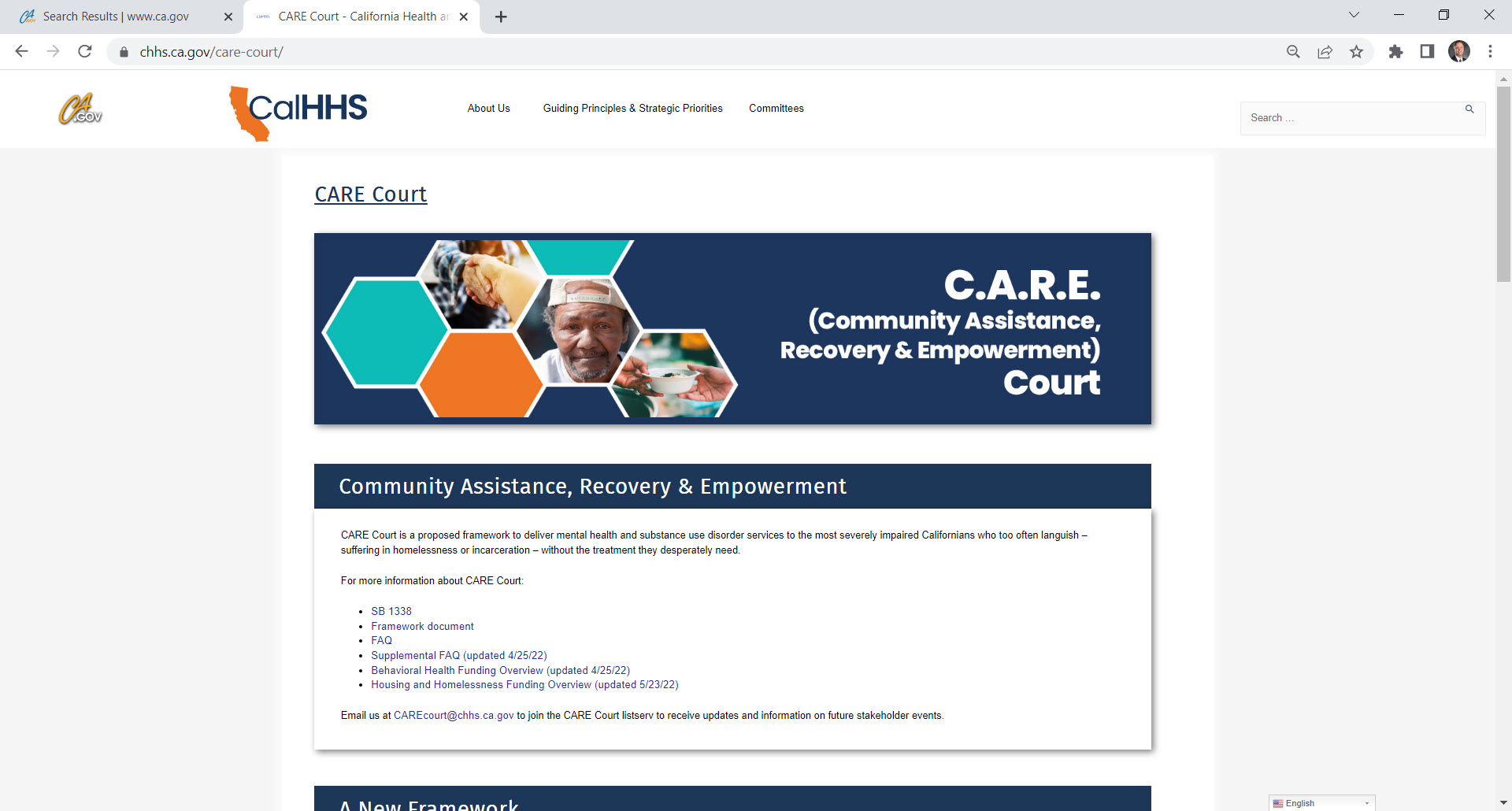
California C.A.R.E. Court advances

I wrote about the C.A.R.E. Court in my blog post at: https://wordpress.com/post/californiaestatetrust.com/2421

It looks like the Court might now be referred to as C.A.R.E. Court although I am still also seeing CARE Court.

This new Court is progressing, and I expect that it will become law, although we need to wait for the final legislative statutory wording. A May 25, 2022, release from the Office of Governor Newsom states that the “California Senate Votes to Support CARE Court, as Leading State Business Organizations Join Expanding Coalition.” Governor Newsom proposed the CARE Court. The Court is SB 1338.

Here is a partial scan of the C.A.R.E. Court website through CalHHS:

* * * * * * *

Best to you,

David Tate, Esq. (and inactive CPA)

  • Litigation, Disputes and Trials – Business, Contract/Commercial, Owner, Founder, Shareholder and Investor; Trust, Estate, Probate, Elder/Dependent Abuse, Conservatorships, POA, Real Property, Health and Care, and Contentious Administrations, etc.
  • Mediator and Dispute Resolution
  • D&O, Governance, Workplace/Employment, Officers, Boards, Investigations, IP, Auditing and Internal Controls, Law, Legislation, Communications, Authority, Duties, Responsibilities, Rights and Liability, Risk and Success Management, and Dispute Resolution and Mediation, etc.

Remember, every case and situation is different. It is important to obtain and evaluate all of the evidence that is available, and to apply that evidence to the applicable standards and laws. You do need to consult with an attorney and other professionals about your particular situation. This post is not a solicitation for legal or other services inside of or outside of California, and, of course, this post only is a summary of information that changes from time to time, and does not apply to any particular situation or to your specific situation. So . . . you cannot rely on this post for your situation or as legal or other professional advice or representation.

Also note – sometimes I include links to or comments about materials from other organizations or people – if I do so, it is because I believe that the materials are worthwhile reading or viewing; however, that doesn’t mean that I don’t or might not have a different view about some or even all of the subject matter or materials, or that I necessarily agree with, or agree with everything about or relating to, that organization or person, or those materials or the subject matter.

Thank you for reading this post. I ask that you also pass it along to other people who would be interested as it is through collaboration that great things and success occur more quickly. And please also subscribe to this blog and my other blog (see below), and connect with me on LinkedIn and Twitter.

My two blogs are:

http://tateattorney.com – business, D&O, audit committee, governance, compliance, etc. – previously at http://auditcommitteeupdate.com

Trust, estate, conservatorship, elder and elder abuse, etc. litigation and contentious administrations http://californiaestatetrust.com

David Tate, Esq. (and inactive California CPA) – practicing as an attorney in California only.

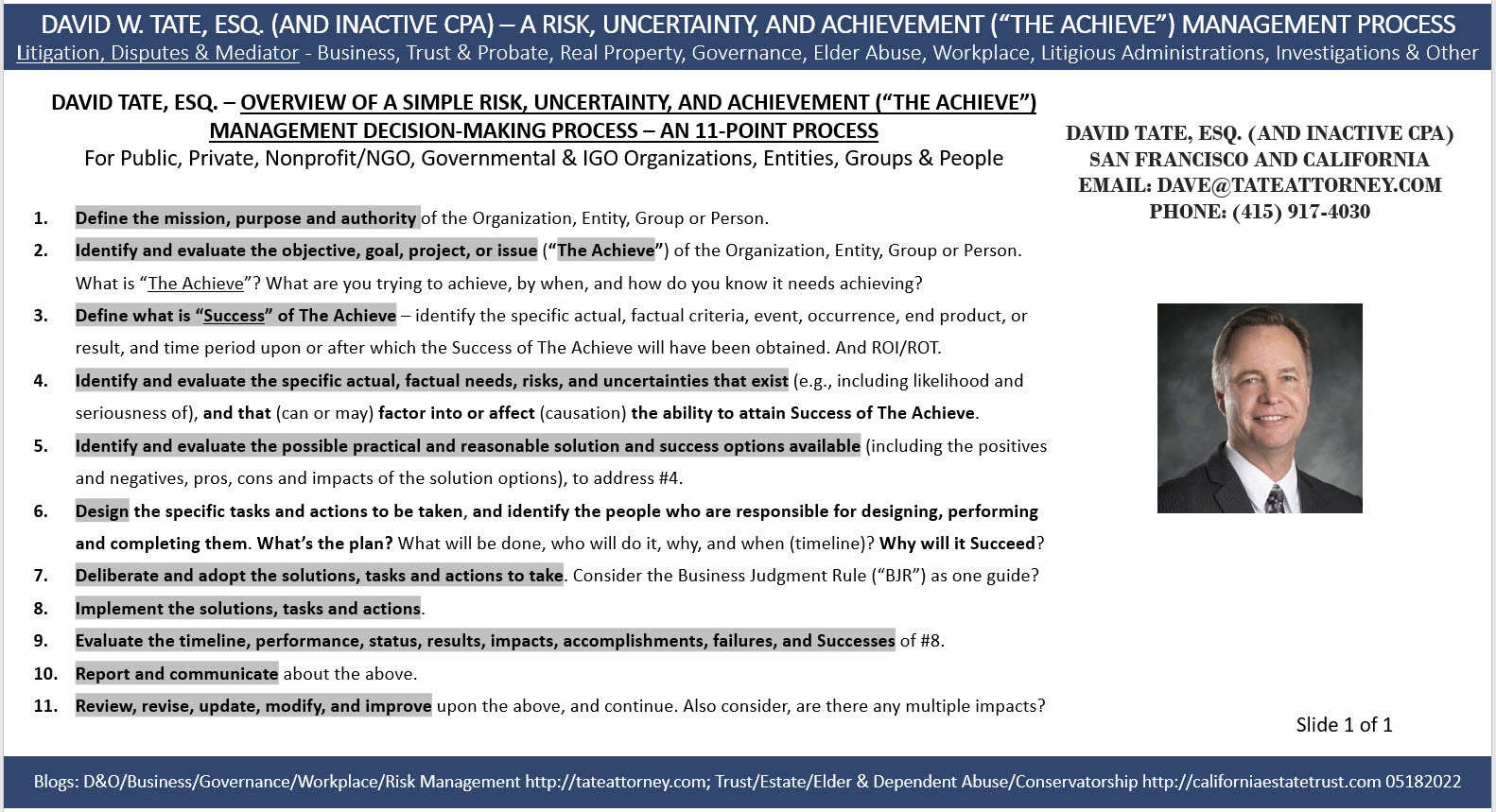
Updated Risk, Uncertainty and Achievement Management Process – 11 Steps

* * * * * * *

Best to you,

David Tate, Esq. (and inactive CPA)

  • Litigation, Disputes and Trials – Business, Contract/Commercial, Owner, Founder, Shareholder and Investor; Trust, Estate, Probate, Elder/Dependent Abuse, Conservatorships, POA, Real Property, Health and Care, and Contentious Administrations, etc.
  • Mediator and Dispute Resolution
  • D&O, Governance, Workplace/Employment, Officers, Boards, Investigations, IP, Auditing and Internal Controls, Law, Legislation, Communications, Authority, Duties, Responsibilities, Rights and Liability, Risk and Success Management, and Dispute Resolution and Mediation, etc.

Remember, every case and situation is different. It is important to obtain and evaluate all of the evidence that is available, and to apply that evidence to the applicable standards and laws. You do need to consult with an attorney and other professionals about your particular situation. This post is not a solicitation for legal or other services inside of or outside of California, and, of course, this post only is a summary of information that changes from time to time, and does not apply to any particular situation or to your specific situation. So . . . you cannot rely on this post for your situation or as legal or other professional advice or representation.

Also note – sometimes I include links to or comments about materials from other organizations or people – if I do so, it is because I believe that the materials are worthwhile reading or viewing; however, that doesn’t mean that I don’t or might not have a different view about some or even all of the subject matter or materials, or that I necessarily agree with, or agree with everything about or relating to, that organization or person, or those materials or the subject matter.

Thank you for reading this post. I ask that you also pass it along to other people who would be interested as it is through collaboration that great things and success occur more quickly. And please also subscribe to this blog and my other blog (see below), and connect with me on LinkedIn and Twitter.

My two blogs are:

http://tateattorney.com – business, D&O, audit committee, governance, compliance, etc. – previously at http://auditcommitteeupdate.com

Trust, estate, conservatorship, elder and elder abuse, etc. litigation and contentious administrations http://californiaestatetrust.com

David Tate, Esq. (and inactive California CPA) – practicing as an attorney in California only.