New Case – How Far Can A Court Go To Interpret A Trust – Ammerman v. Callender

In Ammerman v. Callender (March 24, 2016, Case No. G049880) the California Court of Appeal for the Fourth Appellate District was called upon to determine the extent to which the lower trial court could interpret the intent of the trustor and to change the terms of the trust to be in accord with the intent that the trial court determined. Below I have pasted relevant wording from the Appellate Court discussing the principles of the court’s ability to interpret the trust.

You should note that this is an appellate level court decision, other California appellate courts have issued decisions that are not necessarily entirely in accord, California Supreme Court decisions may differ and overrule this decision, and in significant regard, even when reading the below posted language, how far to interpret the trustor’s intent and the extent to which the introduction of extrinsic evidence will be allowed to express the trustor’s intent remain at the discretion of the trial judge.

Two principles do appear certain, (1) it is the intent of the trustor that should prevail, and (2) the court cannot rewrite the terms of the trust unless there is sufficient evidence, based on the wording of the trust or based on extrinsic evidence, or based on both, that the wording of the language in the trust is in conflict, or is ambiguous, or fails to address the present situation, or in some manner fails to express the trustor’s intent, and even in those circumstances the court cannot simply go ahead and rewrite the terms unless the evidence taken as a whole indicates that the trustor so intended the new terms.

It would logically also seem that the more radical the new or different terms are from the current terms of the trust, the greater the evidence would need to be that the trustor really, truly did intend the application of the new or different terms. Further, I continue to disagree with these being judge-determined cases – a jury trial should be available for the interpretation of intent and extrinsic evidence.

Below, at the bottom of this blog post, I have pasted relevant wording from the decision discussing principles of trust interpretation.

Dave Tate, Esq., San Francisco and California, tel.: (415) 917-4030, http://tateattorney.com, http://californiaestatetrust.com, http://auditcommitteeupdate.com, trust, estate, probate, real estate, conservatorship, power of attorney, elder and dependent adult, and business litigation; administrations guiding fiduciaries and beneficiaries; audit committees and D&O.

DTatePicture_Square

The following is relevant wording from the decision in Ammerman v. Callender.
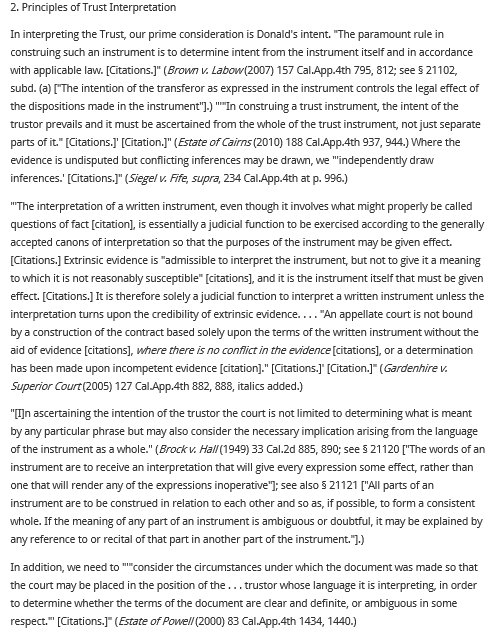
Ammerman v. Callender Principles of Trust Interpretation

New Case – Hospital That Was Systematically Understaffed Supported Cause Of Action For Elder Abuse – Fenimore V. Regents Of The University Of California

This is an important new case, but you do need to read the facts and opinion carefully to determine whether your situation fits. Here is a pdf of the opinion Fenimore v. The Regents of the University of California.

It is arguable that this opinion expands the situations where an elder abuse claim can be stated.

For more than 20 years there has been a tug-of-war between ordinary negligence including medical or care malpractice on the one hand and elder abuse on the other hand. And that tension will continue; however, very slowly the courts are more often holding that elder abuse can be alleged in a medical or care situation where there are systemic deficiencies such as, for example, lack of staffing and inadequate training, particularly where those deficiencies violate a statutory duty, requirement or standard of care.

As the underlying opinion in Fenimore applies in the circumstance of systemic violation of a statutory duty, arguably this case, as it applies to elder abuse, could be cited in a whole host of care and other situations including but not limited to nursing homes, RCFE/assisted living, fiduciary care duties, fiduciary financial duties, and more.

Dave Tate, Esq. San Francisco and California – civil real property and business, trust, estate, conservatorship, power of attorney and elder abuse litigation, and helping fiduciaries and beneficiaries in administrations. http://californiaestatetrust.com, and audit committees and D&O http://auditcommitteeupdate.com.

New Story – elder in board and care assisted living (RCFE) runs out of money, and doesn’t qualify for a nursing home under Medi-Cal

I heard about this recently – a new situation is arising. I’m just telling you about it. The elder is living in a residential care facility for the elderly, sometimes referred to as a RCFE, or assisted living or board and care. The elder is paying with private money. The assets and money run out. The elder doesn’t have family, or the family doesn’t have money, or the family won’t pay for the elder. Medi-Cal will not pay for a RCFE. In the past, in some situations, going to a nursing home was a last resort as Medi-Cal will pay for the cost of the nursing home. In the past the referral to a nursing home might merely have needed a doctor’s signature. Increasingly, Medi-Cal or its agents or representatives are starting to evaluate whether the elder’s physical, medical or mental conditions actually qualify the elder to be in the nursing home. In other words, if it is decided that the elder’s conditions are not sufficiently bad to qualify the elder to be in the nursing home, Medi-Cal will not pay for the costs of the nursing home, and the elder either will not be allowed initially into the home, or the nursing home and Medi-Cal will want to discharge and force the elder from the nursing home. But in those situations the elder has nowhere that she or he can afford with private pay.

Broad Process Conservatee and Fiduciary/Conservator Decision Making

The California Fiduciaries Code of Ethics and the National Guardianship Association Standards of Practice provide requirements for professional fiduciaries, which are also helpful to guide non-professional fiduciaries. The following is a summary of the broad process for conservatee and fiduciary/conservator decision making in the Code of Ethics and the Standards of Practice – of course the Code of Ethics and the Standards of Practice contain much greater coverage of these topics and each situation much stand and be evaluated separately and by itself – the below discussion about informed consent, substituted judgment and best interest covers the broad process approach. I also find it interesting that I have never heard a discussion by a Court about this or a different process for conservatee and fiduciary or conservator decision making. Comparing this to board of director deliberations, perhaps this might, at least in small part, be analogized to the business judgment rule?

1. Informed Consent – The decision should first be made by informed consent if possible.

A person’s (the conservatee’s) agreement or decision to allow or to have something happen that is based on a full disclosure of facts needed to make the decision intelligently, i.e., knowledge of the risks involved, alternatives, etc.

In other words, the individual choice or decision by the conservatee, that the conservatee is capable of making, unless doing or allowing so would violate the fiduciary’s duties to the conservatee or impose unreasonable expense to the estate.

2. Substituted Judgment – Second, if informed consent cannot be obtained, the decision is made by substituted judgment if possible.

The principle of decision making that requires implementation of the course of action that comports with the individual person’s (the conservatee’s) known wishes expressed before incapacity, provided the conservatee was once capable of developing views relevant to the matter at issue and reliable evidence of those views remains.

In other words, the decision is made or action taken or not taken, by the fiduciary, based on the ascertained desires and wishes, if any, of the conservatee, as expressed or demonstrated by the conservatee while the conservatee had capacity to so express or demonstrate, relevant to the current subject matter at issue, unless doing or allowing so would violate the fiduciary’s duties to the conservatee or impose unreasonable expense to the estate.

3. Best Interest – If informed consent, first, and substituted judgment, second, are not available or possible, the decision is made based on best interest.

The course of action that maximizes what is best for a person (the conservatee) and that includes consideration of the least intrusive, most normalizing, and least restrictive course of action possible given the needs of the conservatee.

Attended San Mateo County Estate Planning Section Discussion About Trust Health, Education, Maintenance And Support Payments

Just a short note of interest. On Thursday I attended the monthly San Mateo County Bar Association Estate Planning and Probate Section monthly seminar luncheon. This one was about health, education, maintenance and support payment provisions in trusts. A very good discussion and good speakers. The handout materials were excellent. In particular the speaker from Trust and Fiduciary Services at Boston Private Bank & Trust Company gave an excellent discussion as she related the materials to actual cases and situations. These provisions can raise challenging issues for trustees, including, for example, how to gather information about and evaluate whether to pay for a particular expense based on what the expense, activity or event is, the trust wording and trustor intent, other options available, the beneficiary’s resources and needs, and the other assets in the trust and the other beneficiaries. These situations can lead to litigation and trustee liability. Risk management, due diligence, and various prudent options for handling these situations should be considered.

Investment Advisors – Having Your Client Agree To A Designated Helper For The Advisor To Contact

I have provided below a link to a discussion and a service by Carolyn Rosenblatt for investment advisors in situations where the mental capacity of an elder client might be questioned, and in situations of possible undue influence or elder abuse. As you might know, investment advisors have been encouraged to enact policies and processes for these situations. There might be additional legislation in this area later this year, or at least legislation relating to advisor fiduciary duty. Please click on the below link, and then also click on the additional link at the bottom of that page to view the 10 step video. These policies and processes are good ideas and are needed – and they might arguably also already be legally required under standard of care, prudent due diligence, and elder abuse reporting requirements.

As I have previously posted, however, the designated helper also will need to know an attorney that she or he can contact to remedy the situation through the court system. Reporting to adult protective services or the police in appropriate situations might or might not provide emergency relief, but APS and the police do not have the people, time, and expertise resources to pursue a case through the legal system. And here is a link to my elder abuse and protection presentation slides http://wp.me/p1wbl8-dm

Here is the link to Carolyn’s discussion

The Confidentiality Conundrum: Can You Call A Third Party When Your Client Shows Signs Of Dementia?

Thanks. Dave Tate, Esq., San Francisco and California

Gun Trust Changes Coming July 2016, Ask Your Trust Attorney And Estate Planner

I’m passing this along – a brief discussion on JD Supra. There are more gun trust changes on the way in July 2016. Gun trusts have become more common – but the requirements also need to be followed. Here is a link to the discussion CLICK HERE

Dave Tate, Esq., San Francisco and throughout California, trust, estate, power of attorney, conservatorship and elder abuse litigation and contentious administrations, http://californiaestatetrust.com


Fraudsters’ Latest Target: The Already Defrauded – NY Times

2016-02-16_11-43-30

The below is a link to a good article in the NY Times, fraudsters target the already defrauded by promising to recover their originally lost money for a fee and then doing little or nothing to recover the originally lost money – clearly preying on the already victims. Strong people who are good need to take action – stay regularly in touch with the elder, in person if possible, really talk about and share things that are happening in the elder’s life, and consider helping or taking control over finances [you might legally be required to], but while leaving the elder with freedoms and self-respect. These are difficult situations. Call me if you have a situation where legal help is needed – (415) 917-4030 – San Francisco Bay Area and throughout California. For the article CLICK HERE.
Best,
Dave Tate, Esq., Trust/Estate Blog: http://californiaestatetrust.com, Website: http://tateattorney.com.

California Trustee Discretionary Powers – Video

California Trustee Discretionary Powers – see the video immediately below, and the primary text for the video at the bottom of this post. Thank you. Please pass this information to other people who would be interested. Dave Tate

Text: California Trustee Discretionary Powers

Hello, I’m Dave Tate. I am a San Francisco litigation attorney and I handle cases throughout California in trust, estate, conservatorship, elder abuse and civil litigation, and I also represent fiduciaries and beneficiaries in administrations.

This discussion is about trustee discretionary powers. You can find additional information on my blog at http://californiaestatetrust.com.

A trust will typically contain provisions that give the trustee discretionary powers, that is, the power to use his or her own judgment in specific circumstances. The courts will strictly construe the amount of the discretion from the language in the trust document and the intent of the trustor.

Be cautious, however—and this is important, even if the trust provides sole, absolute or uncontrolled discretion, courts still require the trustee to act within the fiduciary standards, to not self-deal, and to not act in bad faith or in disregard of the purposes and interests of the trust and of the beneficiaries. You can refer to Probate Code §§16080-81.

In other words, if the issue of a trustee’s discretion is presented to the court, the judge will make a determination based on his or her own evaluation of the trust, the trustor’s intent, and the circumstances at issue.

Unless limited by the terms of the trust, the trustee will also have other statutory powers. You should review the powers and limitations specified in the trust document, and also the powers listed at Probate Code §§16200-16249. These sections are important – however, they are too detailed to include in this discussion.

That’s it for now. There are of course other cases and statutes that can apply, and the facts of each situation are different. This discussion doesn’t constitute legal advice. You need to consult a lawyer or professional for your situation. You can find more information on my blog at http://californiaestatetrust.com. Thanks for listening.

Dave Tate, Esq. (San Francisco / California)

California Trustee Investment Portfolio Risk Management and Responsibilities, Elder Abuse, Etc.

The following are links to posts discussing California trustee investment risk management and responsibilities. This is one of the trustee responsibility areas that would keep me up at night if as a trustee I had responsibility over a significant investment portfolio. But the issue doesn’t stop there – it isn’t just a matter of having a prudent portfolio approach to investing, the California Probate Code also contains other specific statutory investment related provisions that the trustee should consider. Stock markets go up and down – for every buyer there is a seller – a loss in value by itself doesn’t necessarily mean that the trustee breached his or her duties – and risk of adverse events cannot be eliminated, but a trustee should want feel covered to the extent possible. The following are links to blog posts discussing these topics.

The Stock Market Dropped Today – Trustee Portfolio Investment Strategy Risk Management – Very Relevant Now and Always, http://wp.me/p1wbl8-cM

California Trustee Investment and Management Responsibilities (Part 2 of 2), http://wp.me/p1wbl8-9c

California Trustee Investment and Management Responsibilities (Part 1 of 2), http://wp.me/p1wbl8-97

See Discussion Paper – A Summary of California Trustee and Beneficiary Responsibilities and Rights, http://wp.me/p1wbl8-eB

California Trustee – What Would Keep Me Up At Night – February 2015, http://wp.me/p1wbl8-ak 

And for those of you who are interested in undue influence, mental capacity and consent, elder abuse and related topics, here’s a link to some presentation slides – Updated Elder Abuse and Protection Presentation Slides – Please Read and Forward, http://wp.me/p1wbl8-dm

Dave Tate, Esq. (San Francisco and California), http://californiaestatetrust.com and http://auditcommitteeupdate.com, including Tate’s Excellent Audit Committee Guide (updated January 2016, 183 pages)