Dave Tate, Esq. – looking for collaborating and growing law firm and attorney relationships, in multiple California locations – trust/estate litigation, business litigation, etc.

Looking for collaborating and growing law firm and attorney relationships. My practice is primarily trust/estate and business litigation, with some mediator services, and some owner, officer, director, board, governance, workplace and other legal areas.

I am looking to connect with a growing, collaborating law firm, and to grow my relationships with collaborating attorneys, and in multiple locations or footprints in northern and southern California. At the risk of being a bit redundant, the collaboration and working or sharing together are an important aspect of this.  

  • It could be a northern California law firm or relationship that is looking for litigation help in northern California and that has a footprint in southern California.
  • It could be a southern California law firm or relationship that is looking for litigation help in northern California.
  • It could be a firm or relationship with multiple northern California locations or footprints.
  • Or it could be a relationship with a single attorney or small firm that is collaborating.

I am available in both northern and southern California. I am also available to help with marketing, mentoring, and management. The relationship needs to be collaborating and growth oriented. A variety of arrangements are possible.

Regards, Dave Tate, Esq. (and inactive CPA)

* * * * * * *

Best to you,

David Tate, Esq. (and inactive CPA)

  • Litigation, Disputes and Trials – Business, Contract/Commercial, Owner, and Founder; and Trust, Estate, Elder/Dependent Abuse, Conservatorships, POA, Real Property, Health and Care, Contentious Administrations, etc.
  • Mediator
  • D&O, Governance, Workplace, Boards, Committees, and Executives, Investigations, Internal Controls and Auditing, Law, Laws and Legislation, Responsibilities and Duties, Rights, Liability, and Damages, etc.

Remember, every case and situation is different. It is important to obtain and evaluate all of the evidence that is available, and to apply that evidence to the applicable standards and laws. You do need to consult with an attorney and other professionals about your particular situation. This post is not a solicitation for legal or other services inside of or outside of California, and, of course, this post only is a summary of information that changes from time to time, and does not apply to any particular situation or to your specific situation. So . . . you cannot rely on this post for your situation or as legal or other professional advice or representation.

Also note – sometimes I include links to or comments about materials from other organizations or people – if I do so, it is because I believe that the materials are worthwhile reading or viewing; however, that doesn’t mean that I don’t or might not have a different view about some or even all of the subject matter or materials, or that I necessarily agree with, or agree with everything about or relating to, that organization or person, or those materials or the subject matter.

Thank you for reading this post. I ask that you also pass it along to other people who would be interested as it is through collaboration that great things and success occur more quickly. And please also subscribe to this blog and my other blog (see below), and connect with me on LinkedIn and Twitter.

My two blogs are:

http://tateattorney.com – business, D&O, audit committee, governance, compliance, etc. – previously at http://auditcommitteeupdate.com

Trust, estate, conservatorship, elder and elder abuse, etc. litigation and contentious administrations http://californiaestatetrust.com

David Tate, Esq. (and inactive California CPA) – practicing as an attorney in California only.

Representing clients with diminished mental capacity – scenarios 1 and 2 – California State Bar Standing Committee ethics Opinion 2021-207

Representing Diminished Capacity Clients. It goes without saying that an attorney might be approached by a prospective client for representation, or might be representing a client, who has or who might have “diminished mental capacity.” These are or can be extremely difficult issues and situations. I put “diminished mental capacity” in quotes to acknowledge the issue; however, it is not a purpose of this post to start discussing exactly what that means or might mean.

Instead, I am writing to provide you with a link to new California State Bar Standing Committee on Professional Responsibility and Conduct Formal Opinion No. 2021-207, and to provide you with scenarios 1 and 2 and their respective evaluations as provided in Opinion NO. 2021-207. I have added yellow highlight to certain wording in scenarios 1 and 2 and their respective evaluations. A link to the Opinion, and scenarios 1 and 2 in pdf are provided below.

A couple of additional quick comments relating to scenarios 1 and 2.

Scenario 1 involves a conservatorship or possible conservatorship scenario. The attorney believes that the client or prospective client has mental capacity to make the decision to oppose the conservatorship, but the attorney believes that the client’s decision in that regard is imprudent.

But what if the attorney believes that the client or prospective client’s decision is imprudent and that the client or prospective client for whatever reason lacks mental capacity to make that decision? Of course, every situation is different and unique in at least some regards. Nevertheless, I believe that in that situation the Opinion would require that the attorney not represent or not continue to represent the prospective client. However, declining to represent, and withdrawing representation also present other issues, and possibly other options, as in part discussed in the Opinion. Additionally, as a prospective conservatee is entitled to legal counsel and is entitled to a jury trial, at least the Court would need to address the issue of the conservatee’s legal representation, and recent case authority states that generally the prospective conservatee is entitled to be represented by the attorney of the prospective conservatee’s choice.

Scenario 2 involves estate planning for a client who the attorney reasonably believes lacks testamentary capacity and that but for that diminished capacity the client would not be making the new testamentary dispositions (and that the client is at substantial risk of being unduly influenced by the client’s younger companion). Scenario 2 states that the attorney is required to provide the client with candid advice concerning the attorney’s conclusions, and that if the client declines to accept the attorney’s advice, the attorney should decline to prepare the will. And, of course, there are other issues, and possible options that will or that might arise. See also, footnote 31, for example, which is discussing pre-engagement inquiry into or perhaps assessment of client capacity and ability to give informed consent v. doing so after engagement – under either situation, however, it appears that the attorney should not prepare the will (or trust).

It might also be interesting to compare duties and responsibilities of other professionals who sometimes are involved in estate planning or financial advising, such as CPAs, and financial, investment, and wealth advisors and professionals.

Here is a link to Opinion 2021-207 https://www.calbar.ca.gov/Portals/0/documents/publicComment/2021/COPRAC-Formal-Opinion-No.2021-207.pdf

And below are Scenarios 1 and 2, and their respective evaluations, as copied from Opinion 2021-207, with my yellow highlights added.

* * * * * * *

Best to you,

David Tate, Esq. (and inactive CPA)

  • Litigation, Disputes and Trials – Business, Contract/Commercial, Owner, and Founder; and Trust, Estate, Elder/Dependent Abuse, Conservatorships, POA, Real Property, Health and Care, Contentious Administrations, etc.
  • Mediator
  • D&O, Governance, Workplace, Boards, Committees, and Executives, Investigations, Internal Controls and Auditing, Law, Laws and Legislation, Responsibilities and Duties, Rights, Liability, and Damages, etc.

Remember, every case and situation is different. It is important to obtain and evaluate all of the evidence that is available, and to apply that evidence to the applicable standards and laws. You do need to consult with an attorney and other professionals about your particular situation. This post is not a solicitation for legal or other services inside of or outside of California, and, of course, this post only is a summary of information that changes from time to time, and does not apply to any particular situation or to your specific situation. So . . . you cannot rely on this post for your situation or as legal or other professional advice or representation.

Also note – sometimes I include links to or comments about materials from other organizations or people – if I do so, it is because I believe that the materials are worthwhile reading or viewing; however, that doesn’t mean that I don’t or might not have a different view about some or even all of the subject matter or materials, or that I necessarily agree with, or agree with everything about or relating to, that organization or person, or those materials or the subject matter.

Thank you for reading this post. I ask that you also pass it along to other people who would be interested as it is through collaboration that great things and success occur more quickly. And please also subscribe to this blog and my other blog (see below), and connect with me on LinkedIn and Twitter.

My two blogs are:

http://tateattorney.com – business, D&O, audit committee, governance, compliance, etc. – previously at http://auditcommitteeupdate.com

Trust, estate, conservatorship, elder and elder abuse, etc. litigation and contentious administrations http://californiaestatetrust.com

David Tate, Esq. (and inactive California CPA) – practicing as an attorney in California only.

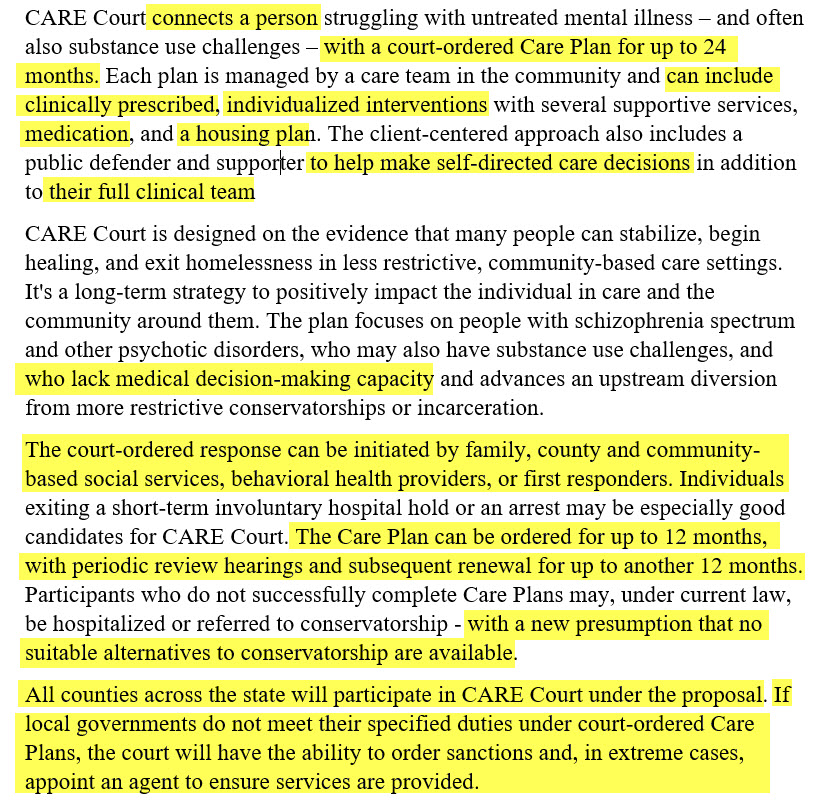
Proposed California CARE Court – sounds close to a conservatorship

I have attached below a clip from the Governor’s fact sheet discussing the new proposed California CARE Court. I added the yellow. These are difficult situations and issues. Any proposed improvement is welcome. I note, however, that when the Legislature works on this legislation they consider that this proposal sounds very close to a conservatorship or a limited conservatorship. It would be a State action (legislation and Court) that limits or restricts a person’s freedoms and personal decision making, and also that perhaps results in forced or ordered medications and living conditions.

Several California cases have addressed some of the issues and rights in conservatorship cases – the proposed conservatee is entitled to have legal counsel, and legal counsel of the proposed conservatee’s choice, and a jury trial. Additionally, the medical diagnosis and the name of the medical diagnosis are not determinative of whether or not the conservatorship will be granted or the powers and restrictions that are ordered – instead, the questions pertain to the proposed conservatee’s actual abilities and limitations, and need, or not, for help. Any conservatorship ordered must be the least restrictive possible, and the alternatives must be considered. The conservatorship also must be reviewed annually or more often. See also my post about the recent enactment of Assembly Bill No. 1194 including burden of proof and other issues https://wordpress.com/post/californiaestatetrust.com/2367

The following is the clip from the Governor’s fact sheet discussing the new proposed California CARE Court.

* * * * * * *

Best to you,

David Tate, Esq. (and inactive CPA)

  • Litigation, Disputes and Trials – Business, Contract/Commercial, Owner, and Founder; and Trust, Estate, Elder/Dependent Abuse, Conservatorships, POA, Real Property, Health and Care, Contentious Administrations, etc.
  • Mediator
  • D&O, Governance, Workplace, Boards, Committees, and Executives, Investigations, Internal Controls and Auditing, Law, Laws and Legislation, Responsibilities and Duties, Rights, Liability, and Damages, etc.

Remember, every case and situation is different. It is important to obtain and evaluate all of the evidence that is available, and to apply that evidence to the applicable standards and laws. You do need to consult with an attorney and other professionals about your particular situation. This post is not a solicitation for legal or other services inside of or outside of California, and, of course, this post only is a summary of information that changes from time to time, and does not apply to any particular situation or to your specific situation. So . . . you cannot rely on this post for your situation or as legal or other professional advice or representation.

Also note – sometimes I include links to or comments about materials from other organizations or people – if I do so, it is because I believe that the materials are worthwhile reading or viewing; however, that doesn’t mean that I don’t or might not have a different view about some or even all of the subject matter or materials, or that I necessarily agree with, or agree with everything about or relating to, that organization or person, or those materials or the subject matter.

Thank you for reading this post. I ask that you also pass it along to other people who would be interested as it is through collaboration that great things and success occur more quickly. And please also subscribe to this blog and my other blog (see below), and connect with me on LinkedIn and Twitter.

My two blogs are:

http://tateattorney.com – business, D&O, audit committee, governance, compliance, etc. – previously at http://auditcommitteeupdate.com

Trust, estate, conservatorship, elder and elder abuse, etc. litigation and contentious administrations http://californiaestatetrust.com

David Tate, Esq. (and inactive California CPA) – practicing as an attorney in California only.